49 works in this view — arrow keys or swipe to move between them.
Dance in Art
Dancing Couple
Unknown artist
- Medium:
- Source:
- New York Public Library
- Rights:
- Public domain — free to use, share and adapt.
- Recorded as:
- public_domain
This work is a rare surviving image of how Renaissance and early Baroque courtly dance was visualized and conveyed to the public through print. It shows how dance was understood not only as movement but as a vehicle for displaying status, fashion, and the rules of courtship—and how engraving allowed these models to circulate widely. For dancers and historians, it captures a moment when dance instruction and courtly etiquette were inseparable.
What you are looking at
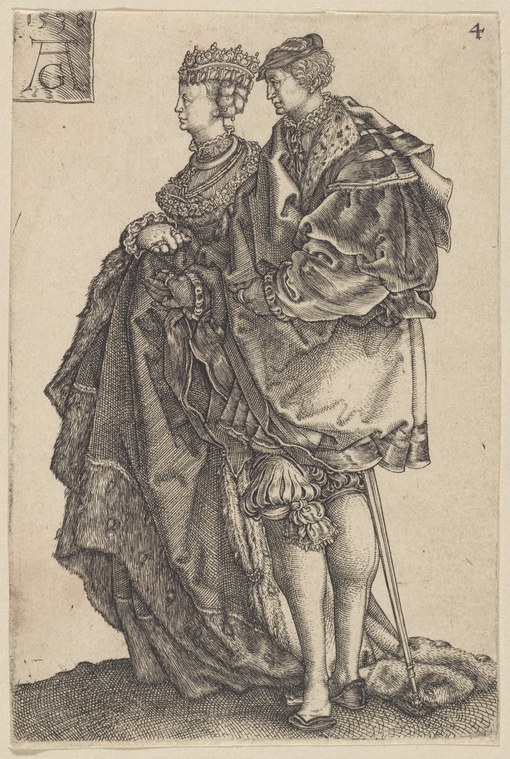
This is an engraving of a couple in Renaissance or early modern dress, dancing or in close physical contact. The woman on the left wears an elaborate gown with a high collar, jeweled headdress, and a richly patterned cloak or mantle trimmed with fur that sweeps to the ground. The man on the right, taller and positioned slightly behind her, wears a feathered hat, fitted jacket, and hose. His left arm encircles her waist while his right hand holds a sword or staff. Their bodies are positioned in profile, their faces close together in a moment of intimate contact. The woman's head is tilted slightly toward the man's. The composition is tightly framed, with both figures occupying the full height of the plate, set against a plain background with minimal shading. The engraving is executed with fine parallel lines and cross-hatching that model the fabric textures and create depth.
The dancing
The pair are in contact throughout—the man's arm clearly supports or embraces the woman at her waist, while she leans slightly into him. Their relative heights and positioning suggest he is leading. The woman's skirts are voluminous and would likely obscure her footwork; the man's legs and posture suggest he bears weight and controls the motion. Neither figure's feet are clearly visible. The holds and proximities—the arm placement, the proximity of faces, the tilt of torsos—suggest either a formal partnered dance or a moment of courtship theatrically rendered.
The dance depicted
The dress, poses, and engraving style point to 16th- or early 17th-century court dance, likely a pavane or galliard, or a moment from a courtship dance of the Renaissance or early Baroque period. No specific dance is inscribed. The woman's richly jeweled formal gown and the man's feathered hat and sword are consistent with courtly display; the intimate, supported hold and the profile positioning recall dance manuals of the period, in which couple dances emphasized elegance, hierarchy, and controlled proximity. Without more context, this is best read as a generic representation of courtly paired dance rather than a documentation of a specific style or movement vocabulary.
How it was made
This is a finely executed engraving, likely produced in the 16th or early 17th century, recognizable by the consistent parallel and cross-hatched line work that creates tonal modeling throughout. Engraving allowed for fine detail in dress and jewels and for wide circulation in print form. The technique and composition suggest this was created as a print for a reasonably educated and wealthy audience—collectors, courtiers, perhaps users of dance manuals or etiquette books. The numbered '4' in the top right corner suggests this is one plate from a series.
About this work
This engraving depicts a fashionably dressed Renaissance or early Baroque couple in an intimate, supported dance or dance-like embrace. The woman's elaborate jeweled gown and the man's courtly attire locate the image in a context of aristocratic display and courtship ritual. The engraving technique, fine detail, and composition indicate this was a circulating print, likely part of a series on courtly manners, dance, or courtship. It documents not a specific dance step but rather the visual conventions and values of partnered courtly dance in the early modern period—the emphasis on hierarchy, elegance, and the formal management of proximity and touch between man and woman.
How to look at it
Attend to the woman's posture: she leans into her partner, her body supported and led. The man's arm placement and the tilt of his body show the active lead and control expected of the male partner in formal Renaissance dance. The faces turned toward each other, despite the bodies' profile orientation, suggest a moment of intimate attention—a courtship moment frozen in the formal grammar of courtly dance. The fine dress and jewels draw the eye but serve primarily to establish the social rank of the dancers; the real subject is the rules of partnering and proximity that governed aristocratic behavior.
The period
This engraving dates to an era when courtly dance was central to aristocratic life and education. The 16th and early 17th centuries saw the flourishing of the pavane, galliard, and other couple dances that emphasized formality, geometric spacing, and controlled partnering. Dance manuals by figures like Thoinot Arbeau (1588) and others codified these dances in text and woodcut; engraved prints like this one disseminated idealized images of courtly couples to readers and potential students. The costume and jewels reflect the wealth and display expected of participants in court dance; the print format allowed such images to serve as both documentation and aspiration for a broader audience beyond the court itself.
Where it lives
This engraving is held in the New York Public Library collection. It is catalogued as a print, and the presence of the plate number '4' suggests it is one sheet from a numbered series, though the series title and publisher are not recorded.
Dance in this work
Questions about this work
What dance is this showing?
No specific dance is identified in the record. The formal dress, the hold, and the positioning are consistent with Renaissance or early Baroque courtly dances such as the pavane or galliard, but this appears to be a generic representation of courtly partnered dance rather than a depiction of a named step or style. The engraving likely served as a model of courtly behavior and dress rather than as a technical instruction in movement.
Is this a famous work or from a known series?
The numbered plate (4) indicates this is one from a series, but the original series title, publisher, and date are not recorded. The quality of the engraving and the subject matter suggest it was a moderately circulated educational or courtly print, but without more provenance information, the full context cannot be determined.
How do we know this is dance and not just two people embracing?
The profile positioning, the formal dress, the careful composition, and the supported hold all align with conventions used to depict partnered dance in Renaissance and early modern prints. Dance and courtship were visually similar in this period—dances like the galliard involved close contact and flirtation—but the deliberate framing and balance of the composition suggest the primary subject is the formal rules and display of courtly dance.
More dance artwork