45 works in this view — arrow keys or swipe to move between them.
Dance in Art · 2019
Soupirs des fleurs polka and the Camellia polka mazurka
Unknown artist
- Medium:
- Lithograph
- Dance:
- Polka
- Era:
- Late 1800s (Victorian Ballroom)
- Source:
- New York Public Library
- Rights:
- Public domain — free to use, share and adapt.
- Recorded as:
- public_domain
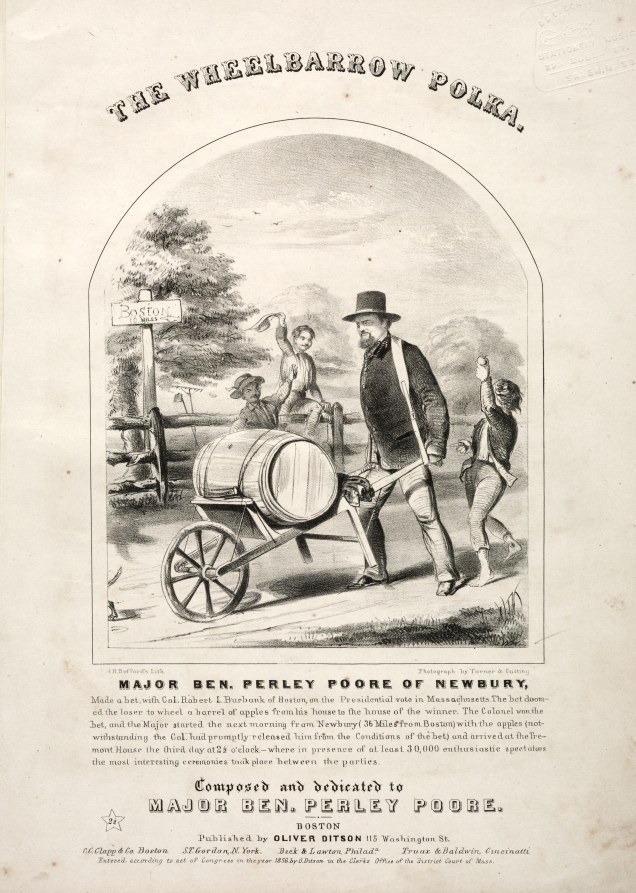
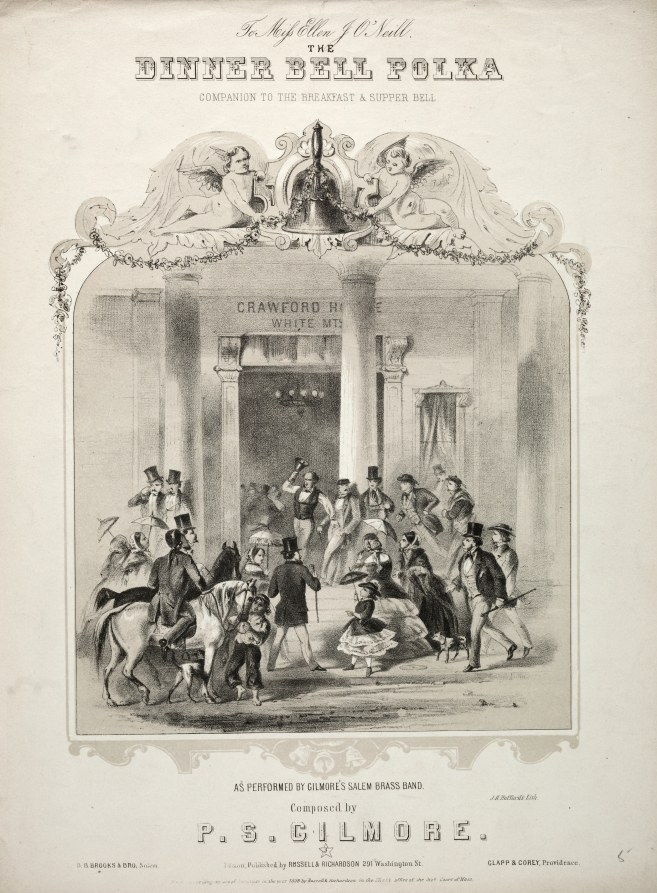
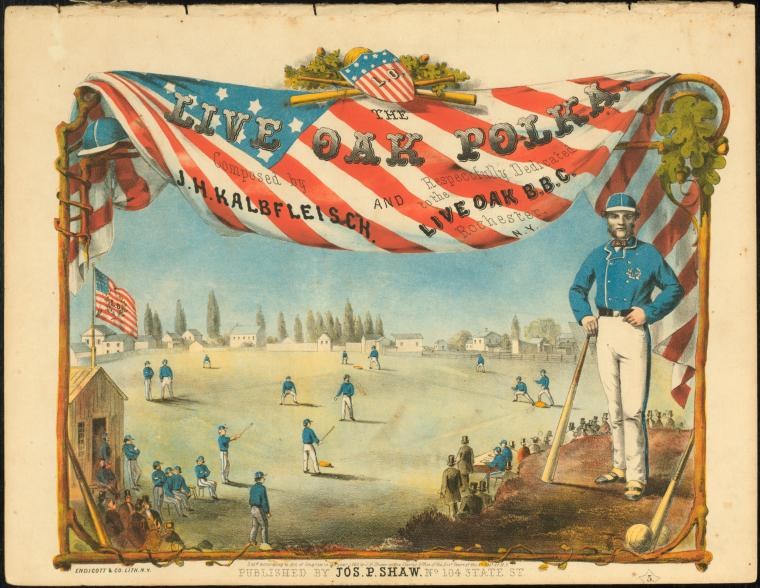
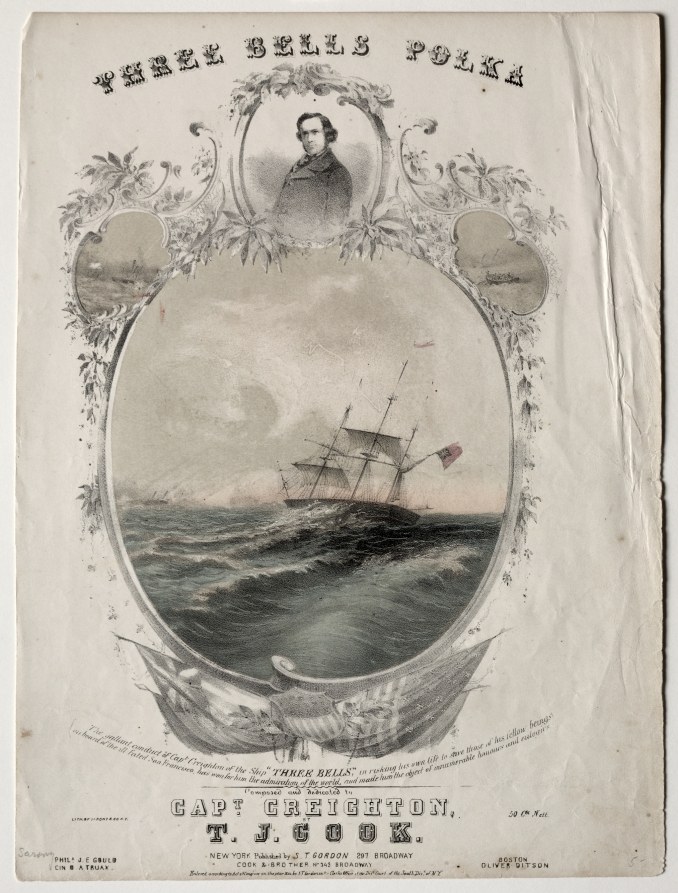
This image is one of the few surviving visual records of two named character dances that are now forgotten. It shows how polka variants were marketed and taught in the late nineteenth century, and it documents the gendered formal dress and ballroom architecture that framed social dancing for the Victorian upper classes. For historians of ballroom dance, it is evidence of what the ballroom looked like and how couples positioned themselves.
What you are looking at
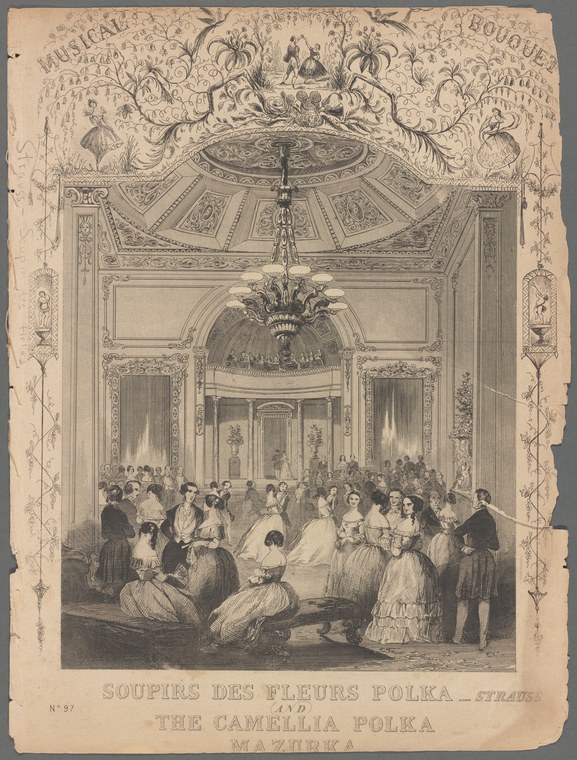
A grand ballroom filled with dozens of fashionably dressed dancers occupies the lower half of this lithograph. The space is defined by elegant neoclassical architecture: a coffered ceiling with a central oculus and chandelier, pilasters and arches framing doorways, and ornamental wall panels. The dancers, dressed in the full skirts and formal attire of the 1880s–1890s, are distributed across the floor in various configurations—some in close couples, others standing at the periphery. The lighting falls from above, creating a sense of spacious grandeur. The upper half of the print is crowded with ornamental engraving: a scrolled cartouche at the top bears the title, and the border is filled with rococo flourishes, musical instruments, and fanciful figures that playfully frame the scene. This decorative excess—typical of sheet music covers of the period—establishes the work as both a visual record and a commercial product.
The dancing
The dancers occupy the full depth of the ballroom in multiple groups. Those nearest the viewer are rendered in darker tones and show the greatest detail: men in tailcoats with women in full-skirted gowns, many in closed ballroom hold with arms extended. Some couples appear mid-turn; one woman's voluminous skirt billows visibly in the foreground. Further back, figures diminish in scale and detail, suggesting atmospheric perspective. The holds are formal and upright, consistent with late-Victorian ballroom convention. No footwork is clearly visible, but the arrangement of legs and the distribution of weight suggest the grounded, controlled posture of polka and mazurka.
The dance depicted
The work depicts two dances: the Soupirs des fleurs polka and the Camellia polka mazurka. Both were popular salon dances of the 1880s–1890s, belonging to the craze for named character dances and polka variants that dominated late-Victorian ballrooms. The polka, originating in Bohemia in the 1830s, had become the standard social dance by mid-century; the mazurka polka was a hybrid that merged the more stately mazurka with polka rhythm. This image shows both as respectable, formal social dances performed in elegant company, with couples in standard ballroom dress and closed position. The presence of multiple couples simultaneously dancing suggests a social ballroom rather than a stage performance.
How it was made
This is a hand-colored lithograph, a printing technique that allowed for mass production of sheet music covers and dance instruction materials in the late nineteenth century. The composition combines both drawn and printed elements: the scene itself is lithographed in black or dark tones, then hand-tinted with pale washes to create the architectural setting and the delicate tones of dress. The technique was ideal for commercial distribution—affordable enough to be included with sheet music, yet decorative enough to hang as parlor art. The quality of the printing and the presence of text and ornamental engraving identify this as a commercial music cover or dance instruction sheet rather than a fine art print.
About this work
This lithograph documents the appearance of two fashionable ballroom dances—the Soupirs des fleurs polka and the Camellia polka mazurka—as they were performed in elite social spaces during the late Victorian era. The title identifies the dances explicitly; the image shows them as they appeared in practice: in formal dress, in closed position, in a grand ballroom setting shared with many other couples. The work is at once a record of ballroom custom, a commercial product (sheet music cover or dance instruction), and an idealized vision of social dancing as genteel entertainment. It belongs in a dance archive because it captures not just the visual appearance of these specific dances, but the social world in which they occurred.
How to look at it
Note the moment the artist chose: most couples are captured mid-figure, with skirts in motion and bodies angled as if turning. The artist has frozen the dance not at a moment of stillness but at the point of greatest visual interest—the lift and swing of the skirt, the lean of a turn. Observe also the social hierarchy visible in the composition: the nearest, most detailed couples are the focus; those deeper in the ballroom fade to suggestion. The ornamental surround—all those allegorical figures and instruments at the top—was a conventional way to mark dance prints as commodities rather than fine art; attend to how it frames and contains the serious business of the ballroom below.
The period
The polka and its variants dominated European and American ballrooms from the 1840s through the 1890s, replacing the quadrille as the primary social dance. The craze for named dances—the Camellia polka, the Soupirs des fleurs, the Tentation polka—reflected both the public appetite for novelty and the role of dance as a vehicle for commercial entertainment. Sheet music covers like this one served as both advertising and instruction: they identified the music, showed how the dancers should look, and circulated the dances through parlors and ballrooms far from the concert halls where they premiered. The ornamental framing and rococo revival elements visible here were typical of mid-to-late Victorian commercial art, even as the ballroom itself was ordered by neoclassical restraint.
Where it lives
This work is held by the New York Public Library, identified as a late-nineteenth-century lithograph. It was likely created as a commercial sheet music cover or dance instruction sheet, and as such was produced in multiple copies and distributed through music retailers, dance teachers, and parlors across America and Europe.
Dance in this work
Questions about this work
What is a polka mazurka?
A polka mazurka was a hybrid social dance that combined elements of the polka (a Bohemian dance in duple meter, characterized by a hop-step-close pattern and fast tempo) with the mazurka, a Polish dance in triple meter with a more stately character. The fusion created a dance that retained the polka's popularity and energy while incorporating mazurka rhythms and styling, appealing to dancers who wanted novelty without abandoning familiarity.
How do we know these are the dances named in the title?
The lithograph carries printed text identifying the dances: 'Soupirs des fleurs polka' and 'The Camellia Polka Mazurka.' These titles were common in late-Victorian sheet music. The visual evidence—the closed ballroom hold, the formal dress, the multiple couples dancing simultaneously in an elegant interior—confirms this is a social ballroom dance of the 1880s–1890s, which accords with the period when these named polka variants were fashionable.
Who danced these dances?
These were dances of the respectable middle and upper classes—the parlor and ballroom dancing public of Europe and America in the late nineteenth century. The formal dress, the elegant setting, and the commercial distribution through sheet music indicate they were meant for amateur dancers (as opposed to stage professionals), performed at balls, assemblies, and private parties. Both men and women danced these dances in couples.
Is this a stage performance or a social dance?
This is a social dance, not a theatrical one. The key evidence is the presence of many couples dancing simultaneously, the absence of a stage or proscenium, the domestic and civic (rather than theatrical) scale of the ballroom, and the commercial function of the print (sheet music cover, meant to teach amateurs). If this were a stage production, we would expect a smaller number of principal dancers, stage lighting, scenery flats, and a theatrical framing.
More Polka artwork