38 works in this view — arrow keys or swipe to move between them.
Dance in Art · 2019
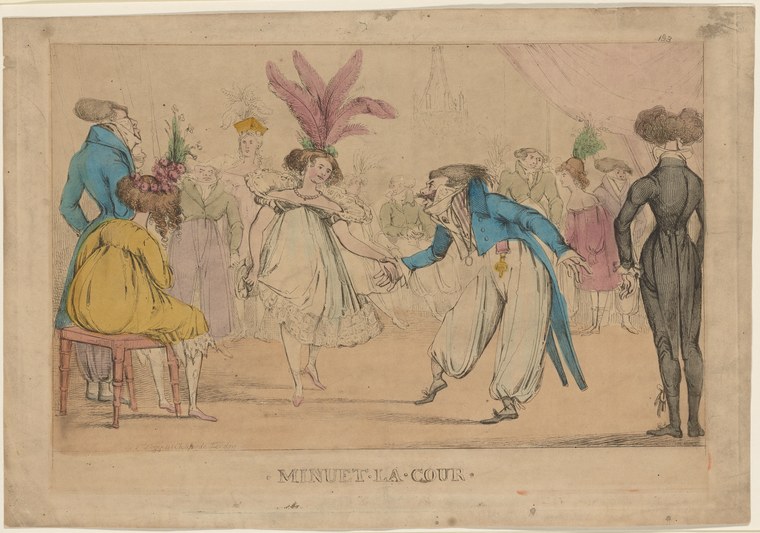
Minuet la cour
Unknown artist
- Medium:
- Engraving
- Dance:
- Minuet
- Era:
- 1700s (Enlightenment/Minuet Era)
- Source:
- New York Public Library
- Rights:
- Public domain — free to use, share and adapt.
- Recorded as:
- public_domain
This engraving is direct visual testimony to the technique and social function of the 18th-century minuet—the most documented and influential courtly dance in European history. It preserves the exact posture, spacing, and formal bearing required of minuet dancers, which no written description alone can convey. For anyone studying 18th-century court dance, body comportment, or the relationship between dance and aristocratic identity, this image is a primary source.
What you are looking at
A court dance scene rendered in colored engraving, likely 18th century. The composition centers on a minuet in progress: a couple occupies the foreground center, the woman in a flowing pale gown with elaborate feathered headdress, the man in blue coat and breeches, both in the formal posture of the dance. Around them stand a seated older woman in yellow skirts and a red-cushioned chair (possibly a chaperone or musician's companion), and a cluster of courtly onlookers—ladies in pink and pale gowns, gentlemen in coats and breeches—arranged in a loose semicircle. A tall man in gray stands at right, observing. The background is lightly sketched with architectural elements suggesting an interior, and the overall tone is warm and sepia, typical of hand-colored engraving. The scene captures a moment of stillness within motion: the dancers are poised in the formal frame of the minuet, not executing a step, but performing the social gravity and refinement the dance required.
The dancing
The dancing couple maintains a clear separation characteristic of minuet form: the woman's right hand rests in the man's left, their arms extended but not clasped. Both figures stand upright with the elongated posture demanded by 18th-century court dancing—shoulders back, the weight appearing to be held forward on the balls of the feet in the turned-out stance of the period. The woman's left arm is extended to the side, palm open in the formal port de bras of baroque dance. The couple's bodies do not touch; the spatial and postural distance between them is deliberate and essential to the minuet's decorum. The watching figures are stationary, some with hands clasped or held at the sides—the posture of spectators observing a social performance.
The dance depicted
This is the minuet de cour—the court minuet—the dominant social and theatrical dance of the 18th century aristocracy, particularly in France and at European courts. The inscription at the bottom confirms this: 'MINUET LA COUR.' The minuet was a couple dance of extreme formality, governed by strict rules of deportment and progression. It involved a series of small, measured steps, rises and falls, and restrained arm movements, all executed with exaggerated verticality. Dancers rose on to the balls of the feet and lowered through the heels in a controlled rhythm. The dance was as much about the display of noble bearing and grace as about the steps themselves. This image captures the essential tableau of a minuet performance: the couple central to an audience of peers, the moment of poise rather than rapid action, the absolute clarity of social hierarchy and courtly manners.
How it was made
This is an engraving, hand-colored with watercolor or gouache. The record confirms the engraving medium. The technique allowed for fine linear detail in the figures' features and dress while the color wash gives warmth and depth; the combination was standard for mass-produced dance instruction and entertainment prints of the 18th century. Engravings circulated widely—they were affordable, reproducible, and thus reached a broad courtly and urban audience. The light brown paper and the wear visible in the margins are consistent with an original 18th-century print that has aged without protection. The engraving medium implies this was a teaching or commemorative image: engravings of dances were used both to document court spectacles and to instruct dancers in proper form.
About this work
This is an 18th-century engraving documenting the minuet de cour—the social and ballroom dance that defined courtly refinement across Europe. The image records not a moment of explosive movement, but the formal tableau the minuet required: a couple in perfect upright posture, framed by courtly witnesses, executing a dance that was as much about displaying noble grace as about the steps themselves. The work belongs to a large body of dance instruction and court documentation prints, most anonymous, which circulated in the 18th century to teach, celebrate, and disseminate the values of aristocratic sociability.
For dancers and historians, this engraving is evidence of how the minuet was actually held and positioned in the body—the separation of the partners, the extended arm carriage, the risen posture, the absolute stillness of the spectating court. It shows the minuet not as narrative or spectacle but as social performance, and captures a moment when even standing upright in a dance frame was itself a statement of rank and refinement.
How to look at it
Attend first to the absolute verticality and stillness of the dancing couple—the minuet does not reward energy or speed, but rather the controlled display of bodily discipline. Notice the separation between partners: they do not embrace, and the spatial distance is part of the decorum. Look at the woman's arm extension and the careful angle of her head and shoulders; this is the kind of detailed body carriage that a dance master would have corrected for hours. Finally, observe the arrangement of the courtly spectators in a formal circle: in the 18th century, dancing was as much about being seen and admired as about moving, and the minuet was a theater of noble self-presentation.
The period
The minuet de cour was the dominant social dance of the 18th century, particularly from the 1650s through the 1760s, originating in France and spreading throughout European courts. It was danced at state occasions, in ballrooms, and in theatrical entertainments. The dance embodied Enlightenment ideals of rationality, proportion, and civility—its measured steps, symmetrical figures, and formal deportment reflected courtly refinement. By the 18th century when this engraving was likely made, the minuet had become codified into a fixed structure taught by dance masters and celebrated in prints and manuals. The rise of printed dance instruction and documentation parallels the professionalization of dance as an art: engravings like this one were tools for teaching, remembrance, and the dissemination of courtly values to the wealthy urban classes who aspired to nobility.
Where it lives
The work is held by the New York Public Library. It is a hand-colored engraving from their collection of 18th-century dance prints and images of courtly life—a common category of popular prints that documented and disseminated fashionable manners and entertainments.
Dance in this work
Questions about this work
Why are the dancers not holding each other?
The minuet was a dance of restraint and formality. Partners held only one hand—the man's left to the woman's right—and kept their bodies apart. Close contact would have been considered improper and would have contradicted the dance's purpose: to display individual noble bearing and grace within a structure of perfect manners. The separation was essential to the minuet's social meaning.
What is the woman with the feathers on her head?
The tall feathered headdress was standard fashion for aristocratic women in the 18th century, not a costume specific to dance. Noblewomen wore their formal dress, including these elaborate feathered coiffures, to the ballroom. The feathers add height and visibility, which was desirable in a space where being seen and admired was part of the social purpose of dancing.
Is this a real dance performance or an invented scene?
This is almost certainly a documentary image—a record of how the minuet was actually danced at court. The specificity of the postures, the presence of the seated observer and the watching courtiers, and the careful detail of dress all suggest this was engraved from observation or from a dance master's prescribed form. Such prints were used to teach the minuet to students and to commemorate ballroom practice.
Who were minuet dancers?
The minuet was danced by the aristocracy and the wealthy urban classes who could afford dance instruction. It was part of courtly education for both men and women, and mastering it was essential to social standing. The minuet appeared both in private ballrooms and in court spectacles, and could also be performed on stage in theatrical entertainments.
More Minuet artwork