49 works in this view — arrow keys or swipe to move between them.
Dance in Art
Dancing Couple
Unknown artist
- Medium:
- Source:
- New York Public Library
- Rights:
- Public domain — free to use, share and adapt.
- Recorded as:
- public_domain
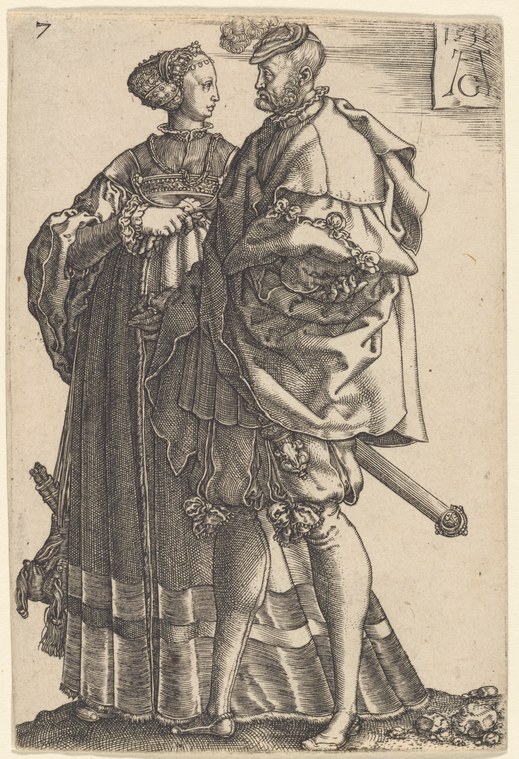
This print preserves evidence of how Renaissance dancers positioned their bodies and related to partners in court contexts—information that cannot be recovered from written dance notation alone. The meticulous rendering of costume details also documents the textile arts and fashion that defined social status and courtly participation. For dance historians and costume historians alike, such engravings are primary sources for understanding the visual and kinetic culture of Renaissance courts.
What you are looking at
A man and woman stand together in an engraved print, positioned as if mid-dance or in formal courtship. The woman, on the left, wears an elaborate long gown with voluminous sleeves and a fitted bodice decorated with jeweled ornaments; her hair is arranged in an intricate braided style pinned atop her head. The man, on the right, wears a short tunic or doublet with decorative slashing, hose, and a draped cloak or mantle swept dramatically across his body; he wears a feathered hat. Their bodies angle toward each other in an attitude of mutual engagement. The woman's left hand rests on or near the man's arm, while his right arm extends outward, the cloak billowing with a sense of movement. The figures occupy most of the composition against a plain background, rendered in fine linear hatching characteristic of sixteenth-century printmaking. A numbering mark "7" appears in the upper left; what appears to be an artist's monogram is visible in the upper right.
The dancing
The two figures stand in an open position rather than a closed embrace, with the woman on the left and man on the right angling their bodies toward each other. Their interaction is mediated through hand contact and spatial proximity rather than a tight hold. The man's posture is notably contrapposto, with his weight shifted and his draped cloak creating diagonal lines of movement; the woman stands more upright. Both heads turn slightly toward each other, suggesting conversation or mutual attention. The gestures are courtly and restrained rather than energetic or athletic.
The dance depicted
This appears to be a depiction of a Renaissance court dance, most likely a pavane or almain based on the formal dress, stately posture, and the nature of the print series to which it belongs. The open position and the emphasis on decorous interaction between partners is consistent with Renaissance dances that prioritized display of costume and courtly bearing over vigorous footwork. The figures' clothing and the engraving style point to sixteenth-century Northern Europe. Without evidence of specific footwork or musical notation, the identification rests on costume and the conventions of dance imagery from this period.
How it was made
This is an engraving, identifiable by the fine parallel hatching lines used to create tone and shadow, the crisp linear definition of form, and the characteristic surface texture of metal-plate printing. The precision of the line work and the tonal modeling suggest skilled execution. The print bears a number (7) suggesting it belongs to a series or suite—possibly a dance manual or a set of costume studies meant for circulation among courtiers or artists. Engravings of this type had relatively wide distribution in Northern Europe and were used as references for costume, courtly behavior, and artistic practice.
About this work
This sixteenth-century engraving documents a moment of courtly dance or courtship ritual in Renaissance Europe. The numbered position in what appears to be a series, combined with the meticulous attention to costume and the formal compositional stance, suggests this was part of a didactic or exemplary set—possibly a dance manual or a compendium of courtly conduct. The work captures not the kinetic dynamism of dance but rather the presentation of self and the social choreography of courtship, where costume, posture, and spatial relationship carried meaning. For historians of Renaissance dance, the print is valuable as a record of how dancers held their bodies, how couples related in space, and what garments accompanied dance in the elite courts of Northern Europe.
How to look at it
Attend to the spatial relationship between the figures and the precise rendering of how their hands and arms connect or gesture. Notice the contrapposto stance of the man and the restraint and verticality of the woman—these are conventions of sixteenth-century courtly presentation rather than dynamic movement. Observe the intricate detailing of the clothing, which would have been as important to contemporary viewers as the gesture itself, since costume advertised status and taste. The numbering suggests comparison with other figures in the series; the single moment frozen here is meant to be read as an exemplum of proper courtly comportment.
The artist
The artist is not recorded in the catalogue. The engraving style and costume details are consistent with sixteenth-century Northern European printmaking, and the print may be by or after a significant master of the period. The numbered format and the subject matter suggest either an artist working in a major printmaking center such as Antwerp or Nuremberg, or a series produced for wide courtly circulation. Such dance and costume engravings were sometimes issued unsigned as part of larger didactic or exemplary series.
The period
In sixteenth-century Europe, dance was a central practice in aristocratic life, and printed images of courtly dance and costume served multiple purposes: they recorded fashion and etiquette, spread knowledge of dances and social rituals, and circulated ideals of courtly conduct. Engraved series of dances, costumes, and courtly figures were published in Northern Europe from the early 1500s onward. These prints reflected the increasing documentation and codification of court dances, parallel to the publication of written dance manuals by masters such as Thoinot Arbeau and Fabritio Caroso later in the century. The emphasis in this engraving on costume and formal bearing reflects Renaissance values of display, decorum, and the social performance of rank.
Where it lives
The print is held in the New York Public Library collection, identified as a sixteenth-century engraving. Its original context—whether a bound dance manual, a loose series, or a broader compendium of courtly subjects—cannot be determined from the catalogue record alone, though the numbering strongly suggests it was part of a larger set.
Dance in this work
Questions about this work
What dance is this?
The specific dance cannot be named with certainty from the engraving alone. The formal dress, open position, and restrained posture are consistent with Renaissance court dances such as the pavane or almain, which emphasized display and decorum. The print was likely meant as an exemplum of courtly interaction rather than a record of a particular choreography.
Why are they wearing such elaborate clothes?
In Renaissance courts, dress was a form of communication about rank, wealth, and allegiance. Dance was an occasion for displaying fine fabrics, jewels, and tailoring. The engraver has taken care to render every fold and ornament, suggesting that the costume was as much the subject as the dance itself.
Is this a real dance or just a pose?
It is both. The figures are positioned as if in a dance or dance-like interaction, but the moment is one of presentation and courtship rather than active footwork. Renaissance court dances often involved such moments of formal address and mutual regard between partners.
Why is there a number on the print?
The number (7) indicates that this engraving is part of a numbered series, likely a set of dance figures, costume studies, or courtly exemplars meant to be viewed together or in sequence. Such series were circulated as references for artists, dancers, and courtiers.
More dance artwork