49 works in this view — arrow keys or swipe to move between them.
Dance in Art · 2019
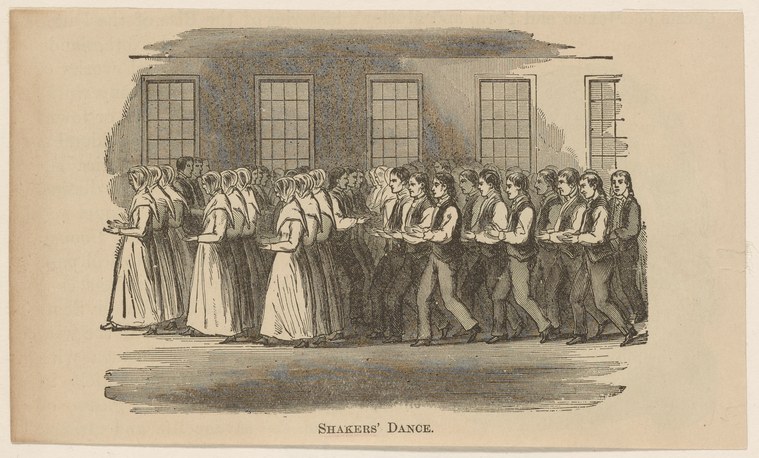
Shakers' dance
Unknown artist
- Medium:
- Source:
- New York Public Library
- Rights:
- Public domain — free to use, share and adapt.
- Recorded as:
- public_domain
This engraving is a crucial visual record of American religious dance practice in an era when such intense bodily expression in worship was seen as radical and heretical by mainstream churches. For dance historians, it offers tangible evidence of how an alternative spiritual community understood movement as a legitimate vehicle for religious experience—a precedent for modern sacred and contemporary dance that values authentic expression over technical codification.
What you are looking at
This engraving depicts a group of Shakers engaged in their characteristic ecstatic dance, a central practice of their religious worship. The composition is tightly framed within a rectangular space defined by tall multi-paned windows and what appears to be the interior wall of a meetinghouse. A line of approximately fifteen figures stretches across the picture plane, alternating between those in long white dresses (women) and those in darker suits and trousers (men). The dancers are arranged in a loose procession or file, their bodies in various attitudes of motion—some appear to be in mid-stride, others with arms raised or extended. The figures nearest the left edge of the composition are most animated, their forms twisted and gestural, while those toward the right maintain a steadier, more linear progression. The engraving technique creates strong contrasts between the lit bodies and the dark cross-hatched background, emphasizing the physicality of the movement against the austere architectural setting.
The dancing
The bodies show vigorous, uninhibited movement characteristic of ecstatic religious practice. Arms are raised, spread, or akimbo rather than held in any ballroom frame or classical alignment. The postures suggest spontaneous, often jerky motion rather than codified steps—several figures twist at the torso, and some appear to be in irregular strides or running movements. There is no consistent partnering visible, and the dancers do not touch one another; instead they occupy a shared space moving independently. The long skirts of the women billow and catch the motion, and the overall impression is of unleashed physical expression within a solemn interior space.
The dance depicted
This is a depiction of Shaker worship dance, the ecstatic movement practice central to the religious life of the United Society of Believers (the Shakers), a millennial Christian sect that flourished in America from the late eighteenth century onward. Shaker dance was not choreographed but arose from spiritual fervor and divine inspiration, with participants moving in whatever manner the spirit moved them—trembling, whirling, walking in processional lines, or free bodily expression. The image captures the paradox of Shaker practice: intense individual spiritual experience occurring within a communal setting and governed by strict codes of conduct and gender separation. This particular representation suggests the energetic phase of worship known as the 'march' or procession, in which members would move around the meetinghouse floor in lines.
How it was made
This is a wood or steel engraving, a reproductive technique that allowed multiple impressions from a single plate. Engraving was the dominant means of circulating visual information in the nineteenth century, and Shaker life attracted considerable curiosity from the outside world. This image was created for a broad American audience, likely appearing in a periodical, broadside, or illustrated book aimed at the general public. The technique's reliance on fine parallel lines to build tone and shadow creates a documentary rather than celebratory character; the artist renders the scene with anthropological distance rather than religious sympathy.
About this work
This engraving is a nineteenth-century documentary representation of Shaker worship dance, created for a curious American public seeking to understand a distinctive and controversial religious community. The Shakers' ecstatic movement practices challenged conventional notions of bodily decorum, particularly the participation of both men and women in uninhibited physical expression within a religious setting. The image records a moment of spiritual fervor translated into bodily form—not technique or learned choreography, but the direct expression of faith through movement. As such, it documents a form of sacred dance that was entirely intentional and theologically grounded, yet visible in the period only through prints and written accounts like this one.
How to look at it
Observe the variety of bodily attitudes captured across the line: the artist has frozen a moment of collective motion that would actually have been continuous and fluid, allowing you to see how individual expressions of spiritual experience coexisted within the communal space. Notice how the architectural setting—with its severe windows and plain walls—frames the dancers' visible exuberance, creating a visual tension between Shaker austerity and Shaker ecstasy. The progression from left to right, with more animated figures on the left and straighter stances on the right, may suggest either the actual flow of movement through the space or the artist's compositional choice to balance action and order.
The period
The Shakers emerged in England in the 1750s and immigrated to America in 1774; their distinctive dance practices developed over the following decades and reached their most theatrical and energetic phase in the early nineteenth century, particularly during the period known as the 'Era of Manifestations' (1837–1847), when inspired movement and visions intensified. This engraving likely dates from the mid-nineteenth century, when Shaker communities were at their numerical peak and the curiosity of outside observers was at its height. The visual language of the engraving—its anthropological tone and lack of editorial commentary—reflects the period's interest in documenting American religious and cultural oddities for mass consumption.
Where it lives
This engraving is held in the New York Public Library collection, a repository of printed ephemera and documentary images from American history. It represents the visual record of Shaker communities as circulated to the general public through periodicals and illustrated publications.
Dance in this work
Questions about this work
Were Shakers really dancing in their worship, or is this exaggerated for effect?
Shaker dance was entirely real and central to their theology. The community understood ecstatic physical movement—trembling, shaking, whirling, and rhythmic walking—as evidence of divine presence. Visitors to Shaker communities in the nineteenth century left detailed written accounts confirming these practices. This engraving is documentary in intent, though like all prints it simplifies and arranges for visual effect.
Is this the same as 'shaking' where the word Shaker comes from?
Yes. The sect was called 'Shakers' partly because trembling and involuntary bodily shaking were understood as signs of the Holy Spirit's presence. However, their dance evolved to include many other forms of movement beyond shaking—processionals, whirling, and free gestural improvisation were equally important.
Why did mainstream churches see this as heretical?
Eighteenth and nineteenth-century Protestant orthodoxy emphasized rational worship, solemn conduct, and bodily restraint as signs of piety. The Shakers' uninhibited bodily expression, gender mixing in public worship, and claim that individual spiritual experience superseded doctrine were radical departures from conventional religion. Their practice challenged fundamental assumptions about the proper relationship between spirit and body.
More dance artwork