49 works in this view — arrow keys or swipe to move between them.
Dance in Art · 2019
The original Redowa waltz ... by Jullien
Unknown artist
- Medium:
- Lithograph
- Dance:
- Waltz
- Era:
- Early 1800s (Waltz Revolution)
- Source:
- New York Public Library
- Rights:
- Public domain — free to use, share and adapt.
- Recorded as:
- public_domain
The Redowa was a commercial and social phenomenon in ballroom dancing, and this image is direct documentary evidence of how the dance was promoted, taught, and understood in its moment. For historians of nineteenth-century social dance, ballroom fashion, and the rise of dance-instruction media, it is a primary source that reveals both the technical content of the dance and the marketing strategies used to sell it.
What you are looking at
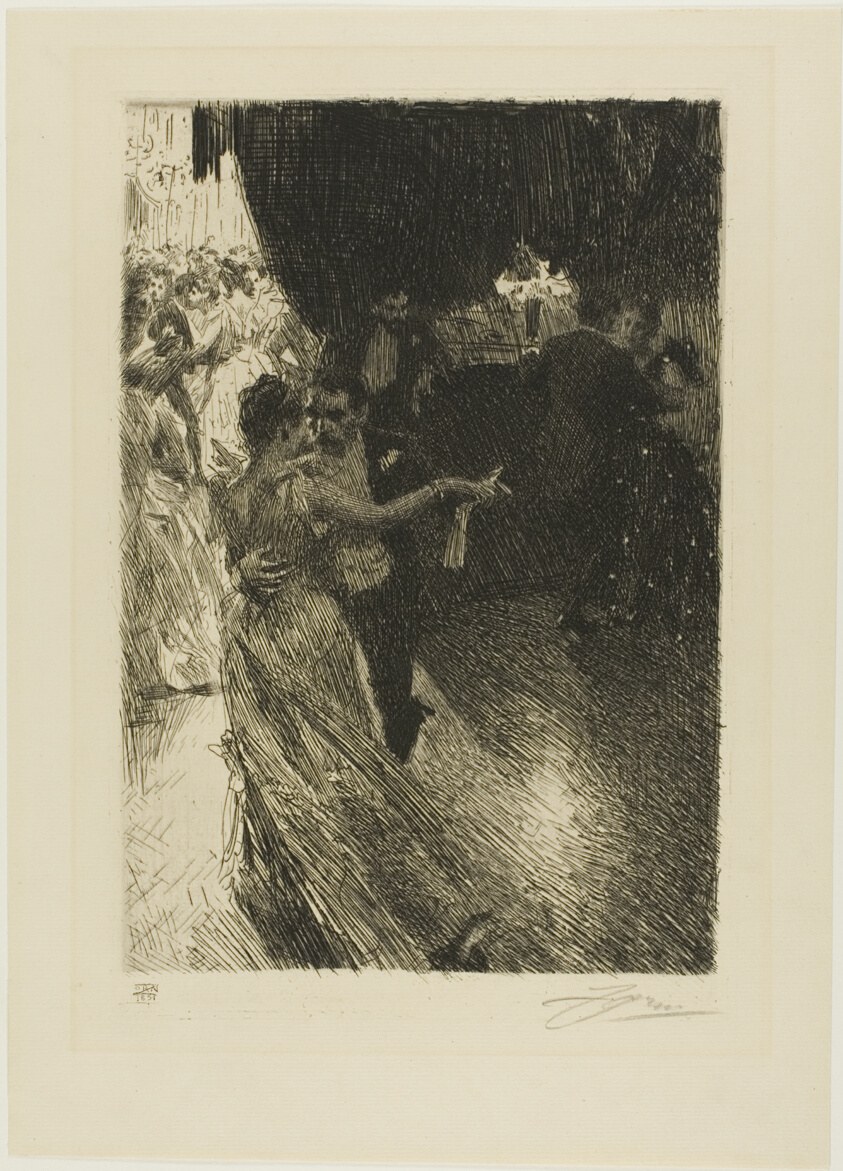
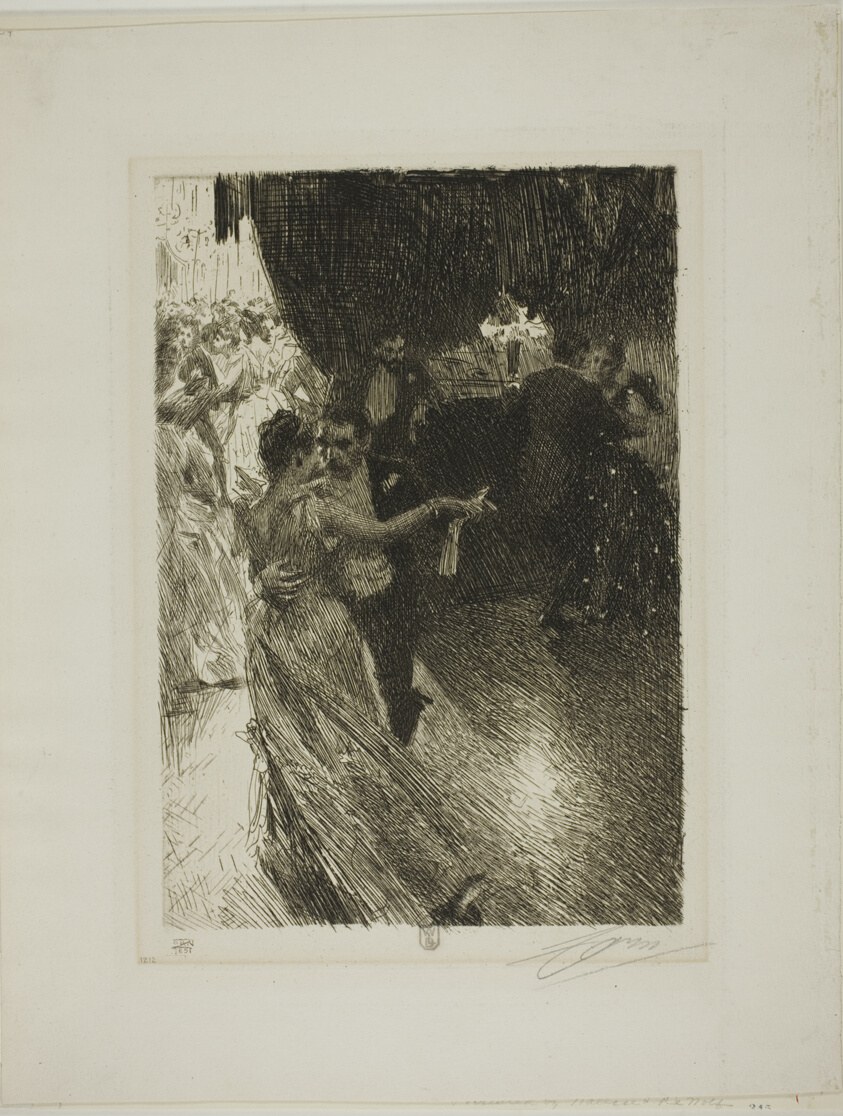
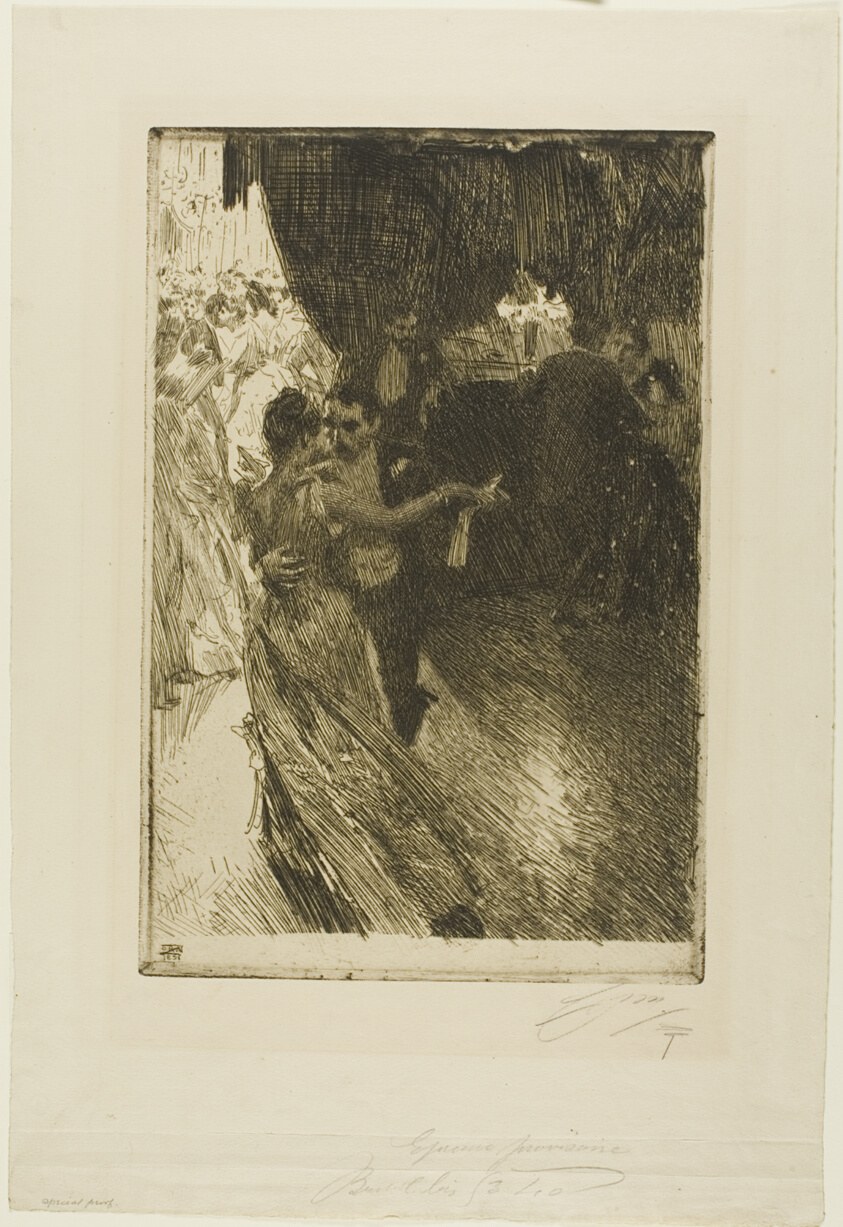
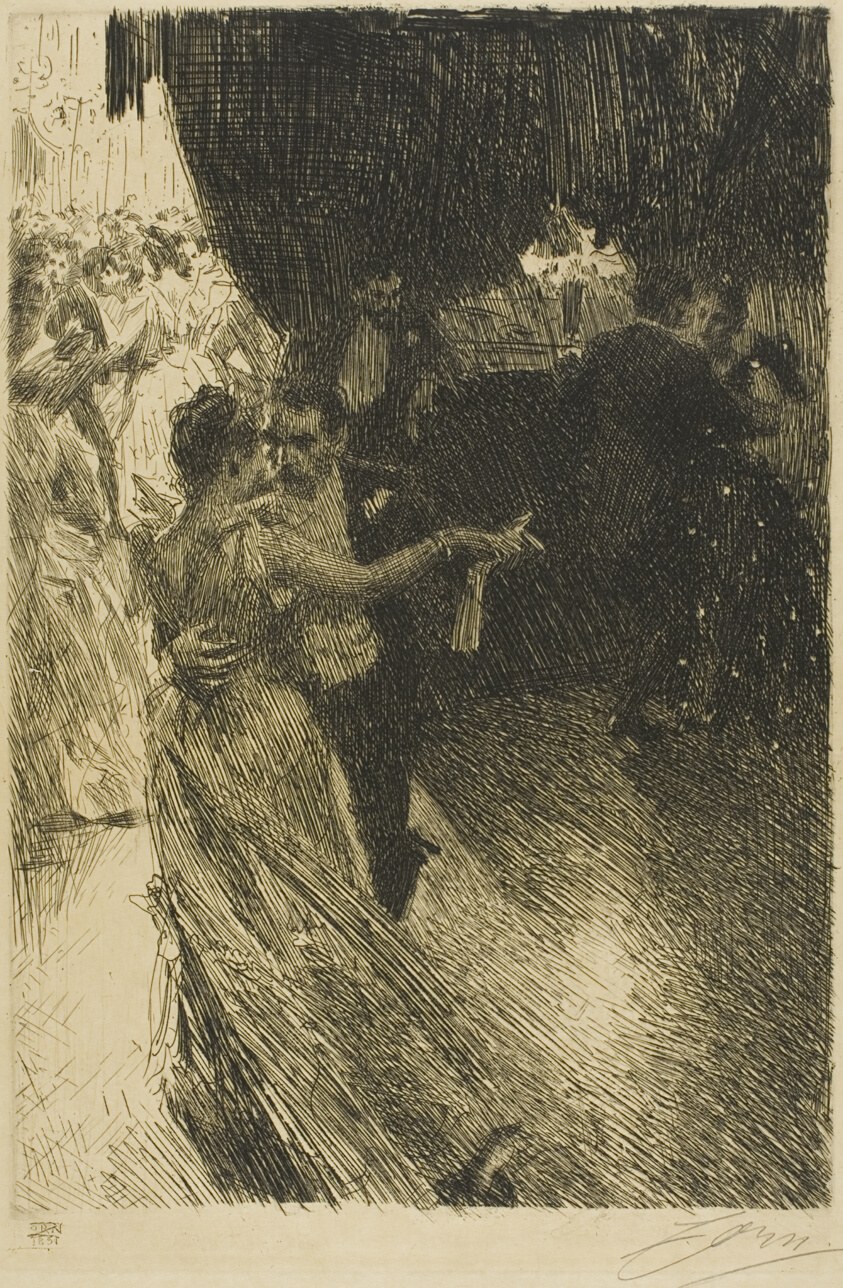
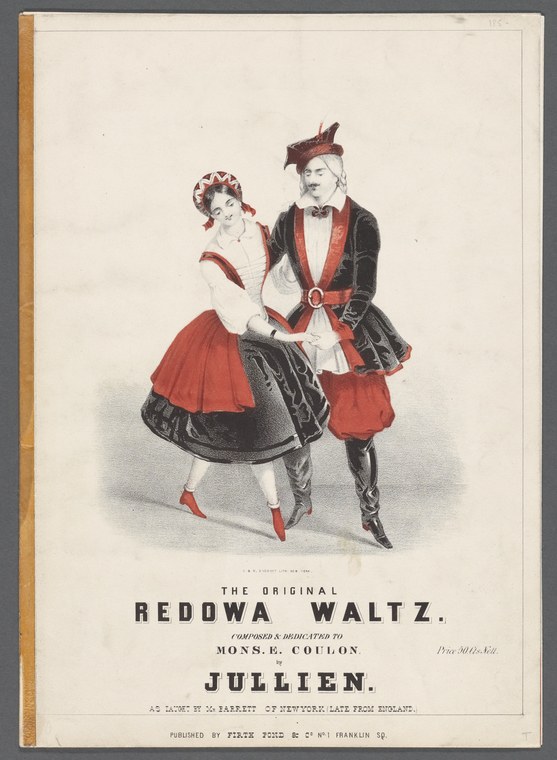
A lithographed dance instruction or promotional image showing a couple performing the Redowa waltz. The man, positioned at right, wears formal evening dress: a black jacket with red velvet lapels and trim, a white shirt front, black trousers, and a feathered hat. He holds the woman at his right side in a ballroom frame. The woman wears a red skirt with black underskirt visible at the hem, a white bodice or corset, and an elaborate red feathered or ribbon-adorned headdress. Both figures are caught mid-turn, their bodies angled to suggest the rotational motion of the dance. The woman's weight is on the balls of her feet and her body leans into the turn; the man's posture is upright and controlling. The background is plain, focusing all attention on the figures and their interaction. The lithographic technique allows fine detail in the fabric textures and the subtle shading of the faces and bodies.
The dancing
The couple stands in a close ballroom position with the man's right hand at the woman's waist and his left hand raised to hold her right hand or arm. Their bodies are turned in the same direction, suggesting a pivoting or rotating movement characteristic of waltz. The woman's left arm appears to rest on or near the man's shoulder. Both dancers' torsos are engaged and centered; their legs are partially visible beneath the woman's full skirt, with the posture suggesting they are on the balls of their feet. The frame is neither fully side-by-side nor fully facing, but at the three-quarter angle typical of mid-nineteenth-century ballroom dance instruction images.
The dance depicted
This is the Redowa (or Redowa waltz), a ballroom dance that emerged in the 1840s–1850s and was considered a novelty variant of the waltz. The Redowa combined waltz rotations with polka-like stepping patterns and was often performed as a faster, more energetic alternative to the standard Viennese waltz. The image claims to depict 'the original Redowa waltz' as choreographed by or associated with Jullien, a prominent dance composer and music publisher of the mid-nineteenth century. The couple's posture and the woman's skirt caught in an apparent turn confirm this is a rotational ballroom dance of the waltz family. The formal evening dress and the promotional framing suggest this image was created to advertise or teach the dance to ballroom society.
How it was made
This is a hand-colored lithograph, a process that allowed for mass production of dance instruction and promotional images in the nineteenth century. The base image was drawn on stone and printed in black or dark ink; the red and flesh tones were then applied by hand or in separate colored stone passes. Lithography was the ideal medium for reaching the urban ballroom-dancing public, as it was cheaper than engraving, faster than woodcut, and could capture the fine detail necessary for understanding dance positions and fashionable dress. The presence of hand-coloring and the quality of the printing suggest this was a commercial product aimed at dance studios, publishers, or affluent amateurs learning the latest ballroom fashions.
About this work
This is a mid-nineteenth-century dance instruction lithograph documenting the Redowa waltz, a fashionable ballroom dance that enjoyed a brief but intense popularity in the 1840s–1850s. The image captures a moment of rotation, showing the formal frame, body positioning, and evening dress required for the dance. The attribution to Jullien, a prolific composer and choreographer of ballroom dances, suggests this was an official or authorized representation of his version of the dance, distributed to dancers and dance teachers across Europe and North America.
The work is significant as evidence of how ballroom dances were taught and commodified in the nineteenth century. It represents a moment when waltz variants proliferated and competed for fashionability, and when the publishing industry created a new visual language of dance instruction aimed directly at consumers. The lithographic format ensured wide circulation among urban middle and upper classes eager to master the latest steps.
How to look at it
Attend to the woman's position: her body is tilted into the turn, her weight forward, her face looking in the direction of travel—all signs of an active, rotating movement rather than a stationary pose. Notice the man's upright, controlling frame: he is leading the rotation. The feathered headdress and formal evening wear anchor this firmly in mid-nineteenth-century ballroom society. The three-quarter angle of the bodies—not side-by-side, not face-to-face—is deliberate: it allows the viewer to see both the frame and the direction of movement. The partial visibility of the skirt hem and the ankles hints at the footwork and the speed of the dance without showing the feet explicitly.
The artist
The artist is not recorded in the catalogue. However, the lithograph is signed or attributed to Jullien, who was the music composer and choreographer, not the artist. Jullien (c. 1812–1860) was a French-born composer and conductor celebrated for his ballroom dance compositions; he worked in London and Paris and was a prolific publisher of quadrilles, waltzes, polkas, and other fashionable dances. The Redowa was one of several waltz variants he championed. The lithographer—the artist who drew and rendered this image—remains anonymous, as was common in commercial dance instruction material of the period.
The period
The Redowa emerged in the 1840s as one of several waltz variants competing for ballroom favor. The 1840s–1850s saw an explosion of named waltz types (Redowa, Cellarius waltz, etc.) as composers and dance masters sought to refresh and market the waltz, which by mid-century was already established as the dominant social dance in Europe and North America. The same decades saw the birth of commercial dance-instruction media: lithographed sheets, pamphlets, and illustrated handbooks aimed at teaching the growing urban middle class the steps and deportment required for fashionable ballroom participation. Jullien was one of the most successful entrepreneurs in this market. Simultaneously, in theatrical ballet, the Romantic era was at its height, though this image belongs entirely to the social dance world, not the stage.
Where it lives
This lithograph is held in the New York Public Library collection. It is a commercial dance-instruction or promotional print, likely distributed to dance teachers, studios, or private consumers in the mid-nineteenth century. The NYPL acquired it as part of its collection of ephemeral ballroom dance and music materials.
Dance in this work
Questions about this work
What is the Redowa, and how does it differ from a standard waltz?
The Redowa is a ballroom dance that emerged in the 1840s as a waltz variant. It combines the rotational movement of the waltz with faster, polka-like stepping patterns, creating a more energetic and playful effect. It was marketed as a novelty or alternative to the standard Viennese waltz and enjoyed particular popularity in mid-nineteenth-century ballrooms in Europe and North America, though it was largely forgotten by the twentieth century.
Who was Jullien, and why did he choreograph or promote the Redowa?
Jullien (c. 1812–1860) was a French composer and conductor who became one of the nineteenth century's most prolific and commercially successful creators of ballroom dance music and choreography. He composed hundreds of quadrilles, waltzes, and other dances, and published them widely. He promoted the Redowa as part of a broader strategy of creating named, marketed dance variants that appealed to the growing middle-class ballroom audience seeking novelty and fashionable status.
How were ballroom dances taught before video, and what role did images like this play?
In the nineteenth century, ballroom dances were taught through live instruction, written descriptions, and illustrated prints like this one. Lithographed dance-instruction images showed the basic frame, body position, and deportment required for a dance, and they were widely distributed as sheets, booklets, or advertisements. These images were not detailed movement sequences but rather canonical poses meant to convey the essential character and formal requirements of the dance to dancers and their teachers.
Why is the woman's headdress so elaborate?
In mid-nineteenth-century ballroom fashion, women wore elaborate headdresses as markers of wealth, sophistication, and attention to current style. The feathered or ribbon-adorned headdress shown here was standard evening wear for fashionable women attending balls and public dance events. The elaborate detail would also have caught the eye of viewers seeing this image in print, emphasizing the glamour and sophistication of ballroom culture.
More Waltz artwork