33 works in this view — arrow keys or swipe to move between them.
Dance in Art
The Waltz
Anders Zorn (Swedish, 1860–1920)
- Dance:
- Waltz
- Source:
- Cleveland Museum of Art
- Rights:
- Public domain — free to use, share and adapt.
- Recorded as:
- CC0 (Public Domain)
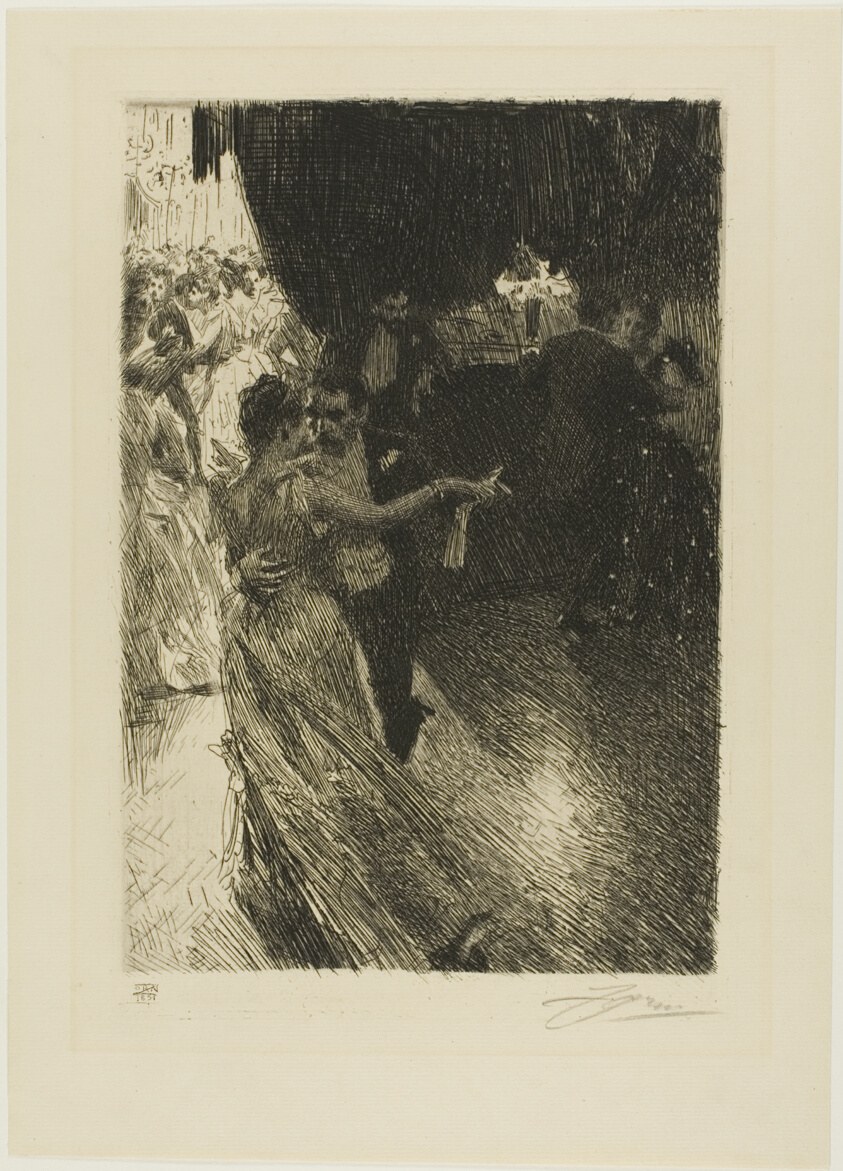
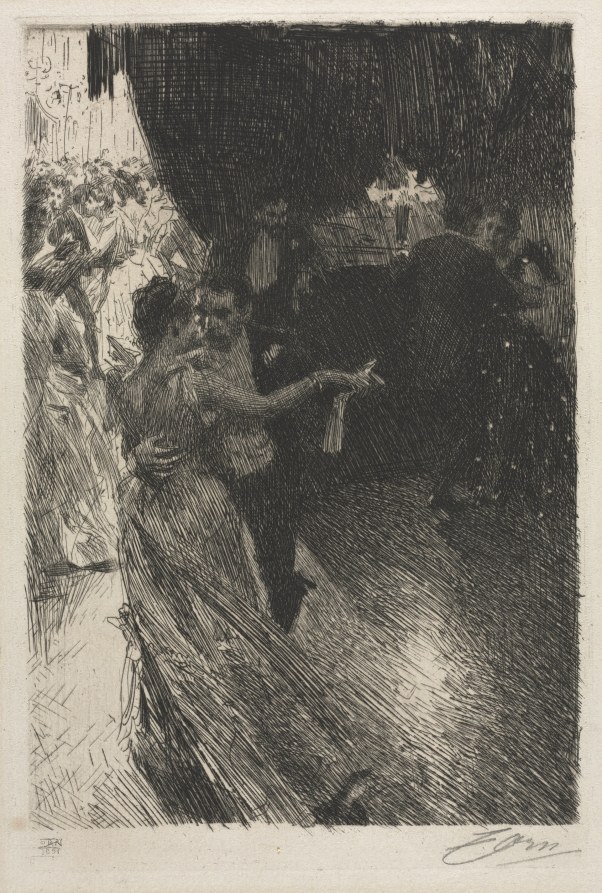
This etching is evidence that by the late nineteenth century, the waltz had become a subject of fine art—not caricature or satire, but sympathetic, even romantic representation. It shows how the dance was understood by visual artists of its time: as intimate, emotionally charged, and fundamentally about the private bond between partners even in a public setting. For historians of ballroom dance and of nineteenth-century social life, it documents both the form of the waltz and the cultural meanings attached to it.
What you are looking at
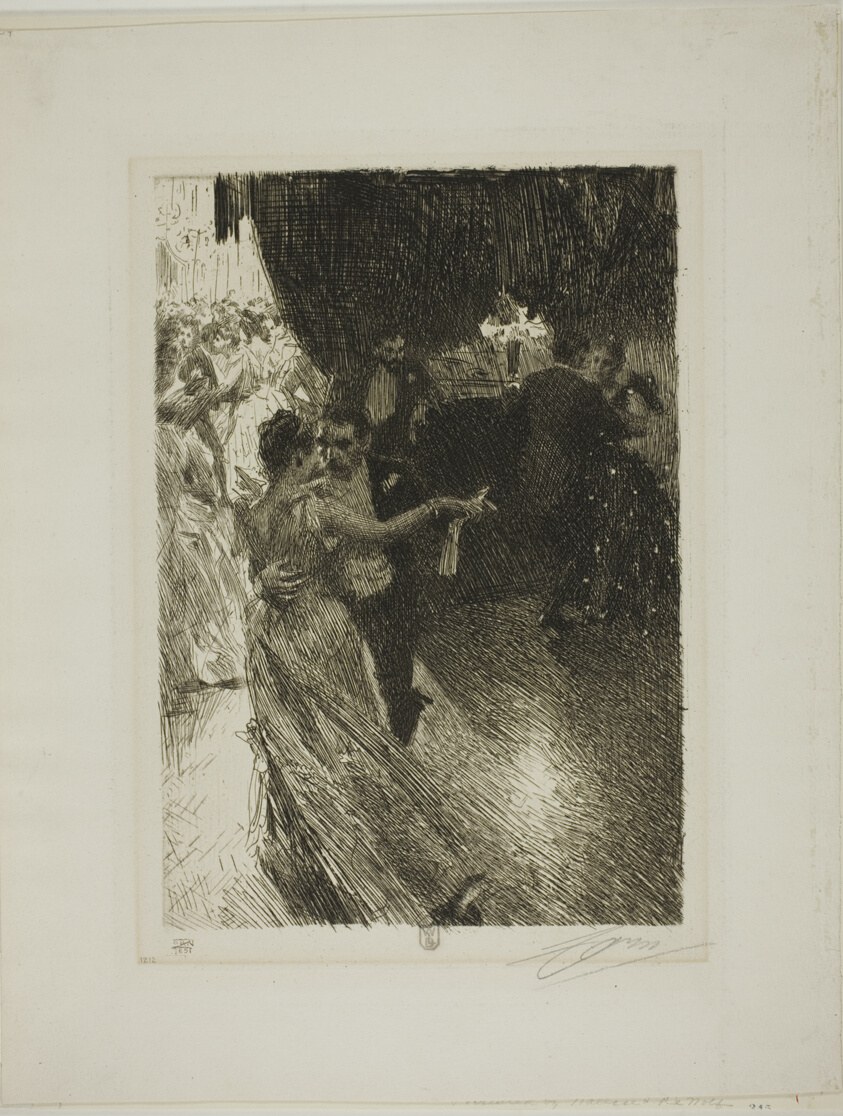
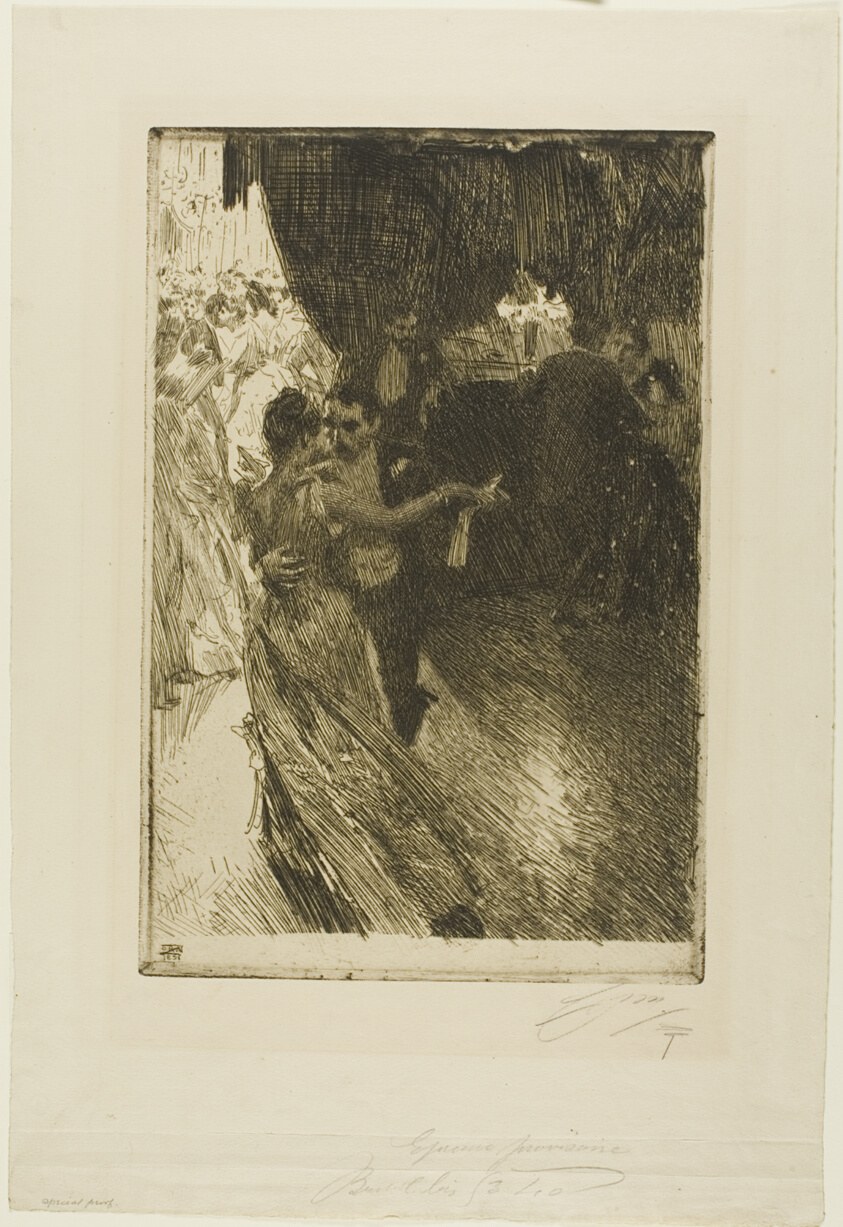
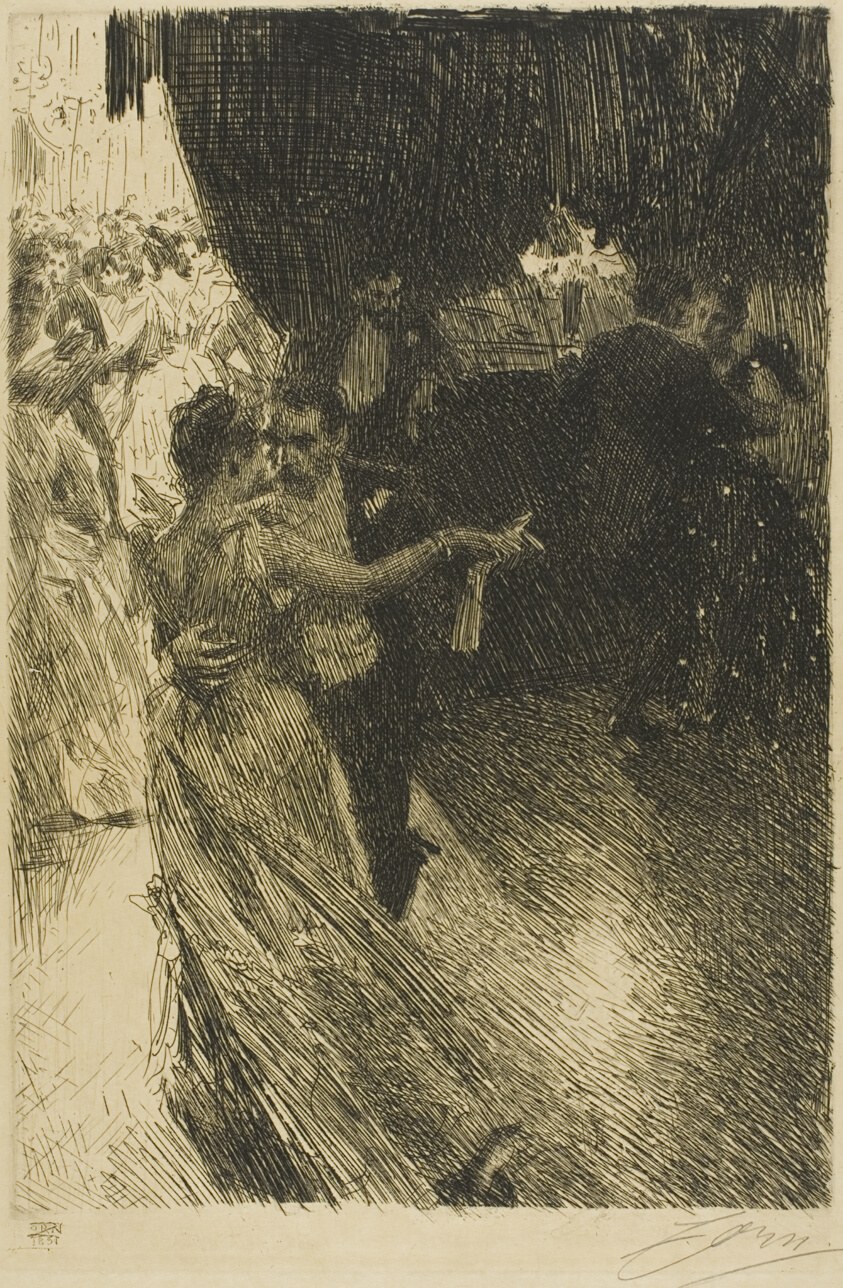
An intimate interior scene rendered in fine etched lines shows a couple engaged in a waltz. The woman, wearing a full-skirted gown with her hair up in period style, is held by a man in dark formal dress—coat and what appears to be a cravat or collar. The couple occupies the right side of the composition in three-quarter view. To the left, barely suggested through vigorous cross-hatching, other figures in lighter dress cluster near what may be a doorway or the edge of a ballroom, their forms fragmentary and atmospheric. The background darkens dramatically into deep shadow, created by dense parallel lines that push the dancing couple forward. A single source of light—perhaps from a window or lamp—illuminates the dancers' faces and the woman's skirt, creating strong tonal contrast. The overall effect is one of a stolen moment, intimate yet public, caught in the midst of a larger social gathering.
The dancing
The couple holds a closed ballroom position: the man's right hand at the woman's back, their other hands joined at about shoulder height. Both figures lean slightly into the frame of the dance. The woman's weight appears to be on her back foot, her skirt lifted slightly as if mid-step. The man's posture is upright and composed, characteristic of formal ballroom partnering. Their faces are close, suggesting either concentration on the steps or the emotional closeness the waltz was famous for conveying in the nineteenth century.
The dance depicted
This is plainly a waltz, as the catalogue record states. The closed hold, the formal dress, the interior ballroom setting, and the woman's characteristic three-quarter pose and lifted skirt all confirm it. The work captures the waltz not as spectacle but as intimate social dance—the kind danced in private or semi-private ballrooms among people of means. The artist has chosen the moment just as the couple turns, when the woman's skirt catches the light and billows. The waltz was the dominant couple dance of the nineteenth century and remained so into the early twentieth.
How it was made
This is an etching, executed with a fine, controlled needle. The artist used varying density of parallel lines (hatching and cross-hatching) to build form and create dramatic chiaroscuro—the play of light and shadow is the work's chief technical achievement. Etching allows for the fine detail visible in the woman's dress and in the faces, while the bold parallel-line technique in the background creates an almost abstract sense of atmosphere and energy. The medium suggests this was made for an educated audience—etchings were collected and exhibited in print societies and galleries, not mass-produced.
About this work
This is a late nineteenth- or early twentieth-century etching of a waltz, likely made when the dance was still the primary couple dance of ballroom society. The artist has captured not the spectacle of dance but its private emotional content: the absorption of the couple in the music and each other, set against the indistinct crowd of other dancers. The work sits at the intersection of social documentation and romantic mood—it is interested in waltz as experience, not as technical display. For a collection focused on dance in art, it represents a crucial moment when the waltz had moved from novelty and scandal into the fabric of respectable social life, worthy of serious artistic attention.
How to look at it
The composition is asymmetrical: the dancers occupy the right side, leaving the shadowed crowd to the left. The light falls on the woman's face and the curve of her skirt, the moment the artist chose to freeze is one of rotation, when the woman's full skirt becomes visible. Notice the artist's handling of the man's dark coat—it is built almost entirely from shadow, with only a few lines to define its edge, making it recede while the woman's illuminated dress advances. The fine etched lines in the faces suggest individual character and attention; the chaotic hatching in the background is less about accuracy than about evoking the bustle and energy of the ballroom as an almost abstract force.
The period
The waltz emerged as a scandalous novelty in the 1780s—the close hold and rotational motion offended conservative observers. By the 1860s–1890s, it was the unquestioned centerpiece of ballroom culture across Europe and North America. The waltz appeared in romantic ballet as well (most famously in Giselle), but it was equally important as a social dance, the principal means by which young men and women of the middle and upper classes came into close contact under controlled circumstances. This etching was made during or after the peak of the waltz's dominance, when it had secured its place in both high culture and everyday social life.
Where it lives
The work is part of the Cleveland Museum of Art's collection of dance-related art. No accession number, date, or artist attribution is recorded in the catalogue.
Dance in this work
Questions about this work
Why is the rest of the ballroom so dark and unclear?
The artist used shadow to isolate the couple, making them the emotional focus of the composition. The other dancers are suggested rather than depicted, which was a common technique in prints of the period to create atmosphere and mood rather than documentary detail. The effect is both romantic and theatrical—we experience the waltz as the couple experiences it, absorbed in their own movement.
What can you tell about the dance from this image?
The closed position, the formal dress, the interior setting, and the rotational motion all confirm this is a waltz. The woman's lifted skirt and the couple's engaged posture suggest they are dancing with full commitment to the form. There is no evidence here of the technical virtuosity of theatrical dance; this is social waltz—the kind ordinary people danced at balls.
Could this be a different dance?
Unlikely. The closed hold, the woman's pose, and the period dress all point specifically to the waltz. Other couple dances of the era—the polka, the mazurka, the quadrille—have different characteristic holds or positioning. The catalogue record's attribution to the waltz is well supported by what is visible.
More Waltz artwork