30 works in this view — arrow keys or swipe to move between them.
Dance in Art
The Waltz
Anders Zorn
- Dance:
- Waltz
- Source:
- Art Institute of Chicago
- Rights:
- Public domain — free to use, share and adapt.
- Recorded as:
- CC0 (Public Domain)
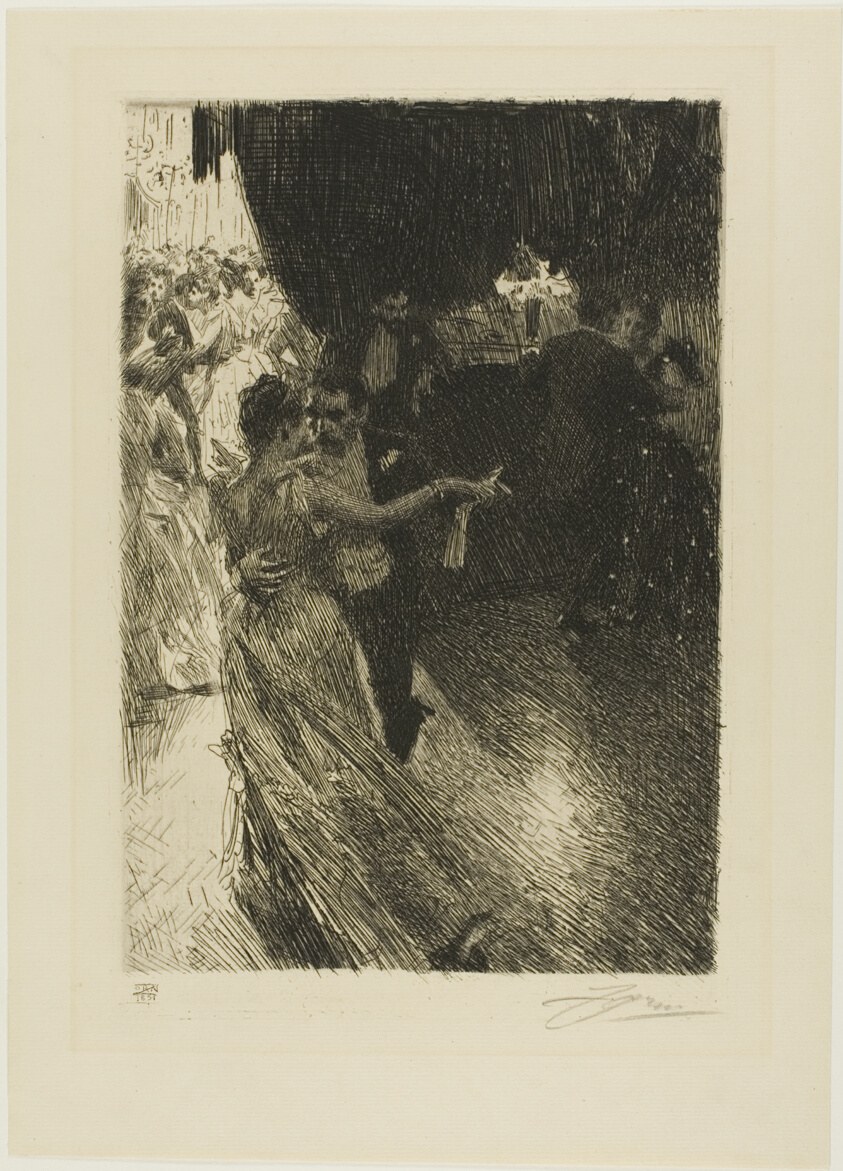
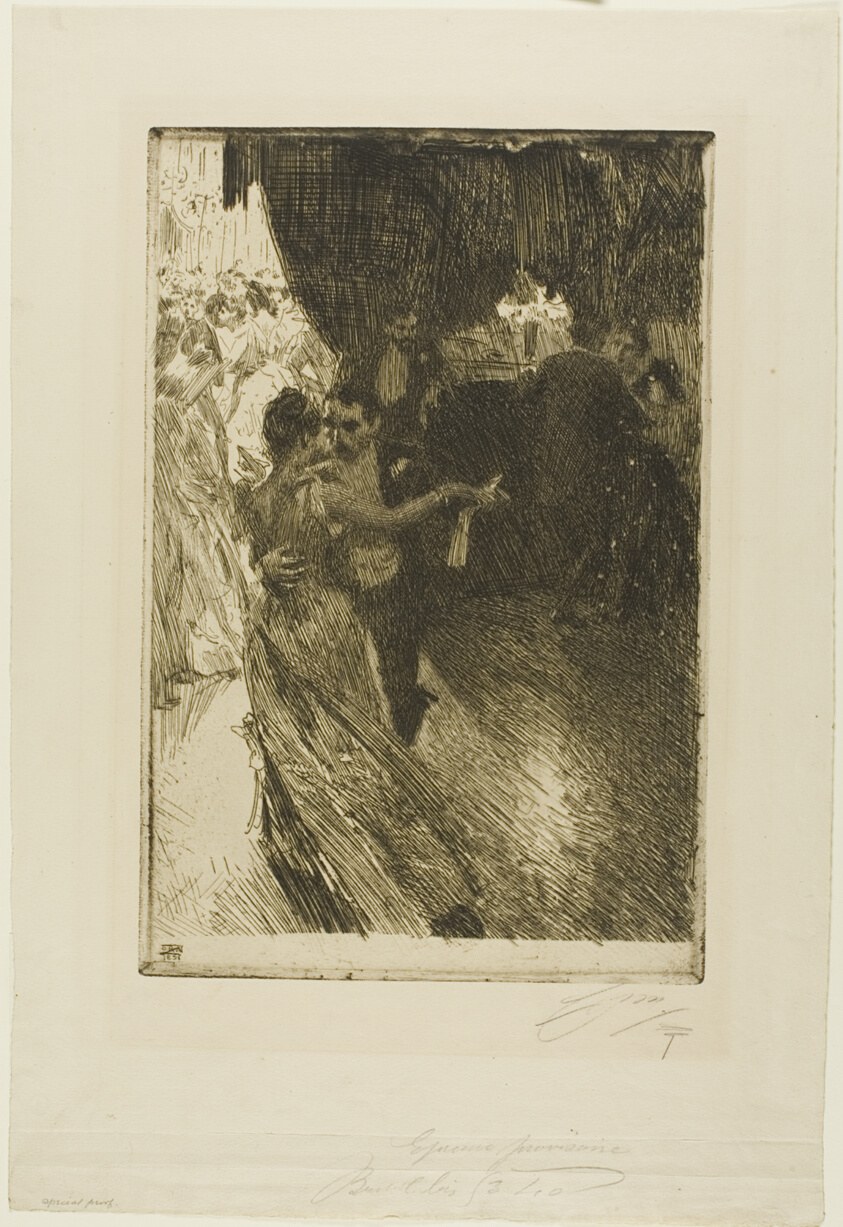
This etching is a precise record of how waltz was danced and dressed in the late nineteenth century, made by an artist who clearly observed the dance closely. For historians of ballroom technique and social dance, it offers evidence of posture, partnership, and the spatial organization of the ball that written sources alone cannot convey. For anyone studying nineteenth-century visual culture, it shows how dance—a fleeting, social practice—was valued enough to merit fine-art documentation.
What you are looking at
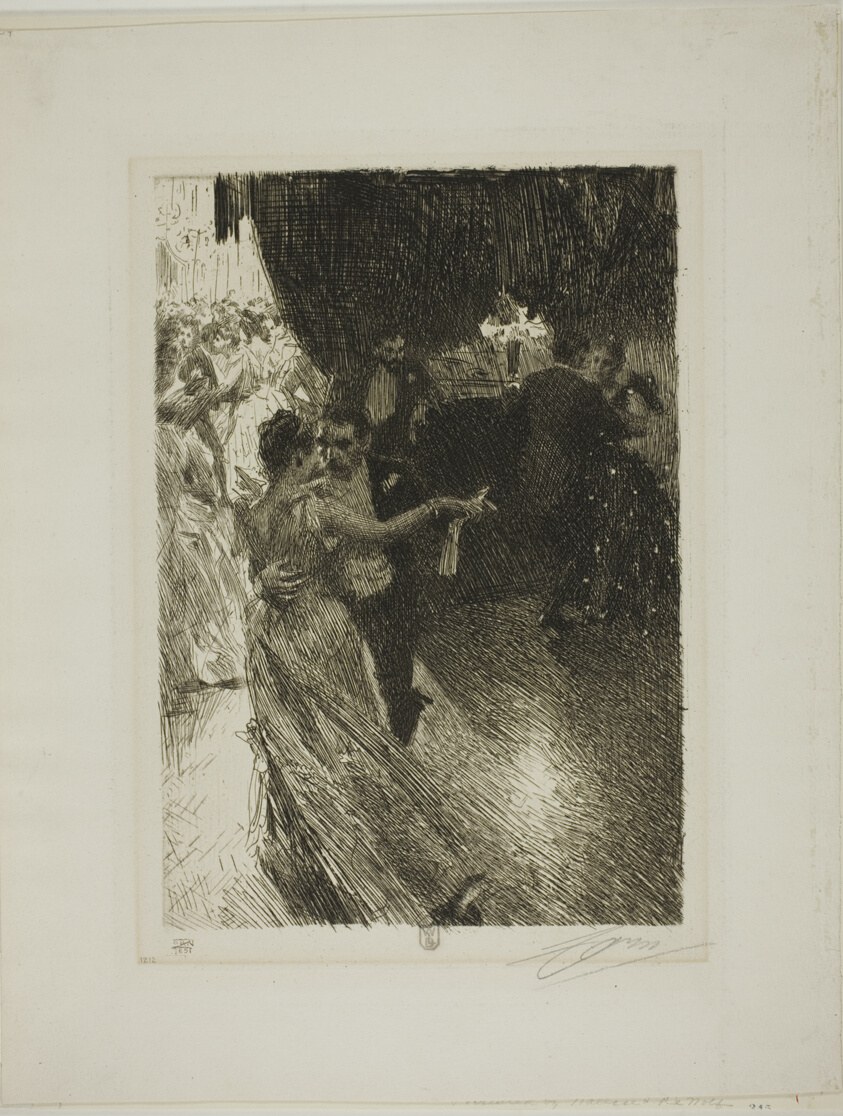
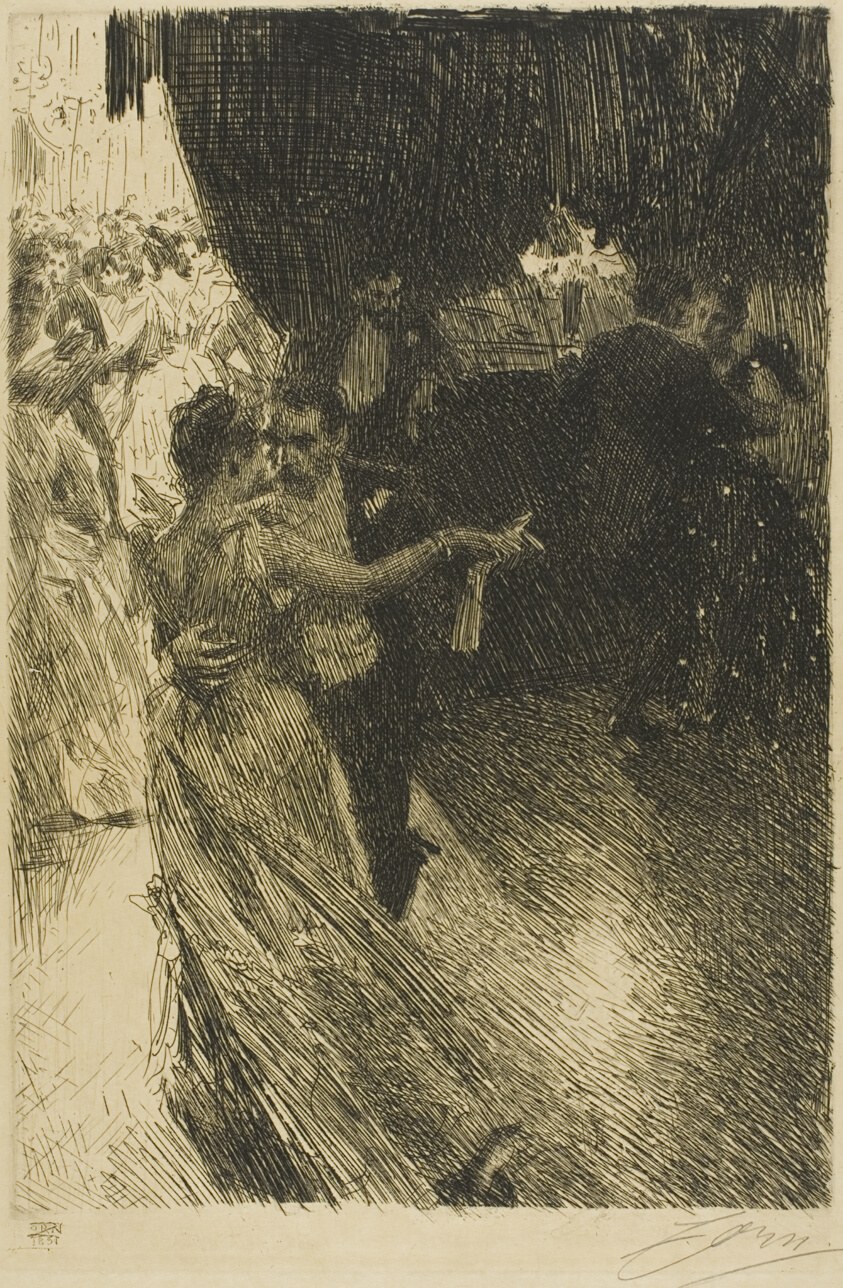
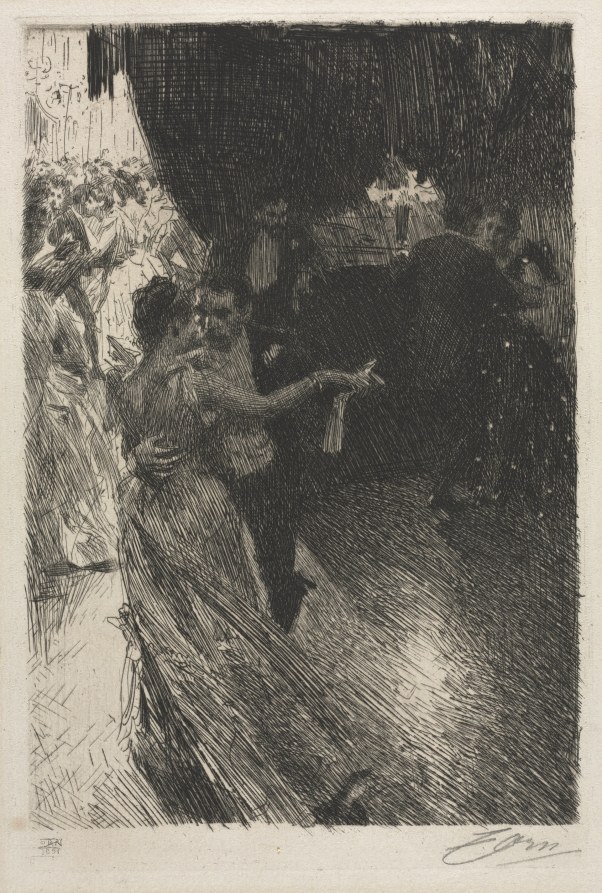
This etching depicts an intimate ballroom scene rendered in fine lines and warm sepia tones. A couple occupies the center, locked in the formal closed position of social dance: the man in dark coat and trousers faces left, his right arm at the woman's back, while she leans into him, her pale gown with elaborate details catching light. Their bodies form a unified frame tilted slightly off-vertical, suggesting motion mid-turn. The setting is theatrical—a grand interior with high ceilings indicated by dense cross-hatching that recedes into shadow. Spectators populate the background in loose groupings, some seated, some standing, their forms rendered more sketchily than the central couple. The overall effect is one of refined social performance: the dancers occupy a privileged space of light and clarity while observers exist in penumbra.
The dancing
The central couple holds the closed ballroom position with the man's right arm supporting the woman's back and their inside hands clasped at chest height. Their bodies are aligned in the frame position characteristic of waltz, though the angle of the woman's upper body—leaning decidedly into her partner rather than maintaining strict parallel alignment—suggests the relaxed elegance of social rather than competitive technique. The woman's gown, with its full skirt and fitted bodice, would have allowed the free vertical rise and fall required of waltz. Neither figure shows rigid posture; instead, both move with apparent ease into the turn.
The dance depicted
This is a waltz—the catalogue identification is correct. The closed ballroom hold, the formal evening dress, the ballroom setting, and the social context all confirm it. The etching captures waltz as it was danced in mid-to-late nineteenth-century European society, where it was the dominant social dance of the ball. The woman's dress—the cut and volume of the skirt, the fitted bodice—dates to the 1870s–1890s era. The image captures not the spectacle of performance but the private experience of the dance itself: two people in motion, aware of observers but focused on each other and the mechanics of their partnership.
How it was made
This is an etching, a technique that allowed fine tonal gradation through controlled parallel hatching. The artist has used close, parallel lines to build shadow and volume—notably in the dark drapery that frames the upper half of the composition and in the coats of the background figures. The medium suits the subject: etching allowed the artist to capture the refinement and delicacy of ballroom fashion while building atmosphere through accumulated line. As an etching, this work circulated through printing, making it accessible to a broad educated audience interested in contemporary social life—far more so than a unique oil painting would have been.
About this work
This is a finely observed etching of a waltz at a nineteenth-century ball, captured in the closed partnership position that defined the dance. The work combines technical mastery of the etching medium with acute attention to the social choreography of ballroom life: the formal frame of the couple, the observing crowd, the play of light and shadow that marks the dance floor as a space of performance. It belongs in a dance collection because it documents not just the visual appearance of waltz but the lived experience of the dance—the contact between partners, the spatial relationship of dancers to spectators, and the dress culture that enabled the movement. The work shows the artist understood ballroom dance as a physical practice, not merely as a social convention.
How to look at it
Notice first the closed frame of the couple and the way the woman leans into the man—this is the characteristic partnering of waltz, not the rigid parallel alignment of later competitive technique. Observe how the artist has lit the couple and left the background in shadow: this creates depth and emphasizes the dancers as the subject, not the crowd. Look at the woman's skirt: its volume and the way it would move through the three-beat waltz phrase are essential to understanding how the dance was both danced and seen. Finally, attend to the spectators—they establish this as a social event where the dance itself, not any external performance, is the point.
The period
By the 1870s–1890s, waltz had completed its transformation from a scandalous novelty to the respectable centerpiece of European and American ballroom culture. The closed position—which had shocked earlier generations because it required the couple to embrace—was now the norm. Etching, as a medium, was experiencing a renaissance in the nineteenth century; printmakers found in the technique a way to document contemporary life with both technical refinement and social relevance. This work sits within a broader tradition of ballroom and dance imagery in printmaking, responding to the appetite among the middle and upper classes for images of their own social rituals.
Where it lives
The work is held in the Art Institute of Chicago. It appears in their collection as a historical print documenting nineteenth-century social practice.
Dance in this work
Questions about this work
How do we know this is a waltz and not another ballroom dance?
The closed position, the alignment of the couple's bodies, and the three-beat frame all point to waltz. The formal evening dress and the ballroom setting are consistent with waltz culture of the period. Other ballroom dances of the era—polka, quadrille, galop—have distinctly different frames and social contexts.
What does the woman's dress tell us about the dance?
The full, gathered skirt and fitted bodice are typical of 1870s–1890s fashion and were designed to work with the vertical rise and fall of waltz. The volume of fabric would have moved fluidly through the waltz turns without constraining the dancer's frame or weight transfer.
Why make an etching of a ballroom dance?
By the late nineteenth century, ballroom dancing was a central element of respectable social life for the educated classes. Fine prints of contemporary social scenes—including dance—were a way to document and celebrate that culture. Etching, being reproducible, allowed the image to circulate among people who danced or attended balls themselves.
More Waltz artwork