28 works in this view — arrow keys or swipe to move between them.
Dance in Art
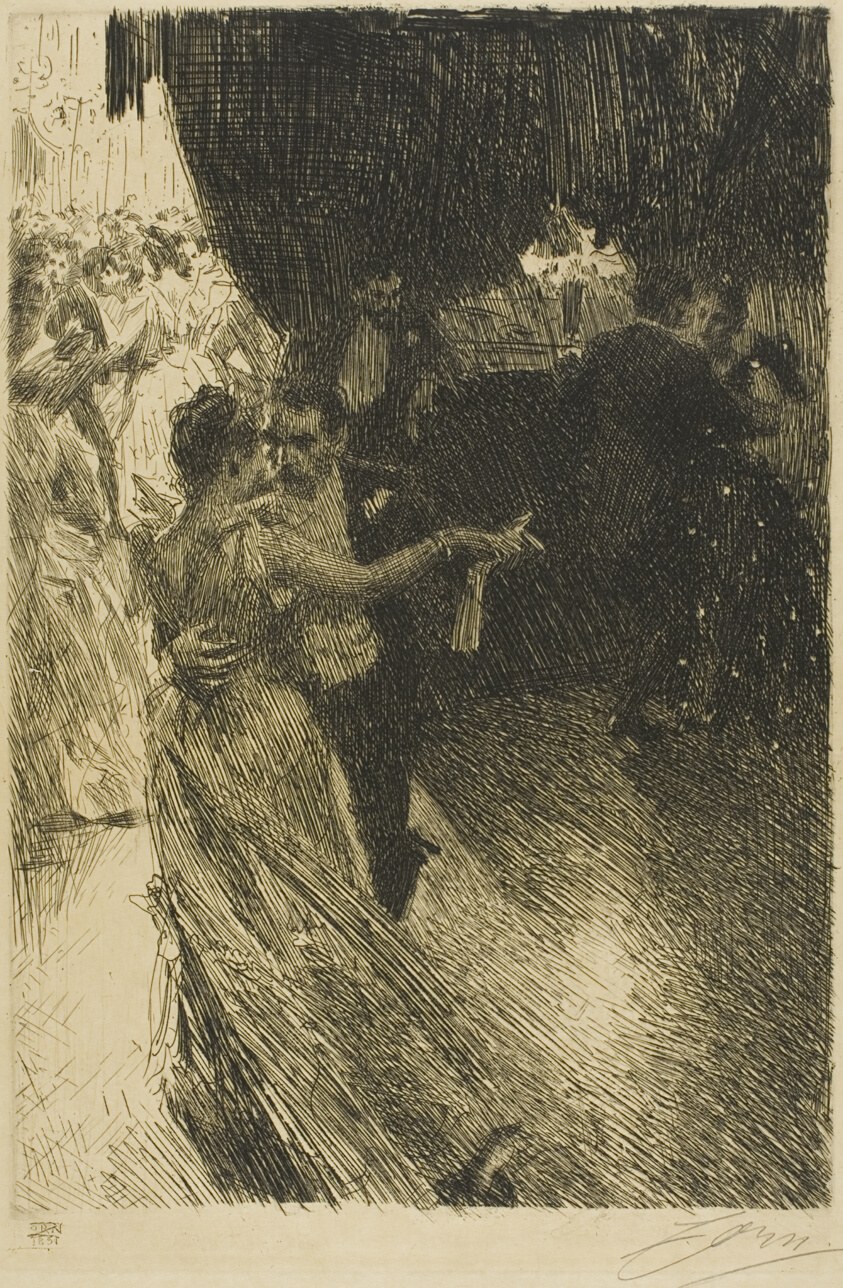
The Waltz
Anders Zorn
- Dance:
- Waltz
- Source:
- Art Institute of Chicago
- Rights:
- Public domain — free to use, share and adapt.
- Recorded as:
- CC0 (Public Domain)
The waltz was revolutionary precisely because it brought partners into close physical contact in public (or semi-public) space, and this etching captures the social intensity that made the dance simultaneously desirable and controversial. For historians of dance, gender, and 19th-century social life, the image documents both the form of the dance and the cultural moment in which it flourished.
What you are looking at
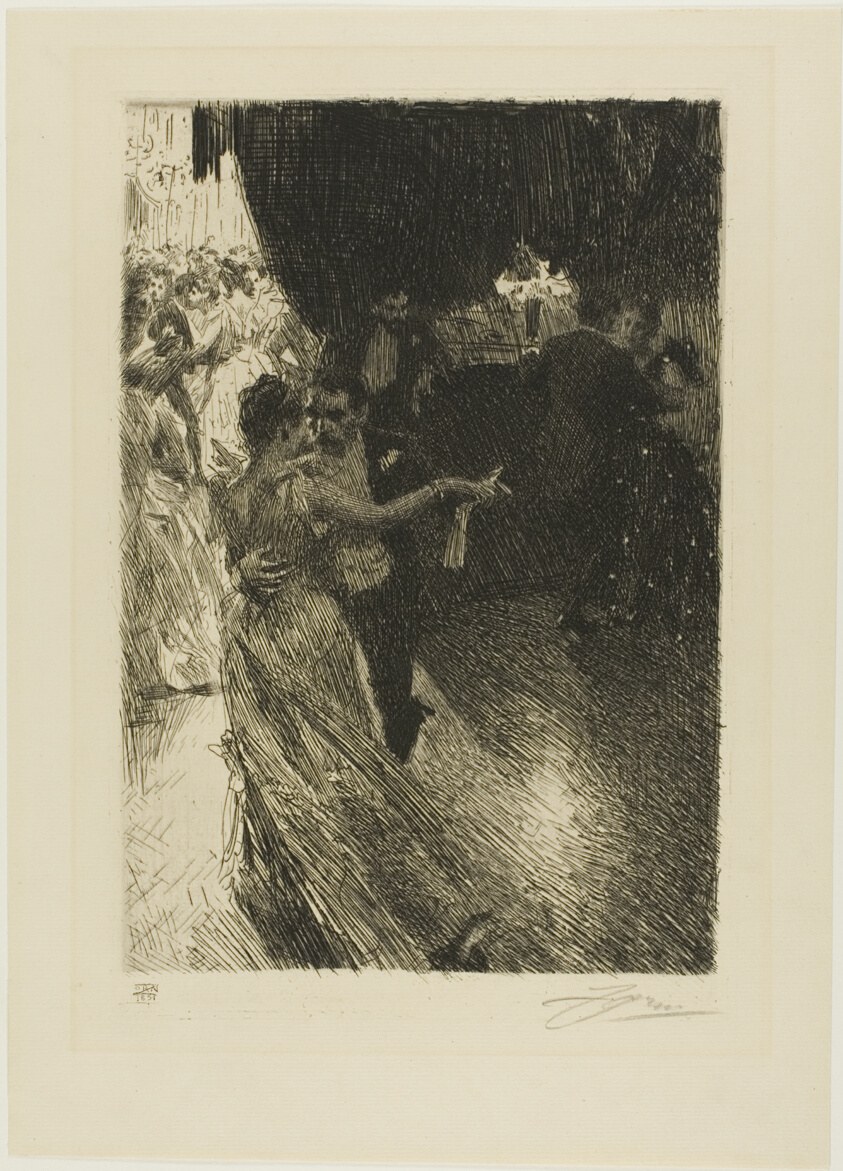
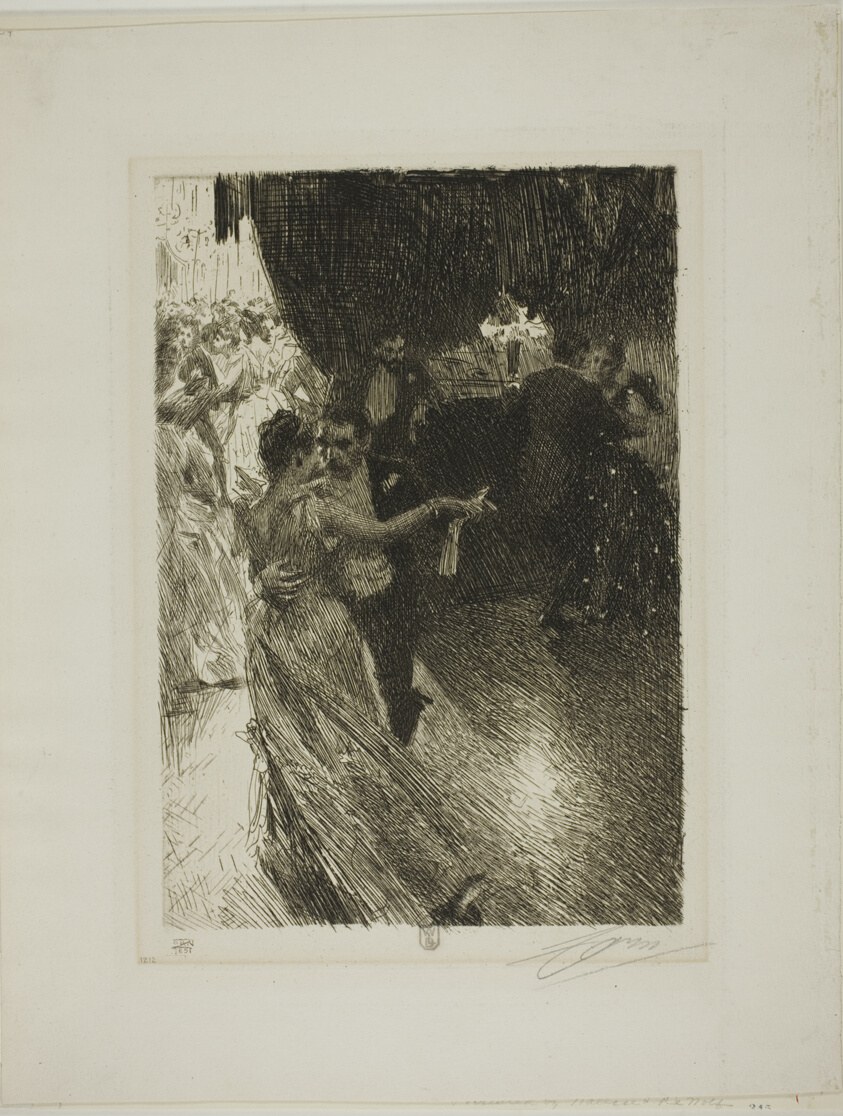
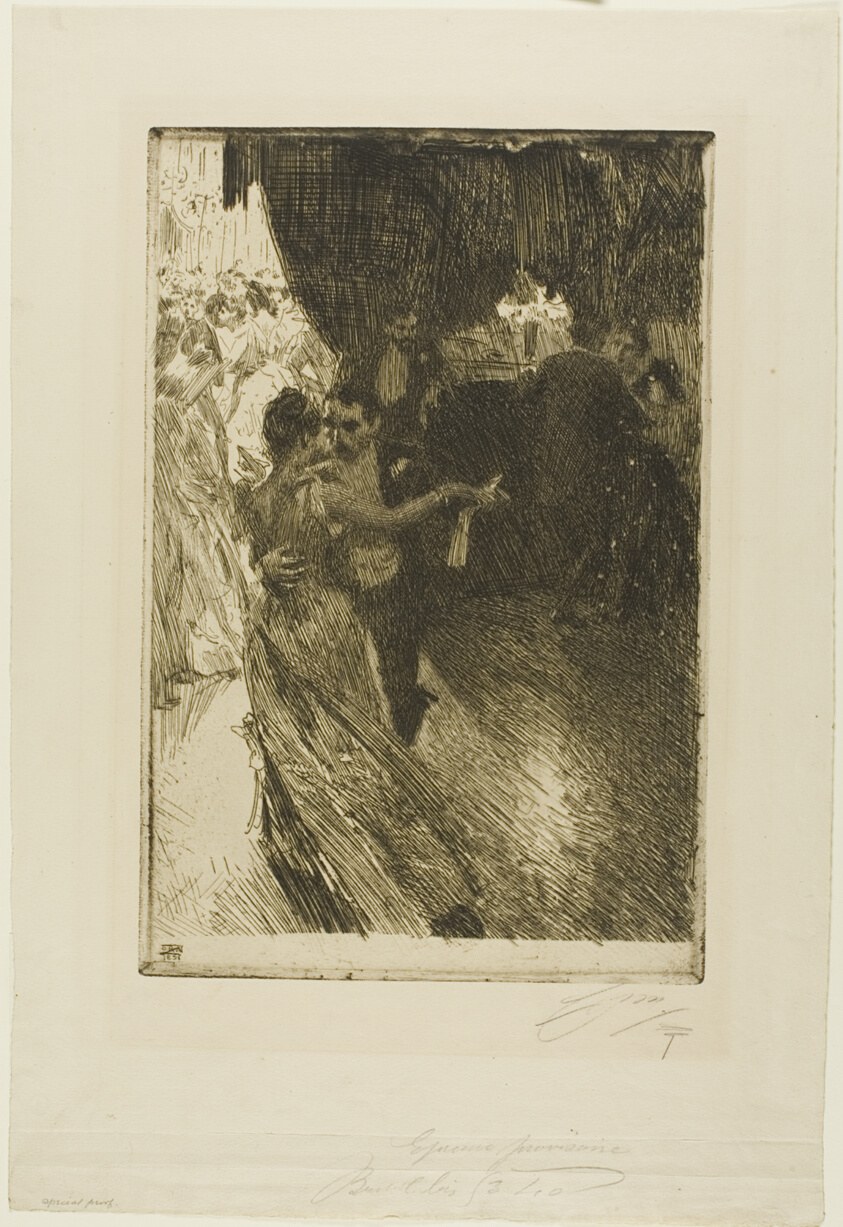
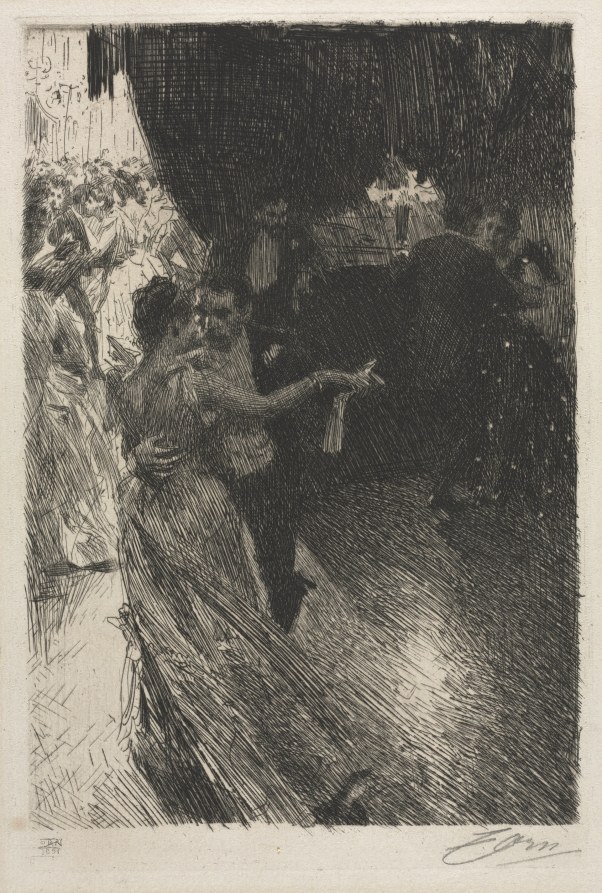
An intimate interior scene rendered in fine crosshatched etching, showing a couple dancing in what appears to be a parlor or drawing room. The woman, in the foreground at left, wears a long dress with a fitted bodice; the man behind her is in dark formal attire. Their bodies are close, suggesting the partnered hold of ballroom dance. The background is heavily worked with dense parallel lines creating deep shadow and architectural definition—tall vertical elements suggest walls or doorways, and at the far left a group of onlookers or musicians is barely visible in lighter tones. The foreground floor is rendered in horizontal hatching that suggests movement and receding space. The overall mood is one of concentration and intimate social performance: the dancers are absorbed in their movement while aware of being observed.
The dancing
The couple maintains a closed ballroom hold, with the man's frame supporting the woman who leans slightly into the dance. The woman's weight appears to be shifting through her body in a forward motion; her skirt has gathered volume suggesting mid-turn or forward travel. Both figures show the upright carriage and engaged posture characteristic of formal ballroom technique. The man's right arm is positioned to guide and support. No visible footwork detail, but the angle of their bodies and the woman's skirt displacement indicate active movement through space rather than stillness.
The dance depicted
This is the waltz, identified by both the title and the visual grammar of closed-hold partnered dance, formal dress, and indoor social setting. The etching dates to the 19th century based on costume and interior style. The waltz was the dominant social dance of the Victorian and Romantic eras, danced in drawing rooms and ballrooms across Europe and America. The image captures the characteristic three-quarter time momentum and the close partnership that made the waltz both revolutionary and controversial in its era—it was the first popular ballroom dance in which couples held each other at close range.
How it was made
This is a fine-line etching, identifiable by the delicate parallel hatching, the play of line weight, and the tonal effects achieved through density of cross-hatching rather than wash or tone. Etching allowed for precise, controlled mark-making and was the preferred medium for reproductive art and fine prints in the 18th and 19th centuries. The technique required the artist to work on a copper plate and understand how fine-lined marks would translate through printing, making it suitable for circulation and collection as a limited edition. The virtuosity of the shadow work here—particularly in the background—suggests a skilled printmaker with command of atmospheric perspective through line alone.
About this work
This is a 19th-century etching of a waltz, one of the defining social dances of the Romantic era. It captures not the spectacle of theatrical dance but the intimate, concentrated moment of social dancing in a parlor—the everyday performance of courtship and social grace that structured middle-class leisure. The technical sophistication of the etching, with its rich spatial depth and atmospheric shadow, elevates what might have been a documentary record into a meditation on social intimacy and the body in motion. The work belongs in a dance gallery as evidence of how waltz dancing was understood and valued in its period: not as technical virtuosity but as a form of close partnership, emotional connection, and social propriety that took place behind closed doors.
How to look at it
Attend to the relationship between the two bodies: the print's real subject is not movement itself but the quality of connection and trust between partners in a closed hold. Notice how the artist has chosen the moment of forward momentum—the woman's gathered skirt tells you this is mid-waltz, not a posed or stopped moment. The dense hatching in the background, which could seem merely technical, actually creates a sense of enclosure and intimacy, focusing the eye on the dancers and implying the social world that surrounds them. The formality of their dress and posture, contrasted with the private setting, captures what made the waltz culturally significant: it was an intense, formal, partnered intimacy.
The period
The waltz rose to dominance in European ballrooms in the 1810s-1820s and remained the paramount social dance through the Victorian era. It had been criticized by moral authorities for the closeness of the hold and the possibility of physical impropriety, yet it became the standard of fashionable dancing. By the mid-19th century, when this print was likely made, the waltz was fully established and romanticized in popular culture—appearing frequently in literature, theatre, and visual art as a symbol of elegance, modernity, and emotional connection. Fine prints like this one served both as documentary records and as objects of aesthetic consumption, circulating among educated middle-class households.
Where it lives
The work is held by the Art Institute of Chicago and is catalogued as coming from that collection. The accession and catalogue details are not currently recorded.
Dance in this work
Questions about this work
What made the waltz controversial?
The waltz was the first popular ballroom dance in which partners held each other in a closed embrace at close range, chest to chest. In the early 19th century, this was considered shocking and improper by moral authorities who saw it as risqué or even as an invitation to seduction. Despite—or because of—this controversy, it became the dominant social dance of the Victorian era.
What's the difference between ballroom waltz and Viennese waltz?
The Viennese waltz, originating in Vienna, is faster, more turning, and more rotational. The Ballroom waltz, which developed in England in the early 20th century, is slower and allows for more variety in figures and movement across the floor. This 19th-century image appears to show the earlier Viennese form, based on the close, continuous hold and the turning action suggested by the woman's skirt.
Who danced waltzes and where?
Waltzes were danced in ballrooms and drawing rooms by the middle and upper classes across Europe and America. They were central to courtship rituals and social events, from formal balls to intimate gatherings. By the mid-19th century, waltz dancing had become the mark of social refinement and modern elegance.
How do I recognize a waltz in a work of art?
Look for: a partnered couple in a closed hold (man's right hand on woman's waist, her left hand on his shoulder, hands joined at the side); upright posture and formal dress; rotating or turning movement through space; and typically an interior or ballroom setting. The three-quarter time of waltz music often creates a sense of continuous, spiraling motion.
More Waltz artwork