27 works in this view — arrow keys or swipe to move between them.
Dance in Art
The Waltz
Anders Zorn
- Dance:
- Waltz
- Source:
- Art Institute of Chicago
- Rights:
- Public domain — free to use, share and adapt.
- Recorded as:
- CC0 (Public Domain)
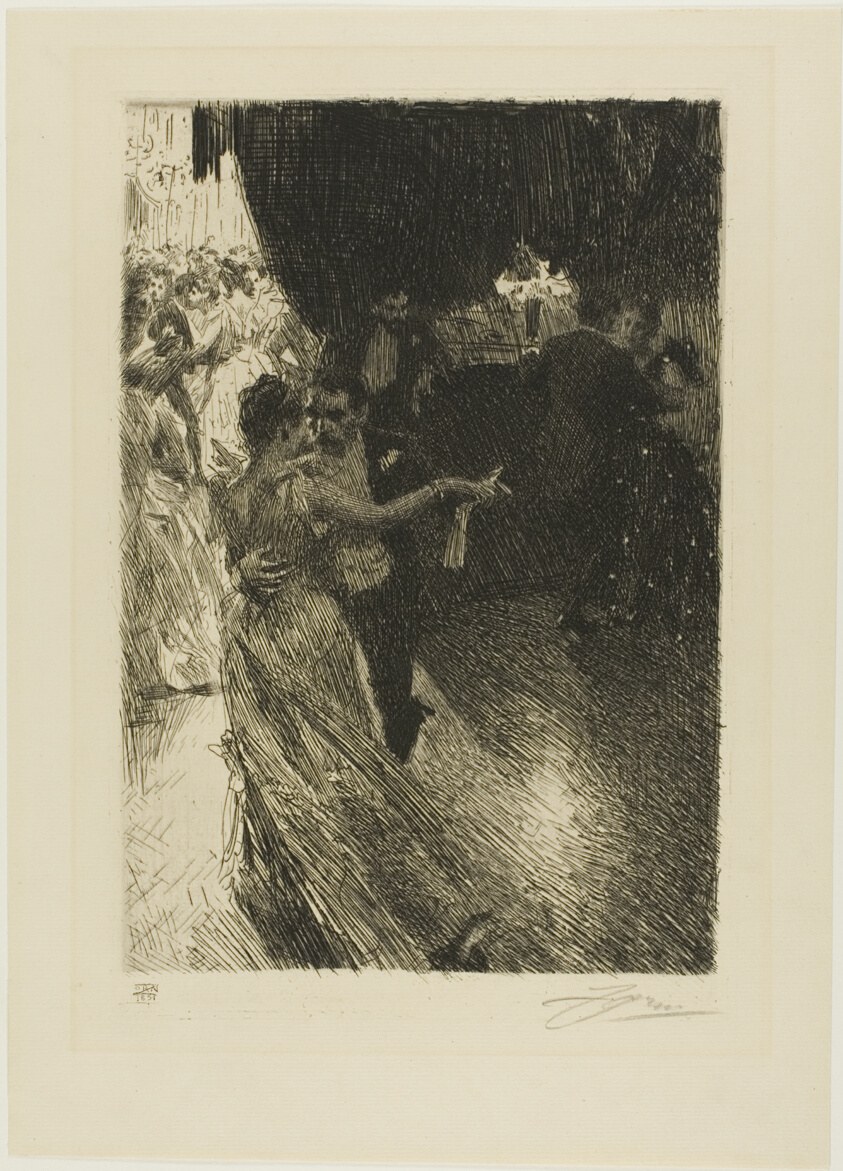
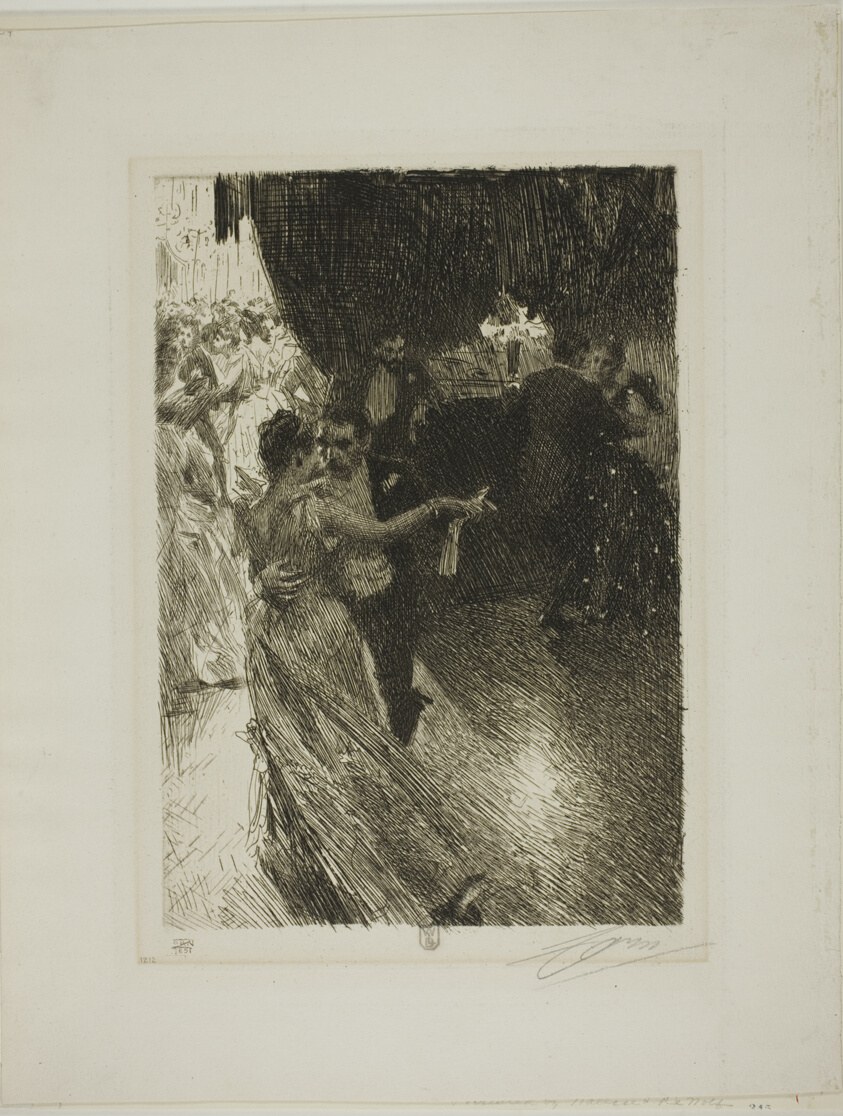
This image is among the finest visual records of how the Romantic waltz was actually performed: the hold, the frame, the body alignment, and the turning action are all rendered with anatomical precision by someone who understood the dance. For historians and dancers studying the waltz tradition, this etching provides concrete evidence of technique and style that written descriptions alone cannot convey. It also testifies to the cultural centrality of social dancing in 19th-century life—the fact that such care and artistic skill were devoted to capturing a moment of the ballroom speaks to how seriously the period regarded the dance.
What you are looking at
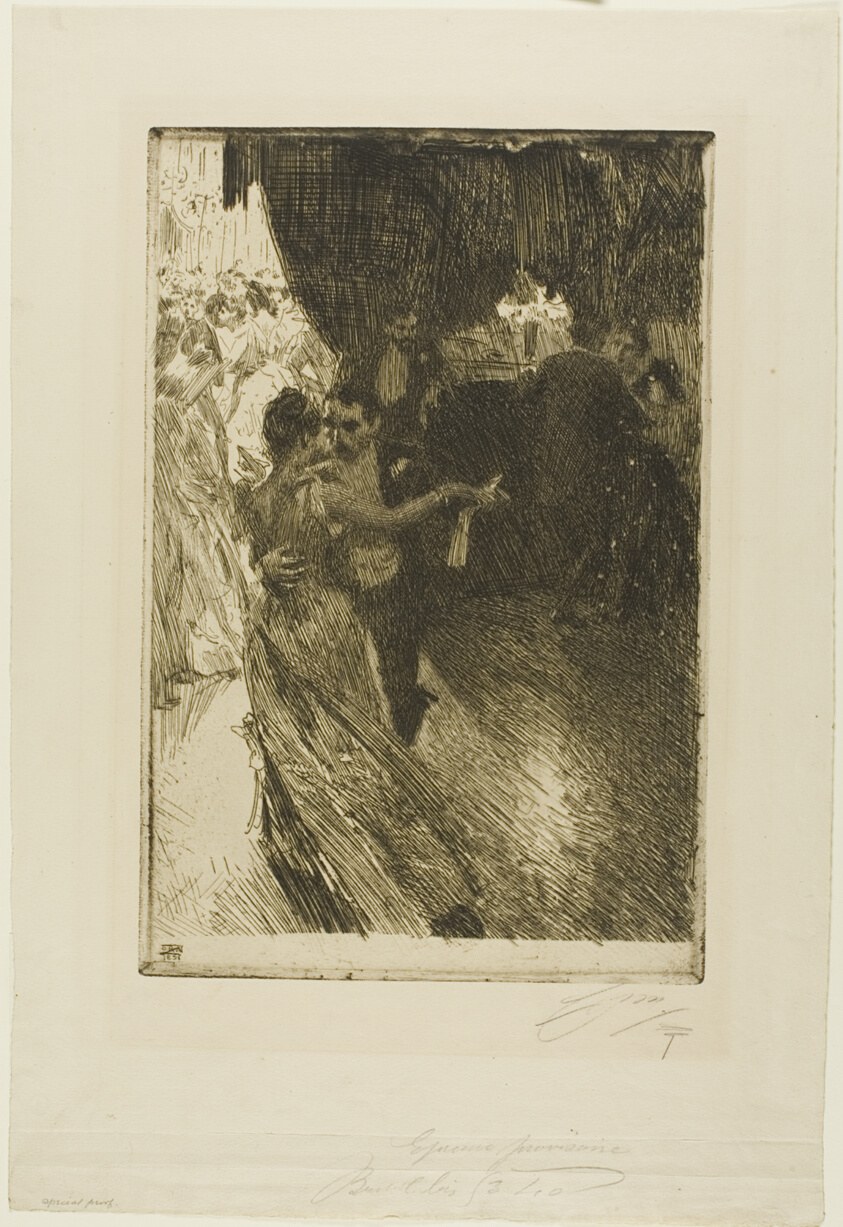
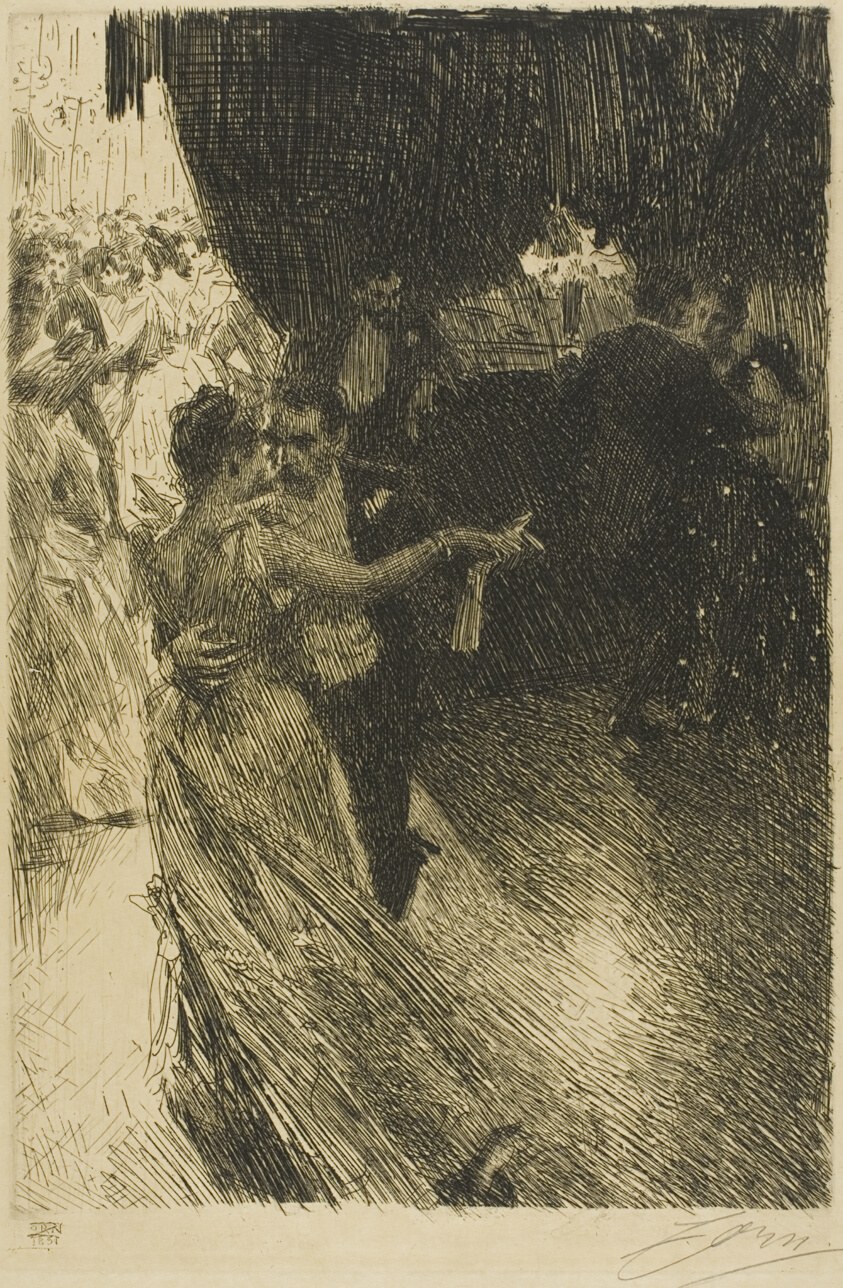
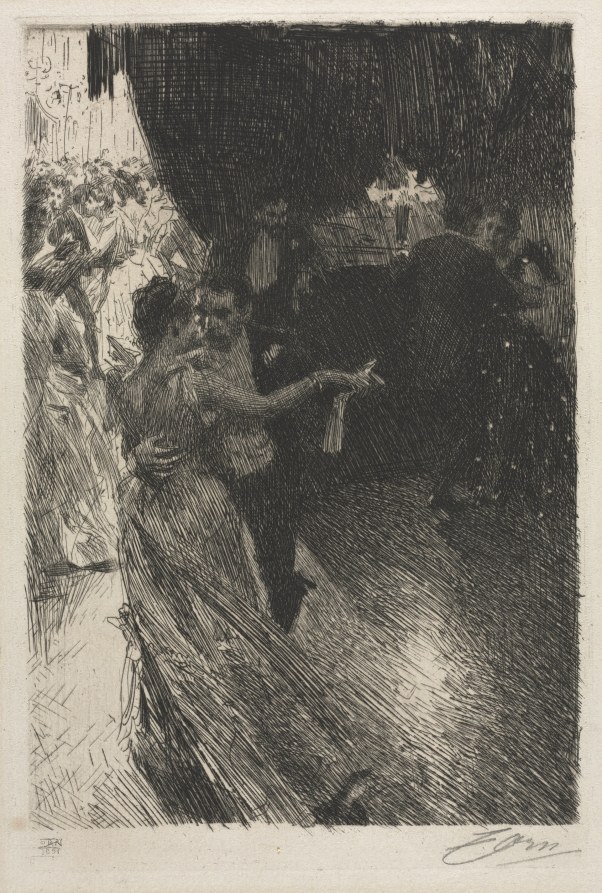
This is an etching depicting an intimate indoor dance scene, rendered in deep shadows and dramatic contrasts. A couple occupies the center of the composition: the woman wears a light-colored dress with full skirt and is held by a man in dark clothing. They are captured mid-waltz, their bodies angled into the turn. The setting appears to be an elegant interior—possibly a ballroom or drawing room—suggested by architectural elements visible on the left (molding, a doorway or alcove) and the gathered onlookers in shadow along the right side of the composition. The lighting is theatrical: the dancing couple glows against the darkness, while spectators remain largely obscured, their forms suggested rather than detailed. The artist has used dense crosshatching to build shadow, creating an atmosphere of evening formality tinged with mystery or intimacy.
The dancing
The couple dances in a closed ballroom hold: the man's right arm supports the woman's back, her left hand rests on his shoulder, and their free hands (his left, her right) are extended at shoulder height. Both figures lean into the turn with their bodies aligned and inclined, weight forward onto the balls of their feet. The woman's skirt swings outward with the momentum of the rotation. Their posture is upright and controlled, knees slightly flexed to absorb the turning motion. The positioning is anatomically precise for a waltz—the hold is correct, the counterbalance is evident, and the frame suggests a dancer who understood the mechanics of the form.
The dance depicted
This is unmistakably a waltz, and almost certainly a Romantic-era waltz from the 19th century. The title confirms this, and every detail of the image supports it: the closed ballroom hold, the turning motion captured mid-spin, the formal evening dress, and the ballroom setting with onlookers. The waltz was the dominant social dance of the 19th century, and this image captures the characteristic intimacy of the form—two dancers in close contact, moving in three-time rhythm—as well as its social context: a formal evening among the educated classes. The artistic rendering emphasizes the private intensity of the dance despite the presence of observers, suggesting the psychological absorption of the dancers in their movement.
How it was made
This is an etching, executed with fine crosshatching and line work to create tonal depth. The technique allowed the artist to render minute detail and atmospheric effect; the accumulation of fine parallel lines builds shadow and creates the dramatic chiaroscuro that gives the scene its emotional charge. Etchings were reproducible, affordable works that circulated widely among educated audiences in the 19th century, making them an ideal medium for scenes of social life. The skill evident in the handling of light and the precision of the figures suggests this is the work of a trained printmaker, though the catalogue record does not identify the artist.
About this work
This etching documents the social waltz as practiced in 19th-century European ballrooms, capturing both its formal technique and its intimate atmosphere. The work belongs to a tradition of dance imagery that treats social dancing as a subject worthy of serious artistic attention—not merely as decoration or background incident, but as the primary subject of the composition. The choice of etching as medium placed this image within the reach of a broad audience, making it a document of how the waltz was understood and valued in its own time. The artist's technical mastery and the psychological depth of the rendering suggest that dance was perceived as a genuine form of human expression, not merely fashionable entertainment.
How to look at it
Observe the hold: the alignment of the bodies, the woman's left arm on the man's shoulder, their right hands extended. Notice how the woman's skirt swings away from her body, indicating the centrifugal force of the rotation—the artist has captured the waltz mid-turn, at the moment of maximum extension. Look at the floor line and the angle of their feet to understand the direction of the movement. The surrounding darkness and the shadowed figures of onlookers frame the couple as if spotlit, creating a sense of intimacy and absorption despite the public setting. The etching technique—the fine lines and crosshatching—creates texture and atmosphere that investing the scene with emotional weight beyond mere documentation.
The period
The waltz rose to dominance across Europe during the early decades of the 19th century, gradually displacing the cotillion and country dance as the primary ballroom dance. By the 1830s-1850s, it was the dance of the ballroom, and a vast body of artistic and literary imagery documented it. The Romantic movement in the arts coincided with the waltz's ascendancy, and both shared an emphasis on feeling, intimacy, and individual expression. In visual art, the ballroom scene became a staple subject for painters and printmakers, who treated it as a vehicle for depicting modern urban life, social interaction, and the psychology of desire and attraction. The dramatic lighting and emotional intensity of this etching reflects Romantic aesthetics: the couple are isolated in their own moment despite the presence of observers, and the shadows suggest depths of feeling that the surface of social ritual cannot fully contain.
Where it lives
The work is held in the Art Institute of Chicago. The catalogue record provides minimal information: the title *The Waltz*, no confirmed artist attribution, no date, and no recording of medium or dimensions. The image itself, however, clearly identifies it as a 19th-century etching of skilled execution.
Dance in this work
Questions about this work
Is this a real scene or an imagined one?
Both. The technique and precision of the figures show that the artist understood actual waltz practice and could have drawn from observed ballroom scenes. But the dramatic lighting, the composition, and the emotional intensity are aesthetic choices—the artist has arranged and interpreted the scene to emphasize its psychological dimension rather than simply documenting it as a snapshot.
How can you tell this is a waltz and not another dance?
The closed ballroom hold—man's right arm around the woman's back, her left arm on his shoulder, their free hands extended—is specific to the waltz (and related dances like the Viennese waltz). The three-beat rhythm of the waltz is visible in the turned position and the swing of the woman's skirt. The title confirms the identification.
What does the presence of onlookers tell us?
The waltz was a ballroom dance, danced at formal evening events in the presence of other guests. The shadowed figures on the right confirm that this is a social context, not a rehearsal or private moment. Yet the composition isolates the dancing couple, suggesting that despite being public, the waltz created a kind of intimate bubble between the partners—a significant aspect of its appeal and its cultural controversy.
More Waltz artwork