29 works in this view — arrow keys or swipe to move between them.
Dance in Art
The Waltz
Anders Zorn
- Dance:
- Waltz
- Source:
- Art Institute of Chicago
- Rights:
- Public domain — free to use, share and adapt.
- Recorded as:
- CC0 (Public Domain)
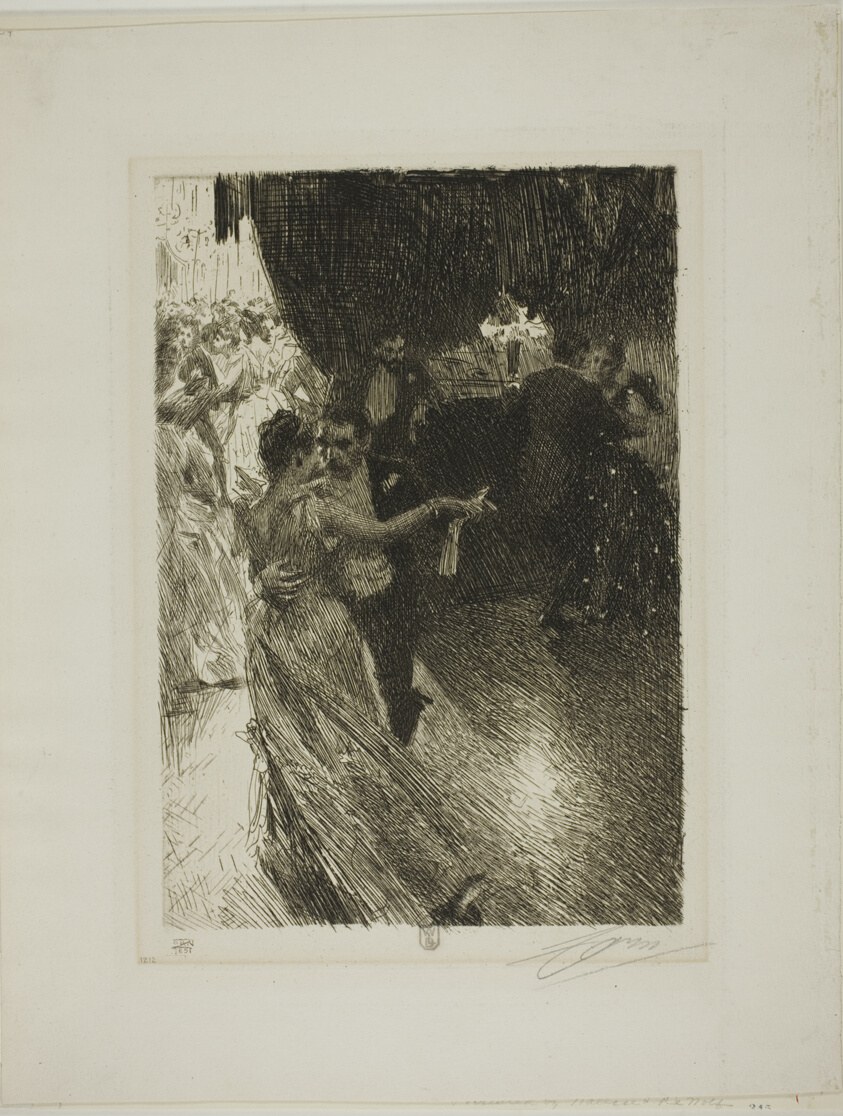
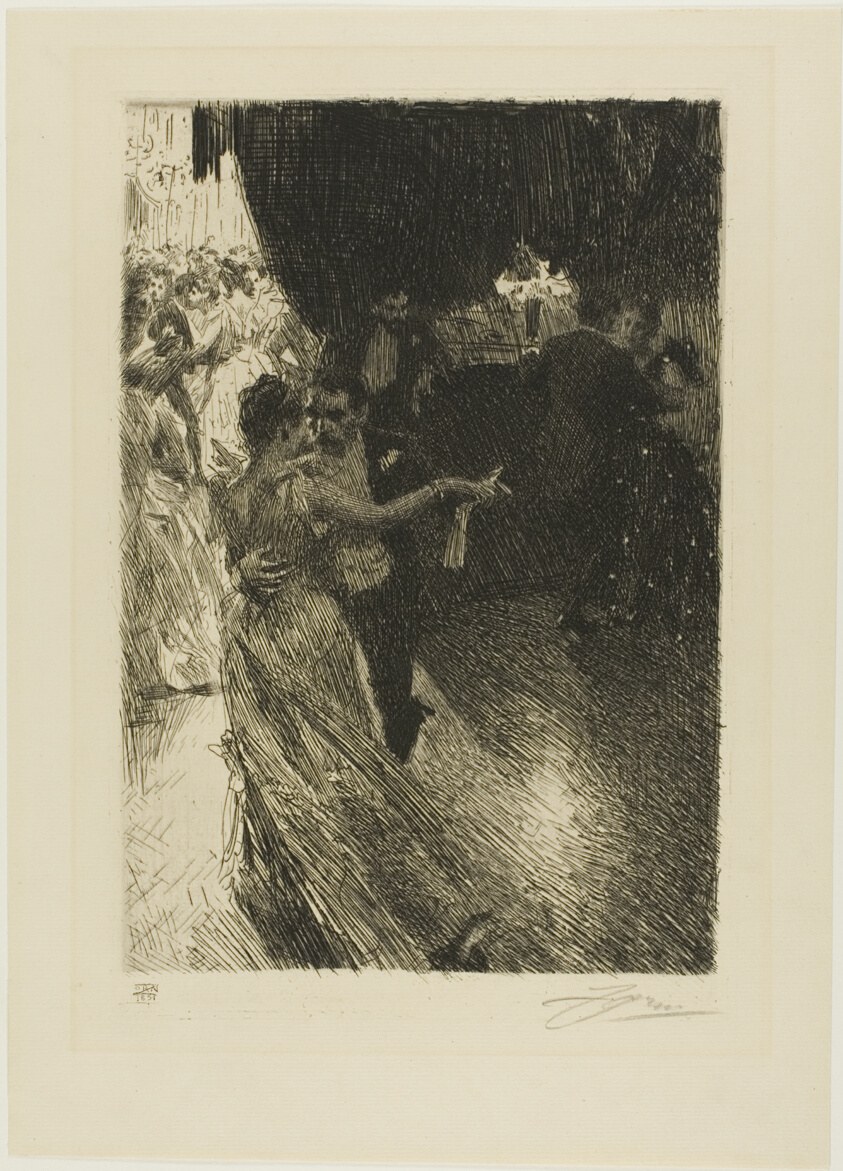
The waltz was one of the most controversial dances of its era, celebrated for its elegance and condemned for its closeness and sensuality. This etching captures that tension visually—the bright, almost ethereal isolation of the couple against the crowd behind them suggests both the dance's power to draw attention and its psychological intensity. For historians and dancers, it documents the actual hold, frame, and formal dress of the waltz at a specific historical moment.
What you are looking at
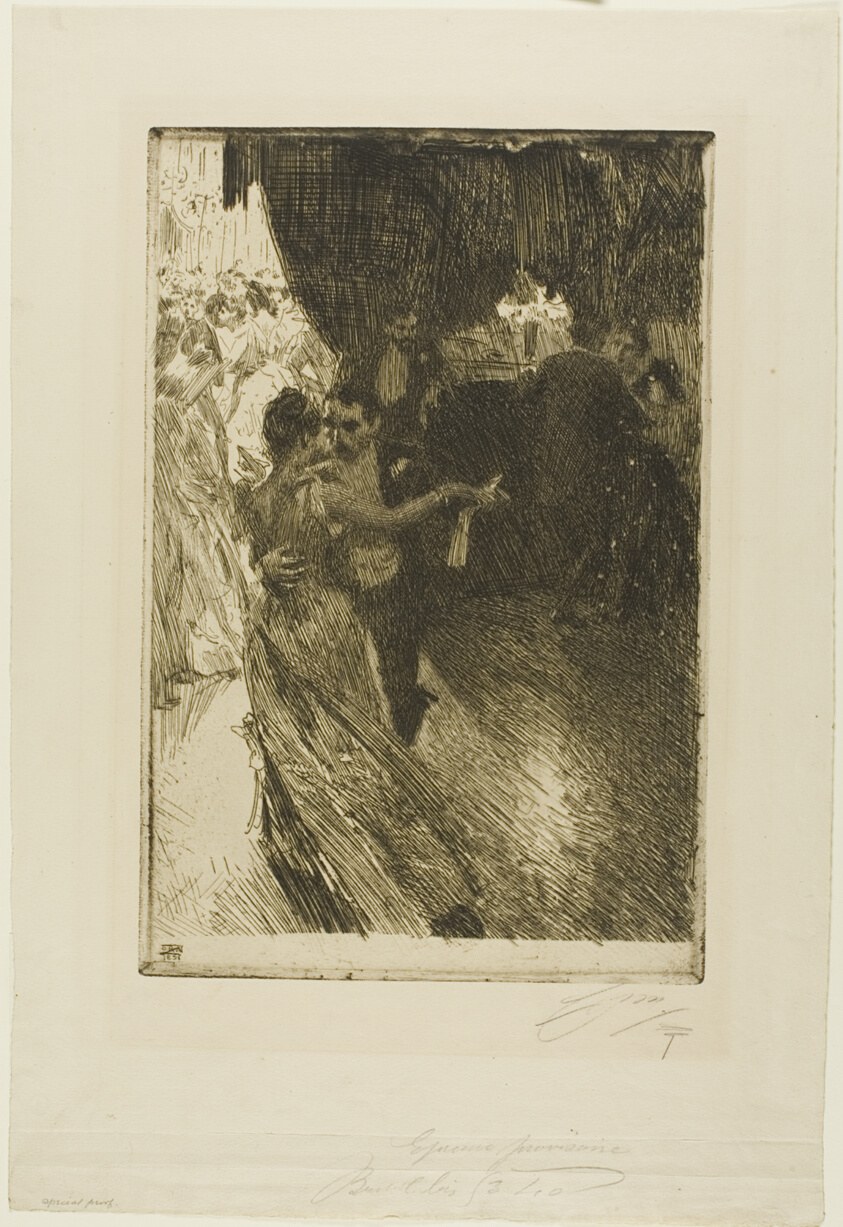
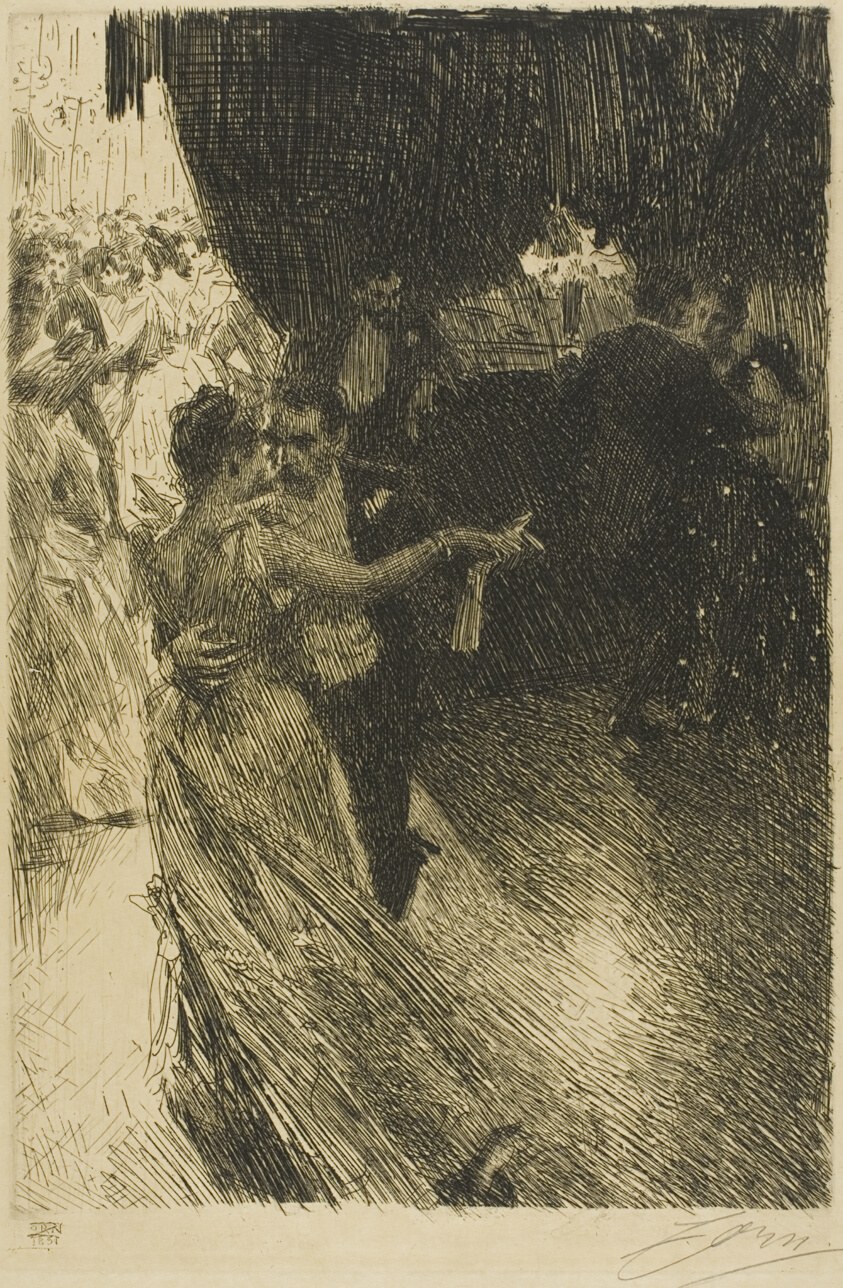
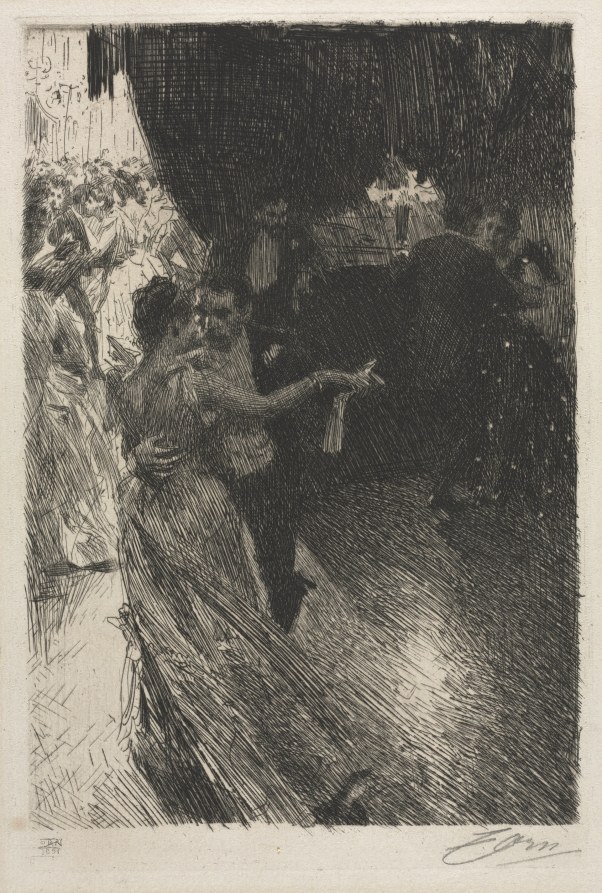
An etching depicting an intimate ballroom scene bathed in deep shadow. A woman in a pale, ornate gown dominates the left foreground, her figure rendered in bright, delicate cross-hatching that contrasts sharply with the darkened interior behind her. She wears what appears to be a corseted dress with elaborate detail at the neckline and possibly jeweled or floral ornamentation in her hair. To her right, a male figure in dark formal dress is visible, his body positioned close to hers in a dancing posture. The background dissolves into dense, almost violent parallel hatching that suggests a crowded ballroom or salon—multiple shadowed heads and shoulders indicate other dancers or spectators, all rendered as dark silhouettes. A chandelier or light fixture is barely discernible at top center. The composition uses extreme contrast between the illuminated woman and the murky surroundings to create an atmosphere of drama and intimacy, isolating the central couple within a sea of shadow.
The dancing
The woman and man are positioned in a closed ballroom hold, with the woman's body angled slightly forward and her skirt suggested by flowing contours. The man's dark form is pressed close, his posture upright and formal. Neither figure shows a clear leg extension or distinctive footwork detail, but their relative positioning and frame are consistent with a standing partner dance of the 19th century. The woman's posture suggests she is being led; her weight appears settled rather than dynamic.
The dance depicted
This is a waltz, as confirmed by the title and the formal closed partnering hold typical of the dance. The image captures the early-to-mid 19th century ballroom waltz in its height of social popularity. The composition emphasizes the intimacy and slight scandal the waltz carried—its closeness of hold and the bodies' proximity were remarkable for the period. The choice to isolate the dancers in light against shadow may reflect both the dance's prominence as a focal point of social life and the artist's interest in the psychological or romantic dimension of the moment.
How it was made
This is an etching, recognizable from the fine parallel lines (hatching and cross-hatching) used to build tone and shadow, and the white of the paper itself left to read as highlight. The technique allows precise control of tonal gradation and an extremely fine linear quality that engraving cannot achieve so flexibly. The dense, almost aggressive hatching in the background is a hallmark of etching's capability to render deep shadow with expressive energy. This is a work intended for circulation among educated viewers—etchings were collected, exhibited, and valued as high art, particularly in Europe, and the level of finish here suggests a completed independent work rather than a study.
About this work
This is a 19th-century etching of a waltz couple in a ballroom setting. The work captures the dance at the height of its social currency and cultural significance. The artist employs extreme chiaroscuro—brilliant light on the woman's figure against deep shadow in the surrounding room—to create dramatic focus and to suggest the waltz's dual nature: a moment of brilliant social display and intimate partnering. The image belongs in a dance gallery both as documentary evidence of waltz practice and costume, and as an artistic meditation on how the dance was perceived and experienced.
How to look at it
Attend first to the contrast: the woman's glowing, intricate dress and composed face against the void of shadow behind her. This contrast is not merely technical but thematic—it isolates the dance from its social context. Notice the formal posture of both figures and the closed, embraced frame they maintain. The artist has chosen a moment of stasis rather than motion, which gives the image an almost suspended quality, as if pausing between steps. The parallel lines filling the background are not merely a rendering technique but an active compositional choice that expresses the density, heat, and chaos of the ballroom itself.
The artist
The artist is not recorded in the catalogue, which limits attribution. However, the technique, subject matter, and finish suggest a professional European artist working in the 19th century, likely someone engaged with ballroom and society subjects. The confident handling of the etching needle and the sophisticated compositional choice indicate trained practice.
The period
The waltz emerged as a popular ballroom dance in Austria and Germany in the early 19th century and spread rapidly across Europe by the 1820s and beyond. It was initially controversial—moralists objected to the closed hold and the couple's relative closeness—but it became the dominant couple dance of the era. In visual culture, waltz scenes appeared frequently in prints, paintings, and later photographs, reflecting both its ubiquity and its cultural cachet. The 19th century saw etching and lithography flourish as media for documenting and celebrating social life, and ballroom subjects were popular among both artists and collectors.
Where it lives
The work is recorded in the Art Institute of Chicago's collection, sourced from the AIC database. It remains undated and unattributed in the catalogue record, suggesting either incomplete documentation or an acquisition without full provenance information.
Dance in this work
Questions about this work
How do we know this is a waltz and not another ballroom dance?
The title is recorded as 'The Waltz,' and the visual evidence supports it: the closed hold with the man's right hand at the woman's back and their bodies in intimate proximity is characteristic of waltz technique. The formal costume and salon setting are also consistent with 19th-century ballroom waltz culture.
Why is the couple so isolated in light while everything else is dark?
This is an artistic choice reflecting the waltz's dual significance: it is simultaneously a brilliant social display (the woman's ornate dress and the couple's formal beauty) and a private, intimate moment (the enclosure of their hold and the murk around them). The contrast also creates visual drama and draws focus.
What does the dress tell us about when this was made?
The woman's gown, with its fitted corseted bodice, full skirt, and ornate neckline and hair decoration, is consistent with 19th-century ball gown fashion, likely mid-to-late 19th century based on the silhouette and detail. The man's dark tailcoat and formal attire are standard ballroom dress of the same period.
More Waltz artwork