39 works in this view — arrow keys or swipe to move between them.
Dance in Art · 2019
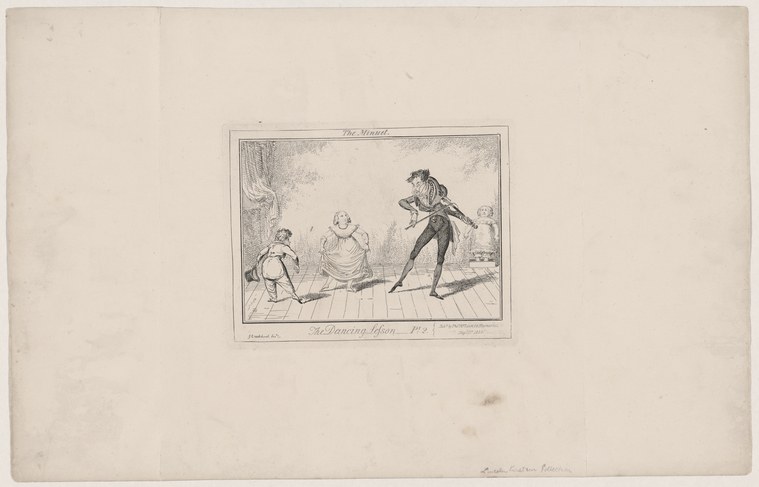
The dancing lesson, pt. 2, the minuet
Unknown artist
- Medium:
- Engraving
- Dance:
- Minuet
- Era:
- 1700s (Enlightenment/Minuet Era)
- Source:
- New York Public Library
- Rights:
- Public domain — free to use, share and adapt.
- Recorded as:
- public_domain
This image is rare visual evidence of how the minuet—often discussed only through notation systems and written manuals—was actually transmitted from master to student in 18th-century society. It shows the minuet not as a finished product but as an object of instruction, revealing the deliberation and hierarchy embedded in one of history's most formal social dances. For anyone studying the minuet or the culture of courtly dance pedagogy, this is primary documentary evidence.
What you are looking at
An engraving depicting the instruction or demonstration of minuet dancing in an interior setting, likely a drawing room or ballroom. A dancing master, identifiable by his prominent position and gestural authority, instructs or performs alongside his pupils. The scene captures the formality and geometry of 18th-century courtly dance instruction: a woman in a full skirt stands at the center-left, while a second figure (possibly male, wearing formal dress) demonstrates or waits his turn. A child or young student crouches or bends at the lower left, apparently learning the foot positions from observation. The setting is rendered in light wash with architectural elements (pilasters or curtains) suggesting an elegant interior. The composition emphasizes the hierarchical relationship between instructor and learner, with the dancing master's animated posture and extended arm creating the focal point of instruction.
The dancing
Four figures of varying heights are deployed across the composition. The central woman stands upright in a formal court dress with a full skirt, her posture erect and composed. The dancing master is shown in profile or three-quarter view, one arm raised in didactic gesture, his body angled to address the pupils. A second adult figure stands passively, apparently awaiting instruction or demonstrating completed form. The young pupil at lower left is captured in a study position—bending or crouching to observe foot placement—a posture that emphasizes the pedagogical purpose. The holds are formal and at distance; there is no contact dance or social pairing, only the vertical alignment typical of master-student demonstration.
The dance depicted
This is unambiguously a minuet lesson. The title identifies it explicitly, and the formal dress, interior setting, and hierarchical teaching structure confirm this as documentation of aristocratic dance instruction in the 18th century. The minuet was the dominant social and court dance of the period, and formal instruction from a professional dancing master was the norm for anyone of rank. The image captures the pedagogical moment—not the dance itself performed in society, but the careful breakdown of step and carriage that made the minuet achievable. The attention to the child's foot position suggests the artist understood the minuet's emphasis on precise placement and the formality of its learning process.
How it was made
This is an engraving, a technique that allowed multiple copies to circulate among the educated classes. Engravings of dance instruction were common in 18th-century instructional manuals and periodicals, making this work part of a broader documentary tradition about courtly behavior. The medium's line-based language captures gesture and posture with clarity while remaining economical—the light wash adds depth without overwhelming the structural clarity of the figures. The technique permitted this image to be widely distributed and republished, making it a functional document of social practice as well as a record of artistic observation.
About this work
This engraving is part of a two-part instructional series on the minuet, the paramount social dance of the 18th-century European aristocracy. It documents not the minuet in performance but the moment of its teaching—the relationship between master and student, the careful construction of formal posture and footwork, and the child's observation of the fundamental positions. The work sits within a long tradition of dance instruction manuals, where images served to reinforce written descriptions of steps and carriage. It is a portrait of pedagogy as much as of dance, capturing the social fact that the minuet was something one learned, formally and from authority, rather than something one simply did.
How to look at it
Attend to the dancing master's gesture—the raised arm is not decorative but instructional, indicating weight transfer or the timing of a turn. The woman's posture is the ideal being transmitted: upright, composed, the skirt arranged to show the movement of the legs beneath. Most tellingly, watch the position of the crouching child, who is examining the master's feet. This is the pedagogical heart of the image: the minuet's elegance lay partly in footwork that was not visibly spectacular but had to be precisely placed. The artist has captured the moment in which formal dance becomes teachable—broken down into positions that a student can see, repeat, and eventually embody without thought.
The period
The minuet dominated European court and aristocratic ballroom culture from the early 18th century through the 1760s–1780s. It was the dance of choice for formal occasions and the primary subject of dancing masters' instruction. This period saw a flourishing of published dance instruction materials—both written treatises with engraved notation and illustrated manuals showing posture and deportment. The minuet's complexity (its specific rhythm, the precise positions of the feet, and the careful spatial geometry of its performance) made professional instruction essential for anyone aspiring to move in polite society. Engravings of such scenes served both as instructional aids and as records of social aspiration—they documented the training by which one became truly genteel.
Where it lives
This engraving is held in the New York Public Library collection. It is the second part of a two-part instructional series on the minuet, suggesting it was part of a larger pedagogical or documentary publication. The catalogue identifies it as part of the "Dancing lesson" series, part 2.
Dance in this work
Questions about this work
What is a minuet?
The minuet was the dominant social and court dance of the 18th century, performed by aristocrats at formal occasions. It is a triple-meter dance characterized by elegant posture, precise footwork, and a formal geometric spacing between partners. It required instruction and was a mark of genteel breeding; one learned it from a dancing master, as shown in this image.
Why would someone need formal instruction in the minuet?
The minuet's apparent simplicity concealed considerable technical precision. The positions of the feet, the timing of the weight shifts, and the carriage of the body all had to conform to an exacting standard. Professional dancing masters made their living teaching aristocrats how to move correctly—badly executed minuet was a visible sign of insufficient breeding or insufficient instruction.
Why is the child crouching down?
The child is observing the master's feet to learn the positions and footwork of the minuet. Since much of the minuet's technique lies in precise foot placement beneath the skirts, direct observation of foot position was essential to learning. This image captures an actual pedagogical moment—learning by watching and imitation.
Is this from a dance manual?
Very likely. The formal compositional structure, the didactic framing, and the existence of a companion image (part 1 of the series) suggest this was part of a larger instructional publication. Such illustrated manuals were common in the 18th century and served as supplements to written step notation.
More Minuet artwork