39 works in this view — arrow keys or swipe to move between them.
Dance in Art · 2019
Polka and mazurka
Unknown artist
- Medium:
- Lithograph
- Dance:
- Polka
- Era:
- Late 1800s (Victorian Ballroom)
- Source:
- New York Public Library
- Rights:
- Public domain — free to use, share and adapt.
- Recorded as:
- public_domain
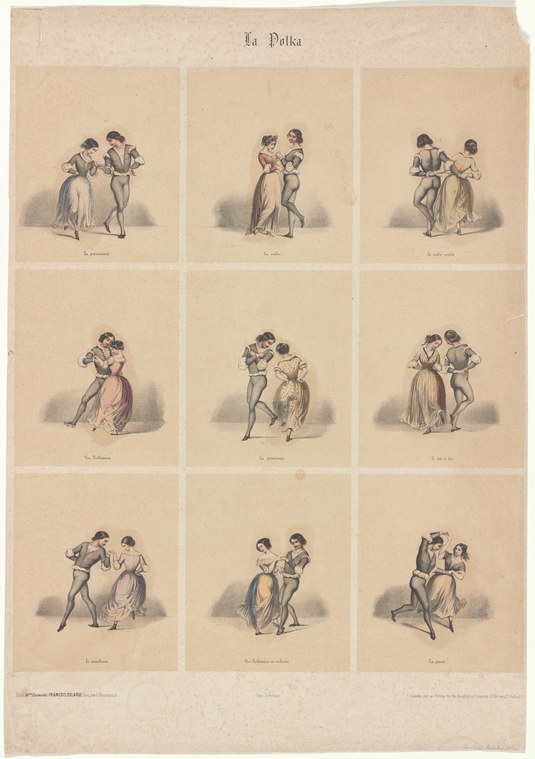
For historians of dance pedagogy, this work is a rare visual record of how ballroom technique was actually taught and understood in the Victorian era—not through notation or prose description, but through carefully observed figure studies that prioritize anatomical clarity and technical accuracy. For dancers, it reveals how the polka and mazurka were conceptualized as decomposable sequences of discrete movements rather than continuous, flowing action; the freeze-frame approach was itself a teaching method.
What you are looking at
A lithograph presented as a grid of nine panels, each illustrating a different figure or couple engaged in the polka and mazurka. The composition is arranged in three rows of three, with French captions beneath each vignette identifying the step or moment. The figures wear the formal dress of the Victorian ballroom era: women in full skirts with corseted waists, and men in dark tailcoats and trousers. Each panel isolates a specific technical moment—a promenade, a turn, a pivot—freezing the dancers mid-gesture against a plain background with subtle shading to suggest depth. The lithographic technique renders the figures with delicate line work, particularly in the folds of fabric and the definition of limbs, while the bodies are rendered with anatomical attention to weight distribution and posture. The overall effect is pedagogical: this is an instructional manual rendered as art, teaching the viewer through sequential visual demonstration rather than narrative.
The dancing
The couples and individual figures display formal ballroom holds: closed position with the man's right hand on the woman's back and her left hand resting on his shoulder, their free hands clasped at shoulder height. The frames are upright and controlled, with bodies angled rather than directly facing forward, suggesting the characteristic side-by-side orientation of these dances. The women's weight appears placed on the balls of the feet, with skirts depicted mid-swirl to indicate rotational movement. Footwork is suggested through the positioning of the legs and the angle of the body's lean, though the exact floor patterns cannot be determined from these static images. The men's posture is attentive and leading; the women's carriage is poised and responsive.
The dance depicted
This work illustrates the polka and mazurka, two of the most popular ballroom dances of the nineteenth century. The polka is a lively couple dance in duple meter (2/4), characterized by quick bouncing steps and rotational movement; the mazurka is a Polish national dance in triple meter (3/4) with more emphatic accents and a distinctive hop or pause. Both were danced in the Victorian ballroom as part of the same social repertoire, and both required formal partnering in closed position. The sequential panels demonstrate the technical progression of steps and figures that a dancer would master, making this a visual dance curriculum. The French captions suggest this was published for a French or francophone audience, where these dances were equally fashionable.
How it was made
This is a hand-coloured lithograph, a print technique that allowed for mass production of instructional materials while retaining the fluidity and sensitivity of drawn line. Lithography's ability to capture fine detail—the pleats of fabric, the curve of an arm, the expression of concentration—made it ideal for dance instruction, where precision of form was essential to understanding technique. The hand-colouring (visible in the flesh tones and the pale washes of fabric) suggests this was a relatively expensive production aimed at the dancing public who could afford formal instruction. The technique allowed for wide distribution of standardized technical information, democratizing access to the steps that were otherwise taught through private lessons or in the ballroom itself.
About this work
This lithograph is a visual dance manual from the late nineteenth century, presenting nine sequential studies of the polka and mazurka in formal ballroom dress and posture. Rather than depicting a single moment of social pleasure or theatrical spectacle, it functions as a pedagogical tool: each panel isolates and demonstrates a specific technical element—a step, a turn, a hold—that a student would need to master. The work belongs to a significant genre of nineteenth-century dance instruction materials that combined visual art with practical utility, making the increasingly codified ballroom dances accessible to the growing middle class. It documents a moment when ballroom dancing was becoming both more standardized and more widely taught, reflected in the proliferation of such instructional prints across Europe and America.
How to look at it
Observe how the artist uses the grid format to isolate each moment: the composition emphasizes that ballroom dancing is built from repeatable, teachable components. Notice the subtle differences in body angle and limb position from one panel to the next—these small shifts convey the progression of a single figure or the variation of technique. The clarity of the outlines and the consistent rendering of the hold across all panels reinforces the standardization of ballroom form. The formal dress—the woman's full skirt, the man's tailcoat—is not decorative but functional, as these garments were part of the visible technique; the skirt's swirl indicates rotation, the upright posture of the tailcoat suggests the ballroom frame.
The period
The polka and mazurka dominated European ballroom culture from the 1840s onward, arriving in Western Europe from Poland and Bohemia respectively and becoming status symbols of fashionable society. By the Victorian era, they were taught through an expanding industry of dancing masters, instruction books, and visual materials. This print belongs to the mid-to-late nineteenth century's explosion of instructional lithographs: the same period saw the publication of elaborate dance notation systems (Zorn, Stepanov), gymnastics manuals, and movement studies. The scientific illustration of human movement was becoming fashionable in art and pedagogy alike, as evidenced by works like Eadweard Muybridge's photographic studies (which began in 1872). This lithograph sits at the intersection of that documentary impulse and the practical needs of a ballroom-dancing public.
Where it lives
This lithograph is held in the New York Public Library collection. It appears to be part of a broader nineteenth-century corpus of dance instruction materials, likely published in French and distributed internationally to teachers and serious amateur dancers.
Dance in this work
Questions about this work
What is the difference between the polka and the mazurka?
The polka is a quick, bouncy couple dance in 2/4 time, originating in Bohemia and characterized by rapid rotational movement. The mazurka is a stately Polish dance in 3/4 time with more pronounced accents and a distinctive hop or pause. Both were taught as part of the standard Victorian ballroom repertoire, and this print demonstrates their distinct technical features through the positioning and frame of the dancers.
How was ballroom dancing taught in the Victorian era?
Ballroom dancing was taught through a combination of private lessons with dancing masters, group classes, and published instructional materials like this lithograph. Students would learn the fundamental steps and holds, then progress to more complex figures. Visual instruction materials like this one were crucial, as they allowed teachers to show the proper position and frame at a glance, and students could study them at home between lessons.
Why are there captions in French?
French was the language of ballroom dancing and social etiquette across Europe during the nineteenth century. French dancing masters set the standard for technique, and dance terminology was largely French. A print with French captions would have circulated among educated, cosmopolitan dancers throughout Europe and beyond.
Is this a single dance or two different dances?
The title indicates both polka and mazurka, and the panels likely alternate or group the two dances. The polka's quicker, bouncing character and the mazurka's more stately, accented rhythm are conveyed through the subtly different body positions and frames shown in the various panels, allowing the student to understand both dances within a single instructional format.
More Polka artwork