38 works in this view — arrow keys or swipe to move between them.
Dance in Art · 2019
Polka and mazurka
Unknown artist
- Medium:
- Lithograph
- Dance:
- Polka
- Era:
- Late 1800s (Victorian Ballroom)
- Source:
- New York Public Library
- Rights:
- Public domain — free to use, share and adapt.
- Recorded as:
- public_domain
This is one of the clearest visual records of how polka and mazurka were actually performed and understood in the mid-19th-century ballroom. The lithographic medium preserved the specifics of hold, frame, and carriage in a way that a written description could not. For dance historians and practitioners, it offers concrete evidence of technique, fashion, and the theatrical character these dances had acquired by the 1860s–70s.
What you are looking at
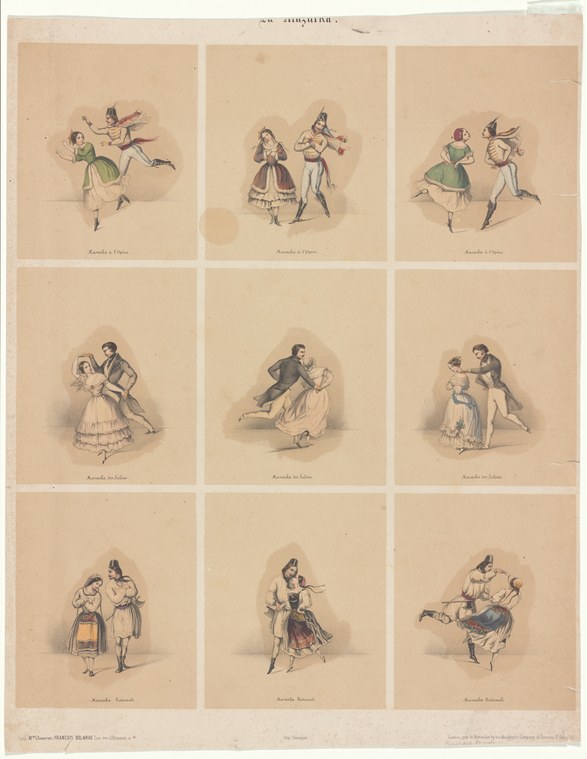
A grid of nine lithographic vignettes, each showing a couple dancing in mid-Victorian dress and style. The compositions are intimate and theatrical, isolating each pair against a plain background with light wash shading to suggest depth. The dancers wear the crinolined skirts and tailored jackets typical of 1860s–1870s ballroom fashion. Each vignette captures a distinct moment or figure type: some show couples in closed embrace mid-turn, others depict more playful or exaggerated poses—one woman's leg extended high, a man in profile executing a dramatic leap. The lithographic line is confident and economical, capturing the silhouette and gesture of the figures with particular attention to the tilt of the torso and the sweep of the skirt. The overall effect is documentary yet stylized, suggesting these are instructional studies or fashionable types rather than a narrative sequence.
The dancing
Each vignette presents one couple. The hold varies: some pairs stand in closed ballroom position with the man's arm at the woman's waist and hands joined; others are more loosely coupled or show the woman in a tilted, off-balance attitude suggesting mid-rotation. The woman's torso frequently leans away from vertical, her skirt bellying out centrifugally. The man's frame is usually upright and controlled, one arm extended to partner. Footwork is suggested rather than explicit, but weight appears to be traveling and the poses capture the suspended or rotational moment rather than a static stance. The proportions and articulation of the limbs show the artist understood ballroom carriage—the elongated line, the squared shoulders, the way the couple's bodies occupy space.
The dance depicted
The title names polka and mazurka, both social dances of the mid-to-late 19th century. The polka—a lively, springing couple dance in 2/4 time—would account for the dynamic, off-balance poses and the high leg action visible in some vignettes. The mazurka—a stately Polish dance in triple meter with characteristic hop, step, and turn figures—is more difficult to distinguish in still poses. The composition suggests these are 'types' or instructional demonstrations rather than a unified narrative: each vignette may represent a different figure, variation, or style of execution within these dances. The fashionable dress and the playful, theatrical exaggeration of some poses suggest these were aimed at a literate, urbane audience familiar with ballroom dancing as both social practice and entertainment.
How it was made
A lithograph, a process that allowed rapid printing and wide circulation. The artist drew directly onto a stone surface, exploiting lithography's capacity for fluid, expressive line and subtle tonal gradations in the wash. This technique was ideal for fashion and dance instruction materials in the 19th century: it could reproduce fine detail in the dress while maintaining the freshness of a sketch. The paper is cream or tan, characteristic of period lithographic stock. The title and notations appear in a copperplate hand at the foot, suggesting this was a commercial publication, possibly from a dance manual, fashion journal, or entertainment broadside.
About this work
This is a mid-Victorian lithographic suite of nine dance vignettes presenting polka and mazurka as fashionable couple dances. Each small composition isolates a pair in a moment of articulate, often exaggerated movement, rendered in a confident, economical line and light wash. The work belongs to a substantial body of 19th-century dance instruction and fashion imagery aimed at the urban ballroom public—it documents how these dances were taught, performed, and imagined. The New York Public Library's holding suggests it circulated as a popular print, not a rare fine-art object.
The vignettes serve multiple purposes: they function as instructional studies (showing different figures or variations), as fashion plates (documenting the silhouette and dress of the era), and as entertainment (the exaggerated poses and theatrical framing suggest wit and knowingness). The series treats polka and mazurka not as ethnic or historical curiosities but as contemporary, metropolitan pleasures—dances that mattered to the urban middle class who would have bought, studied, or simply enjoyed this print.
How to look at it
Attend to the variety of poses: some vignettes capture the rotational moment (the woman's body tilted, the skirt flying), others show a preparatory or transitional figure, and a few appear to present exaggerated or comic types. Notice how the artist has differentiated the couples—some are intimate and graceful, others almost acrobatic. The repetition of the format (nine equal vignettes) suggests a taxonomic or instructional intention, as if the suite were meant to teach or display the repertoire of figures. Compare the hold and frame between different pairs: you will see that the artist understood the distinction between a waltz (closed, rotational) and a polka or mazurka (more varied in frame, with more emphasis on traveling steps and figures). The slight caricature in some poses—the exaggerated tilt, the high kick—suggests this was not meant to be a dry instruction manual but a witty, fashionable entertainment.
The period
The polka and mazurka were among the most popular social dances of the mid-to-late 19th century in Europe and North America. The polka, which emerged in Bohemia in the 1830s, spread rapidly and became a symbol of modernity and democratic sociability—it required no aristocratic training and could be danced by any fashionable couple. The mazurka, a Polish national dance, was elevated to ballroom status and became a vehicle for romantic expression and national identity. Both dances coexisted with the waltz in the ballroom repertoire, and all three were subjects of endless instruction manuals, music, and imagery. By the time this lithograph was made, polka and mazurka had become standardized, codified dances with recognized figures and variations—they were taught, demonstrated, and merchandised as commodities. The lavish crinolined dress and the urbane, slightly knowing tone of this print locate it squarely in the mid-Victorian period (1850s–1870s) when ballroom dancing was at its height as both social practice and commercial entertainment.
Where it lives
From the New York Public Library collection. This is a commercial lithograph, likely from the 1860s–1870s, produced for a broad urban audience. It was the kind of print sold as a stand-alone sheet, bound into instruction manuals, or distributed in fashion and entertainment periodicals.
Dance in this work
Questions about this work
What are the differences between the polka and mazurka as shown here?
The polka is a fast, springing couple dance in duple meter (2/4), known for its traveling steps and energetic bounce. The mazurka is a slower, stately Polish dance in triple meter (3/4) with characteristic figures like the hop and the characteristic side-step. In this print, the polka vignettes tend to show more dynamic, off-balance poses and higher leg action, while the mazurka poses are more upright and measured, though the still image makes the distinction subtle. Both were danced in closed or semi-closed ballroom position, which is what you see throughout.
Who would have used or owned a print like this?
Dance teachers, ballroom students, fashion-conscious young people, and anyone interested in keeping up with ballroom trends. The print could be purchased as a stand-alone entertainment, pasted into a scrapbook, or bound into an instruction manual. It also functioned as a fashion plate—showing the latest in dress silhouettes and deportment. The New York Public Library's holding suggests it was common enough to be collected and preserved as part of the public record of popular culture.
Why is the artist unknown?
Commercial lithographs were often published without attribution to the artist. The designer, lithographer, and publisher might be different people, and only the publisher's name and address (if any) appeared on the stone. Unless the work was signed in the image itself or documented in the publisher's records—which are often lost—the maker remains anonymous. This does not diminish the value of the work; it simply reflects the conventions of 19th-century commercial printing.
More Polka artwork