49 works in this view — arrow keys or swipe to move between them.
Dance in Art
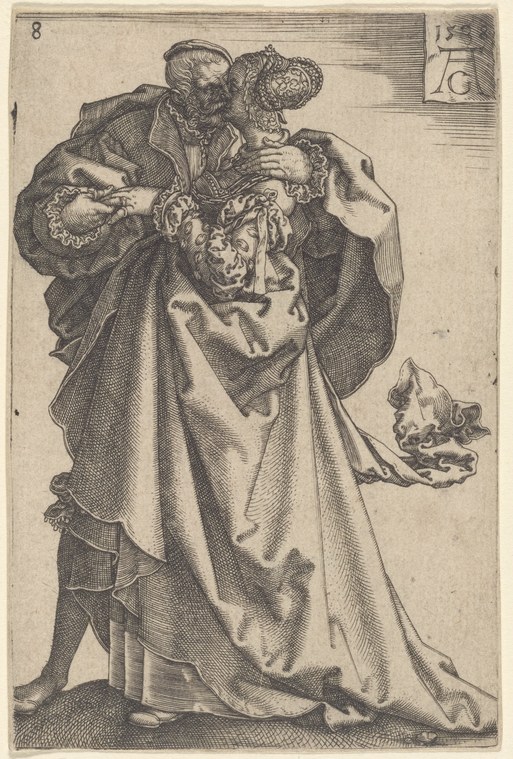
Dancing Couple
Unknown artist
- Source:
- New York Public Library
- Rights:
- Public domain — free to use, share and adapt.
- Recorded as:
- public_domain
This image is primary evidence for how courtly dance was performed and understood in the Renaissance and Baroque—not as continuous movement but as a series of posed, held positions interspersed with figures and traveling steps. It also documents the visual construction of gender and courtship in the dance: the male frame and initiative, the female display and consent, the mutual regard. For dancers and historians, it offers a rare window into how dance was taught and circulated before the invention of notation systems like Beauchamp-Feuillet.
What you are looking at
An engraved couple occupies the center of the composition in a formal pose that reads as both intimate and performative. The man, wearing a dark doublet and hose with a feathered hat, stands behind and slightly to the side of the woman, his arm encircling her waist in a protective or possessive gesture. The woman wears a voluminous gown with layered skirts and a fitted bodice, her hair elaborately dressed, her body angled to present herself to the viewer even as she acknowledges her partner. The setting is undefined—blank background—which focuses all attention on the figures and their relationship. The engraving's fine parallel lines create volume and shadow, particularly in the deep folds of the woman's skirts and the rich texture of the man's cloak. This is not a moment of vigorous movement but a posed presentation, the kind of formalized display that courtship and social dancing required of the nobility.
The dancing
The man's frame is upright and commanding, his extended arm pulling the woman against his side in a closed-position hold. The woman's weight appears shifted into her partner, her torso turned toward him while her face and eyes engage the viewer. There is no suggestion of footwork in progress—this is a stillness, a held position. The spatial relationship and the man's proprietary arm placement suggest paired dancing, but the engraver has chosen the moment of rest or display rather than movement. The formality of the pose, the symmetry of the composition despite the offset figures, and the attention to courtly dress all indicate this depicts social dancing of rank and ritual rather than folk or popular movement.
The dance depicted
This appears to be a courtly dance from the Renaissance or early Baroque period—most likely a pavane, galliard, or other patterned court dance in which couples displayed themselves formally before moving into figures. The absence of footwork detail and the emphasis on the embrace and mutual regard of the partners are consistent with the presentational character of such dances, which were as much about displaying rank, costume, and courtship as about movement. The woman's elaborate dress and the man's finery place this firmly in a noble context. The image documents the visual grammar of courtship through dance in the period: proximity, the male frame, the woman's consent and visibility, the stillness between movements.
How it was made
This is an engraving, executed in fine parallel lines (hatching and cross-hatching) to create tonal variation and form. The technique allows for precise detail in the costume—the feathering of the hat, the embroidery or pattern-work on the doublet, the construction of the sleeves—and for the subtle modeling of the bodies beneath the cloth. Engravings were reproductive works, printed from a copper plate and capable of wide circulation; this would have reached educated and courtly audiences across Europe. The presence of what appears to be a catalogue or inventory number ('8' at upper left, possibly '16' or another mark at upper right) suggests this was part of a series or portfolio—likely a set of model figures or dance types meant for instruction or reference.
About this work
This is a formal engraved study of a courtly couple in a dance pose, likely from a European court dance manual or series of model figures from the Renaissance or early Baroque period. The work documents both the movement grammar and the visual presentation of noble courtship through dance: the closed-position hold, the upright frame, the elaborate costume, and the moment of display. It belongs in a gallery about dance because it is prescriptive, not merely descriptive—it was made to teach or to circulate a model of how dance should look, how partners should hold one another, and how dance functioned as social ritual in the court. The engraving medium and the serial context (hinted at by the numbering) suggest this was one of many such studies, part of the systematic codification of courtly movement that characterized the period.
How to look at it
Note the engraver's choice to freeze the dance at a moment of stillness and display rather than action—the couple is posed and presented, not caught mid-step. Look at the closed-position hold and the man's commanding frame; this is the foundation of paired courtly dancing, from which all steps and figures would proceed. Observe the costume detail: the woman's skirts are rendered with such care that they almost become a second subject. The blank background and the frontal, three-quarter presentation of the figures are conventions of the instructional or model figure—this is how one should look, how one should position oneself. The engraving's fine lines and careful tonal modeling would have made it clear and readable in print, suitable for circulation in courts and among the educated.
The period
Court dances of the 15th through 17th centuries were formalized, highly regulated practices central to noble life. The pavane, galliard, allemande, and courante were the dominant forms, each with prescribed footwork and spatial patterns. Dance manuals, some illustrated, began to circulate from the late 15th century onward (Domenico, Cornazano, Arbeau, Caroso). Engravings became an increasingly important medium for the dissemination of such knowledge—they allowed detailed reproduction of figures, costume, and position across multiple copies. This image may be from such a manual, or from a general series of courtly types and behaviors meant for the education and entertainment of the nobility. The emphasis on costume and visual display reflects the Renaissance understanding of dance as performance and spectacle as much as technical practice.
Where it lives
The work is held in the New York Public Library and is catalogued as a single engraved print, possibly one plate in a numbered series (the '8' visible at upper left suggests this). Without further documentation, the series, artist, date, and original publication context remain unknown, but the style and subject matter point to a European court dance manual or model-figure series from the 16th or 17th century.
Dance in this work
Questions about this work
Is this a real couple dancing, or a type or instruction?
This is neither—it is a model figure, likely from a manual or instructional series. The engraver has posed two idealized courtly figures to show how partners should hold one another and present themselves in a court dance. It is prescriptive rather than documentary.
What dance is this?
The image does not specify a particular dance by name or footwork. The pose—the closed hold, the upright frame, the stillness—is consistent with any number of Baroque court dances (pavane, galliard, allemande, courante) at the moment of display between figures. Without a title or caption, identification remains uncertain.
Why is there no background or setting?
The blank background is a convention of instructional images and model figures. It removes distraction and focuses the viewer entirely on the bodies, the hold, the position, and the costume—the elements that mattered for understanding how to dance and how to appear.
What do the numbers mean?
The '8' at the upper left and the mark at the upper right suggest this is plate 8 in a numbered series—likely a dance manual or a portfolio of courtly figures and types. Without a title page or index, the full series and its contents are unknown.
More dance artwork