41 works in this view — arrow keys or swipe to move between them.
Dance in Art
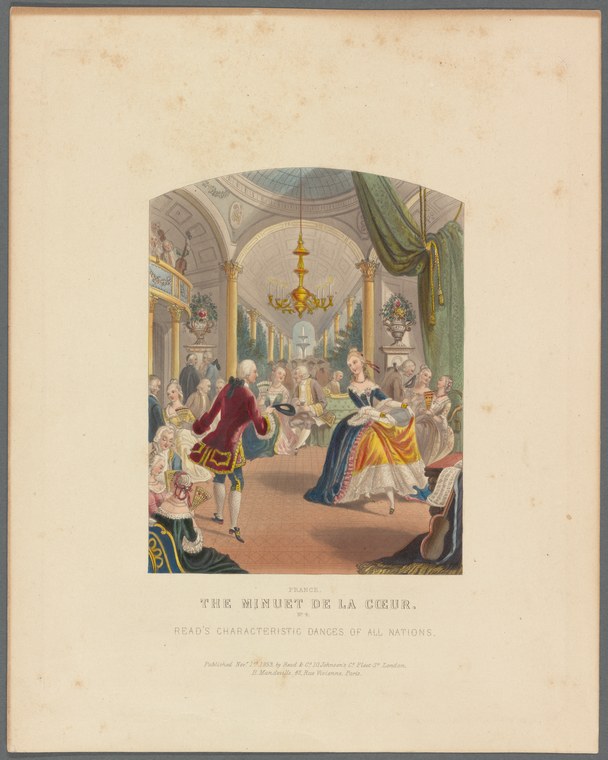
France. The minuet de la cœur
Unknown artist
- Medium:
- Engraving
- Dance:
- Minuet
- Era:
- 1700s (Enlightenment/Minuet Era)
- Source:
- New York Public Library
- Rights:
- Public domain — free to use, share and adapt.
- Recorded as:
- public_domain
The minuet de la cœur represents the apex of courtly dance in the Old Regime—a form so central to aristocratic identity that the ability to execute it elegantly was literally a mark of rank. This engraving captures not just a dance but a social system: the geometry of the ballroom, the passive spectatorship of the court, the decorousness of the male-female interaction, and the absolute separation between noble dancers and servants or lower orders. Understanding how the minuet was performed, taught, and idealized requires images like this one.
What you are looking at
An aristocratic ballroom scene set beneath a coffered dome in an ornate neoclassical interior. The space is defined by a sweeping barrel vault punctuated by architectural detail, Corinthian columns, and draped green silk curtains to either side. A seated audience of fashionably dressed spectators occupies chairs arranged around three sides of the floor. In the center of the composition, a gentleman in a burgundy velvet coat with gold frogging stands in conversation with or attending to a woman in an elaborate gown of yellow and blue silk, her train extended behind her. A musician plays a stringed instrument (likely a lute or theorbo) at left. Other couples and attendants populate the scene, some seated, some standing in clusters of conversation. The lighting is cool and even, with no dramatic shadows, suggesting either candlelit evening or the conventions of engraving reproduction. The composition emphasizes the geometric order and social hierarchy of the court: the architecture frames the dancers centrally, the audience surrounds them, and the positioning suggests a formal choreographed moment rather than spontaneous movement.
The dancing
The central pair exhibits the upright posture and formal distance characteristic of Baroque courtly dance. The gentleman faces the woman with one arm extended in a gesture of deference or invitation; his weight appears evenly distributed and his torso vertical. The woman's posture mirrors his formality—her body aligned over her legs, her head tilted with decorum, her skirts arranged to display the fabric and cut of her gown. No hand-holding or close physical contact is evident; the dancers maintain the separation and visual presentation required of minuet etiquette. The surrounding figures also maintain upright, controlled postures consistent with court decorum rather than vigorous movement.
The dance depicted
This is the minuet de la cœur, or 'minuet of the heart,' a French courtly dance form of the 17th and 18th centuries. The minuet was the dominant social and ceremonial dance of European court culture from the Baroque period through the late 18th century, danced by aristocrats in formal dress as a display of breeding, grace, and social rank. The title 'de la cœur' suggests either a specific named variant or a poetic reference to the courtship and romantic sentiment implicit in the form. The image captures the dance in a moment of formal presentation—the couple turned toward each other in the symmetrical opening phrase of the minuet, with the attendant audience seated to observe and evaluate. The precise footwork of the minuet (the characteristic Z-pattern floor pattern, the bent-knee plié, the turned-out positions of the feet) cannot be read clearly in an engraving at this distance, but the overall bearing and setting confirm the identification.
How it was made
This is a hand-colored engraving, a technique that involved incising lines into a copper plate and then hand-applying watercolor or pigment to impressions. The fine hatching visible in the fabric details, the architectural background, and the faces is characteristic of 18th-century engraving. The coloring has been applied selectively—rich blues, yellows, reds, and greens—to emphasize the luxury of the costumes and the ornament of the ballroom. Engraving was a mass-reproducible medium that allowed this image of court dance to circulate beyond the royal court itself, reaching a print-collecting audience across Europe. The technique preserved fine detail in faces and gestures while allowing the artist to convey the theatrical and ceremonial scale of the scene.
About this work
This hand-colored engraving depicts a formal moment in the minuet de la cœur, the signature courtly dance of the French Baroque and Rococo periods. The work documents not a spontaneous social event but a choreographed spectacle: a couple dancing in the presence of an arranged audience within an architectural frame designed to celebrate the elegance and order of aristocratic life. The image is part of a series illustrating 'characteristic dances of all nations'—a common genre of 18th-century dance prints that functioned as both entertainment and instruction, allowing readers to understand the specific bearing, costume, and etiquette required of each dance form.
The minuet was the most prestigious social dance of its era, danced by kings and courtiers, taught to children of rank, and performed as a centerpiece of formal entertainment. To dance the minuet well was a marker of nobility and refinement. This engraving freezes a moment of that coded performance, preserving for posterity the precise formality that gave the minuet its cultural power.
How to look at it
Attend first to the geometry: the composition places the dancing couple at the exact center and apex of the scene, with the architecture and audience arranged symmetrically around them. This placement is not accidental—it reflects the social reality of court dancing, where to dance well was to be seen well. Notice the posture: the couple is upright, the distance between them is precise, and neither leans toward or away from the other. The woman's skirts are spread to display the fabric and the cut of her gown; the man's coat and stance are equally designed for visual presentation. Look at the audience—they are seated and arranged to watch, and their attention is directed toward the dancers. The moment chosen is not one of vigorous movement but of formal presentation, the opening phrase of the dance where the dancers salute or acknowledge their audience before moving into the more complex footwork of the figure.
The artist
The artist is not recorded in the available catalogue information. The work is identified as from the series 'Read's Characteristic Dances of All Nations,' published in London in the 19th century. The print is housed in the New York Public Library collection.
The period
The minuet dominated European courtly dance from approximately 1650 to the 1780s, originating in France under Louis XIV. The dance codified and celebrated the values of absolute monarchy: hierarchy, grace, visual symmetry, and the subordination of the body to rigid aesthetic rules. By the late 18th century, the minuet was already becoming historical—a mark of the Old Regime that would be swept away by the French Revolution. Prints like this one, issued in the 19th century, were produced for a nostalgia-curious middle-class audience interested in the customs of the aristocratic past. The Romantic era and later Victorian periods developed a fascination with the manners and dances of the 17th and 18th centuries, and prints illustrating 'characteristic dances' became a popular genre of souvenir and instruction.
Where it lives
This engraving is held in the New York Public Library collection. It is part of a series titled 'Read's Characteristic Dances of All Nations,' published in London in the 19th century (likely mid-19th century, though the exact date is not recorded). The series was intended as both an educational and entertainment publication for a middle-class audience interested in the customs and dances of European nobility.
Dance in this work
Questions about this work
What is the 'minuet de la cœur'?
The minuet de la cœur ('minuet of the heart') is a French courtly dance of the 17th–18th centuries, a variant or poetic naming of the minuet proper. The minuet was the most prestigious social dance in Europe during this period, danced by aristocrats as a display of grace, refinement, and rank. The title 'de la cœur' likely refers to the romantic or sentimental associations of the form—the minuet often accompanied courtship and love poetry in Baroque culture.
Who danced the minuet and why?
The minuet was danced by aristocrats and nobility as a marker of rank, breeding, and courtly accomplishment. To dance it well was literally a sign of nobility; even young children of rank were trained in the form. The minuet was performed at court, at balls, and at formal entertainments as both a social pleasure and a coded ritual that affirmed the hierarchy and values of the ancien régime. It was also frequently performed as a show piece by professional dancers.
Why is the couple so stiff and formal?
This is not stiffness but discipline. The minuet required absolute control of the body—turned-out legs, a vertical torso, measured steps, and precise arm positions. The formality and distance between partners were deliberate and required; dancers were taught to maintain decorum and visual clarity at all times. The stiffness visible in this image is the hallmark of the style: it conveyed refinement, order, and self-mastery.
How do we know this is an engraving and not a painting?
The fine hatching lines visible throughout the image, particularly in the architectural detail and shadows, are characteristic of engraving, a technique in which lines are incised into a metal plate. The hand-coloring applied afterward is visible in the solid areas of color (the yellow and blue gown, the red coat, the green draperies). Engravings were mass-produced prints, which is why this image circulated widely among a print-collecting public.
More Minuet artwork