25 works in this view — arrow keys or swipe to move between them.
Dance in Art
Tango at the Street Cafe
Unknown
- Medium:
- photograph
- Dance:
- Tango
- Era:
- 1900-1920 (Ragtime/Early Jazz)
- Source:
- Wikimedia Commons
- Rights:
- Public domain — free to use, share and adapt.
- Recorded as:
- public_domain
Tango was one of the first non-European dance forms to transform Western popular culture, and this image is evidence of how the dance circulated—not in theaters, but in mass-produced prints meant for public consumption. For historians, it documents the look and the social setting of early tango; for dancers, it shows how the form was understood by artists working in the moment of its greatest cultural impact.
What you are looking at
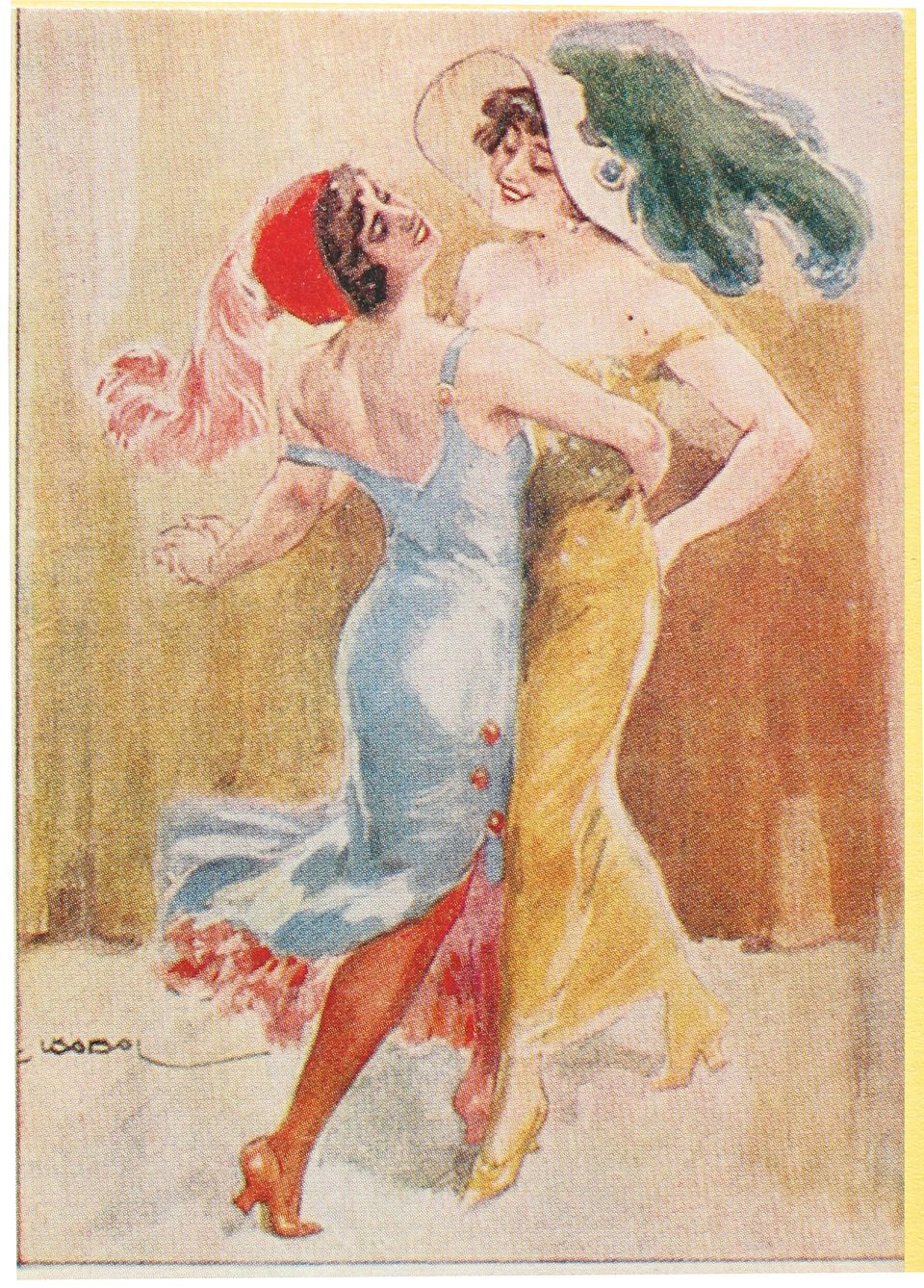
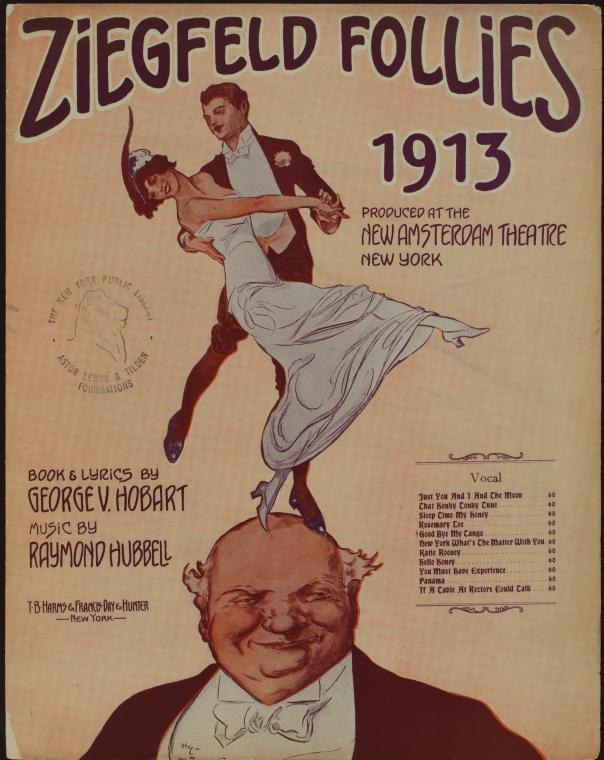
Two couples dance in close embrace in what appears to be a café or indoor social space, rendered in soft lithographic tones of cream, gold, and rust. The pair in the foreground are intimately positioned, the woman in a blue slip dress with red trim leaning back into her partner's frame; her head tilts toward his as they move. A second couple occupies the background, similarly engaged. The woman in front wears a red headpiece and has her weight shifted into the turn; her partner steadies her from behind. The setting is suggested rather than explicit—warm, ambient lighting and neutral walls create an interior venue. The composition captures a moment of active movement and physical connection, with the dancers' bodies angled in a configuration that emphasizes the close, partnered nature of the dance.
The dancing
Both couples are in a tight closed hold, the foundational frame of tango. The front couple show the characteristic Argentine tango posture: the man's right arm encircles the woman's lower back, his left hand connected to hers, while her body folds back into his in a pronounced contra-body position. Her weight appears transferred onto her right leg in what could be a forward step or weight change. The second couple mirror this arrangement. The artists has rendered the dancers' heads very close, the faces nearly touching, which is consistent with the intimate, face-to-face orientation of tango dancing in this era.
The dance depicted
This is Argentine tango, almost certainly. The catalogue record identifies it as such, and the image supports the identification fully: the closed embrace, the angle of the bodies, the intimate head position, and the apparent forward-and-back movement are all characteristic of tango as danced in early 20th-century Buenos Aires. The women's dress—particularly the fitted slip dress and short skirts—is consistent with 1910s–1920s dancewear. Tango had only recently arrived in Europe from Argentina in the preceding decade and was still considered daring for its closeness and sensuality. This image captures the dance as a social practice in a café setting, which is where much Argentine tango was danced before the theatrical codification of the form.
How it was made
This is a hand-colored lithograph, a printing technique that allowed the soft tonal gradations and warmth visible here. The image was printed in chromolithography—a multi-stone color process—with hand finishing, which is evidenced by the subtle blending of the salmon and gold backgrounds and the careful application of color to the figures' skin and clothing. Lithography was the dominant medium for popular dance imagery and sheet music covers in this period, and its ability to produce affordable multiple prints meant that images like this circulated widely as collectibles, souvenirs, and advertising. The soft edges and impressionistic handling suit the sensual subject matter.
About this work
This hand-colored lithograph captures a moment from the early years of Argentine tango's arrival in Europe, probably from the 1910s–1920s. It shows two couples in a café setting, frozen mid-dance in the close embrace that made tango simultaneously thrilling and transgressive to European society of the era. The artist—unknown but accomplished in the lithographic form—has rendered the intimacy of the dance without sentimentality, focusing on the physical connection and the moment of movement. The work belongs in a collection of dance imagery because it documents both a crucial moment in dance history (tango's globalization) and a key artistic strategy: the representation of social dance as an encounter between bodies rather than as a formal display.
How to look at it
Look at the angle of the dancers' heads and the way the woman's body leans back into her partner. This is the tango posture: not an upright, formal frame but an asymmetrical, almost reclining line that gives the dance its distinctive silhouette. The lithographic softness of the image—the lack of sharp outlines—creates a sense of movement and fluidity, as if the moment is being captured mid-motion rather than frozen. Notice also the setting: the café is suggested through color and tone rather than architectural detail, keeping the focus on the dancers' bodies and their connection. The red and blue clothing of the front couple creates a chromatic contrast that draws the eye and anchors the composition.
The period
Argentine tango emerged in the late 19th century in the working-class neighborhoods of Buenos Aires, particularly among immigrant communities. By 1910–1912, it had crossed the Atlantic and caused a sensation in Paris, London, and other European capitals, where its closed hold and sensual movement were viewed as scandalous and intoxicating. The dance arrived at a moment when European society was hungry for 'exotic' cultural forms from the Americas and Africa, though tango was met with particular controversy because it was danced by couples in contact rather than in formation or display. By the 1920s, tango had been partly domesticated—taught in dance studios, incorporated into musical theater, and rendered safe for polite society—but images like this one capture the dance before that process was complete, when it was still perceived as a social rather than a theatrical form, and when the closeness of the embrace was its most transgressive feature. In visual art, the dance became a favored subject for lithographers and illustrators, who used it to signal sophistication, modernity, and a certain erotic charge.
Where it lives
The work comes from Wikimedia Commons. No holding collection is recorded in the catalogue.
Dance in this work
Questions about this work
Was tango really danced this closely when it first arrived in Europe?
Yes. The close embrace—the abrazo—is fundamental to Argentine tango and was there from the beginning. What was shocking to European audiences was not the dance itself but the fact that it was danced by men and women in contact, without a dance master, in social settings like cafés. By the 1920s, versions of tango were being taught in ballroom contexts where the hold was loosened to match European standards, but the true tango, as shown here, maintained the tight embrace.
Why are there so many lithographs of tango from this period?
Tango was the dance of the moment, and lithography was the dominant technology for producing affordable, colorful images for popular consumption. Sheet music, dance instructional materials, postcards, and souvenir prints all featured tango dancers. The form was exotic, modern, and slightly scandalous—everything that made for appealing commercial imagery. These prints were collected, traded, and posted in dance studios and cafés.
What does the café setting tell us?
Tango was a social dance, not a theatrical one in its origin. It was danced in cafés, dance halls, and social clubs, not on stages. This image documents that history. Even as tango entered the theater and ballroom in the 1920s, the café setting remained iconic, associated with authenticity and the dance's working-class Buenos Aires roots.
More Tango artwork
![[Les noces de trottoir, par les compagnies Tango Sumo et Vendaval. Chalon dans la rue. 2007 / photographies de Joël Verhoustraeten] by Verhoustraeten, Joël (1954-2019). Photographe](https://gallica.bnf.fr/iiif/ark:/12148/bc6p058zgkc/f1/full/800,/0/native.jpg)