13 works in this view — arrow keys or swipe to move between them.
Dance in Art
The cotillion
Unknown artist
- Medium:
- Lithograph
- Dance:
- Cotillion
- Era:
- Late 1800s (Victorian Ballroom)
- Source:
- New York Public Library
- Rights:
- Public domain — free to use, share and adapt.
- Recorded as:
- public_domain
The cotillion was a defining social dance of the Gilded Age, and this image is one of the few visual documents showing how it was actually performed and dressed. For historians of dance, fashion, and social life, it reveals the integration of dance with architecture, gender performance, and class identity in the late nineteenth century.
What you are looking at
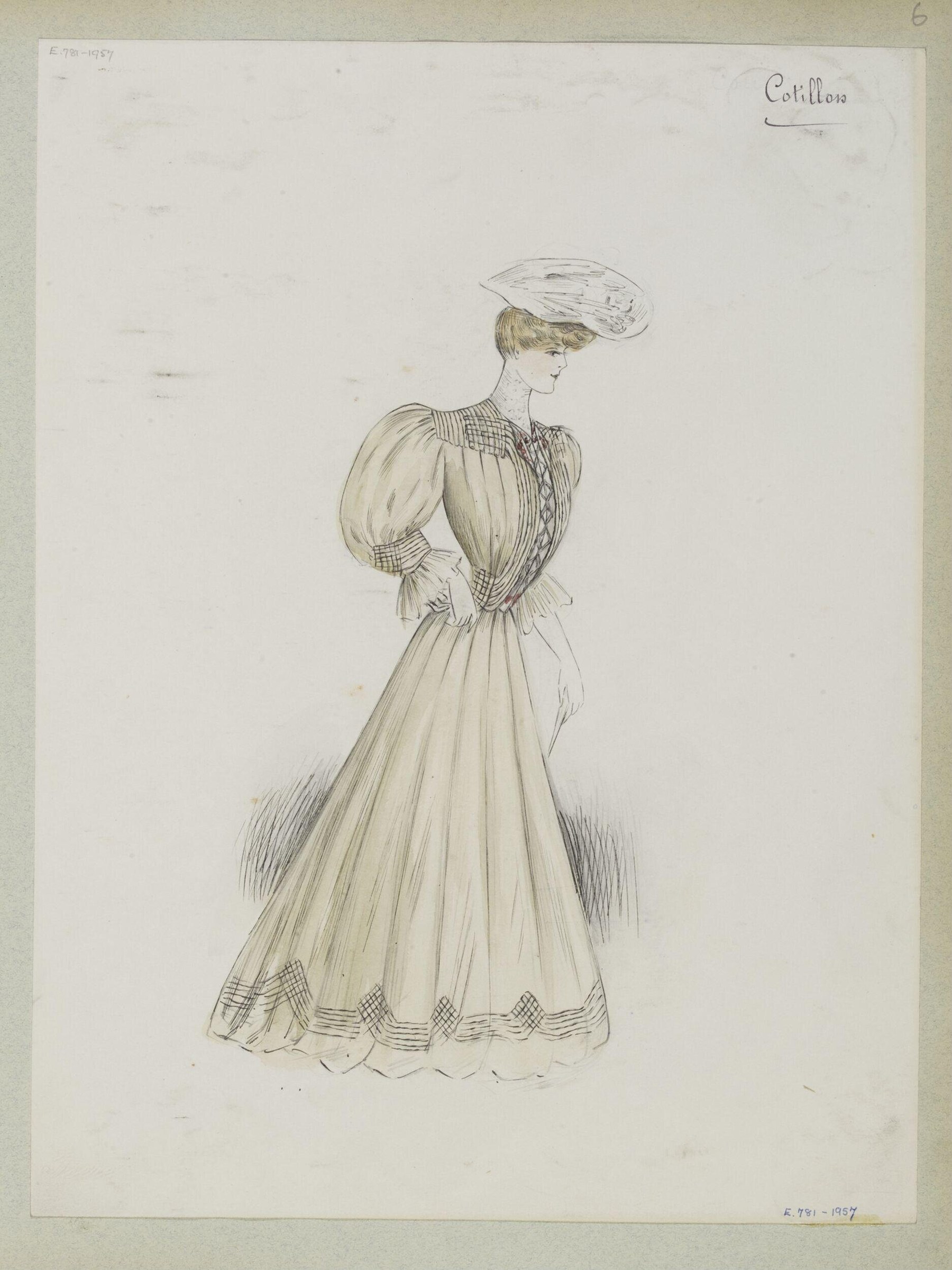
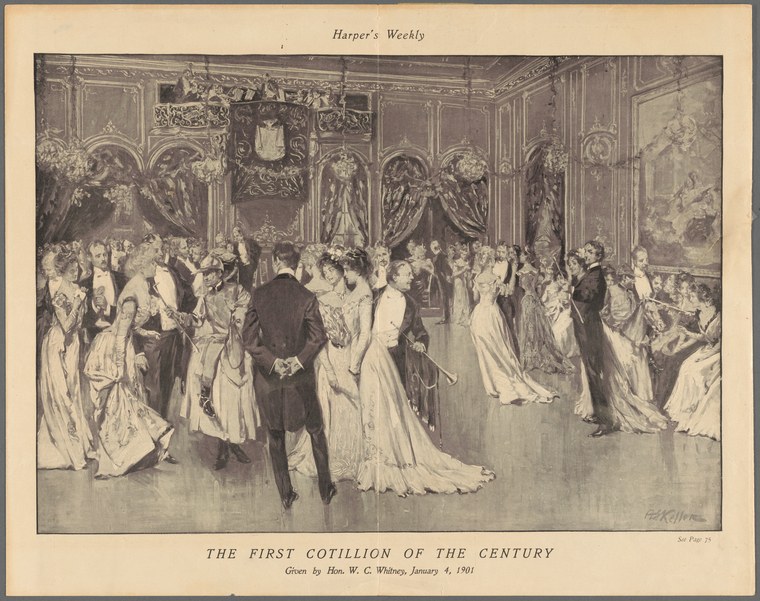
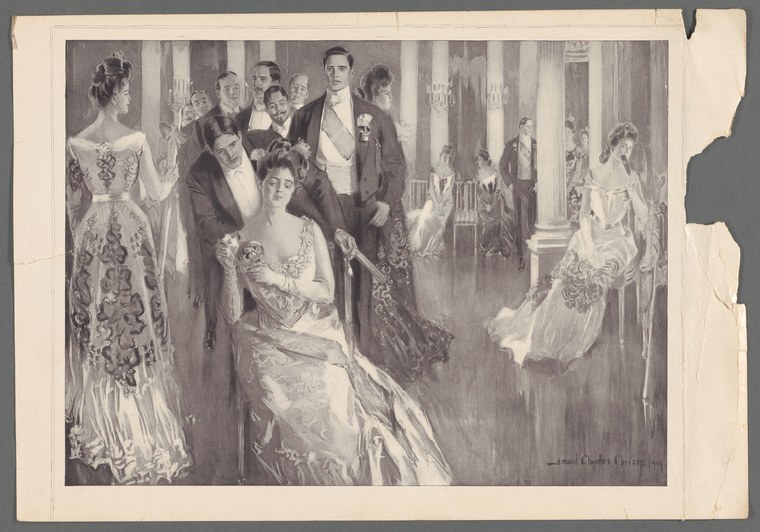
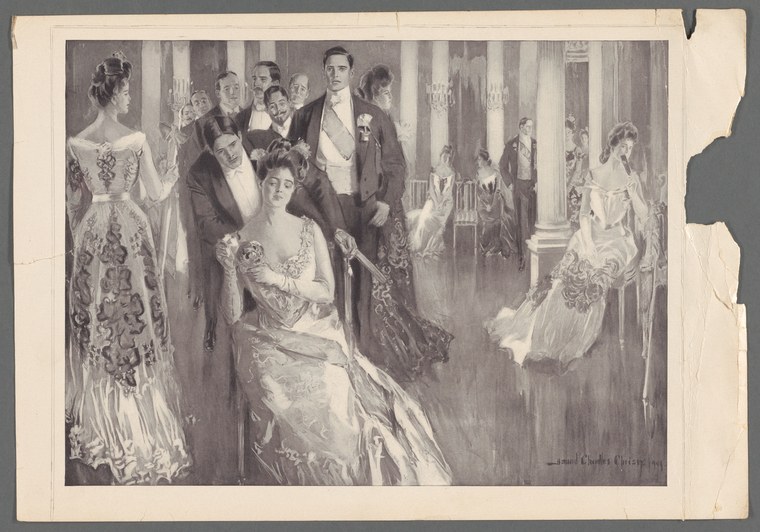
A formal ballroom scene depicting an elegant social dance in progress. The composition shows multiple couples and figures distributed across a columned neoclassical interior with tall pilasters and hanging light fixtures. In the foreground, a woman in an ornate white gown with elaborate embroidered detail and a long train turns or pivots, her upper body inclined slightly backward in a graceful arc. Around her, other figures in formal evening dress—men in dark tailcoats and women in white gowns with decorative elements—are positioned in conversational clusters and paired formations. The lithographic technique creates soft gradations of light that emphasize the formality of the scene: warm light pools on the dancers while the background recedes into cooler shadow. The women's gowns are the visual focus, with their full skirts and jeweled or embroidered bodices suggesting the 1890s–1900s moment. The overall mood is one of restrained elegance and social ceremony rather than vigorous movement.
The dancing
The foreground dancer displays an open, upright frame with slight backward inclination, her posture suggesting a turn or pivot executed with controlled extension rather than closed partnering. The other figures maintain proper social distance and formal bearing appropriate to ballroom convention. Several couples appear to be in closed hold positions, though the soft focus of the lithograph prevents precise detail of hand placement or frame. The positioning of bodies—some facing inward toward partners, others angled toward observers—suggests multiple dance patterns unfolding simultaneously across the floor.
The dance depicted
This depicts a cotillion, the formal group dance that dominated elite American and European ballrooms in the late nineteenth century. The cotillion was a choreographed social dance performed by sets of four couples (or more in larger formations), combining figures derived from the quadrille with individual couple dances, promenades, and set movements. The image captures the social and architectural context in which the cotillion was performed: a grand ballroom with sufficient space for multiple sets, attended by formally dressed couples of social standing. The soft, dignified movement suggested by the foreground figure's inclined posture and the orderly distribution of dancers across the floor reflects the cotillion's character as a dance requiring cooperation, timing, and adherence to prescribed figures rather than improvisation.
How it was made
This is a lithograph, a printing technique that allowed for soft tonal gradations and atmospheric effects—here used to suggest the warm, diffused gaslight of a late-nineteenth-century ballroom. Lithography was the preferred medium for social documentation and fashion illustration of this period, capable of reproducing the fine detail of embroidered gowns and architectural ornament. The technique's capacity for subtle shading and its relative affordability meant that such scenes circulated widely among the middle and upper classes as aspirational images of refined social life. The work's presence in the New York Public Library collection indicates it was likely a published print rather than a unique artwork, part of the visual record of American urban society.
About this work
This lithograph documents the cotillion as it was performed in elite American ballrooms in the late nineteenth century. The image preserves not only the visual spectacle of the dance—the elaborate gowns, the formal architectural setting, the precision of movement—but also its social meaning as a carefully choreographed ritual that displayed refinement, cooperation, and social status. The cotillion was the dominant group dance of the Gilded Age, a democratization of court dance accessible to the wealthy urban middle class. By the 1890s it had become somewhat anachronistic among the youngest dancers, challenged by newer couple dances like the waltz, but remained the formal choice for debutante balls and the most prestigious social occasions. This image captures the form at its height of popularity and visual elaboration, before World War I reshaped American social dance.
How to look at it
Attend to the careful composition of the space: the artist has arranged multiple couples and figures across the ballroom floor to show both the simultaneous action of the dance and the social arrangements that framed it. The foreground woman's inclined posture and the formal bearing of all the figures suggest the controlled, upright frame that the cotillion demanded—this was not a dance of release or individualistic expression, but of geometric precision and collective order. Notice how the lithograph's soft focus and warm tonality create an atmosphere of refinement and distance from the viewer, reinforcing the social exclusivity of the occasion. The elaborate detail in the women's gowns—the embroidery, the trains, the jeweled ornament—was as much a part of the dance as the movement itself.
The period
The cotillion emerged in France in the mid-eighteenth century and became the standard ballroom dance of European and American high society for over a century. By the 1890s, when this lithograph was made, the cotillion was in its final period of dominance. The Gilded Age witnessed an explosion of ballroom dancing among the newly wealthy industrial class; etiquette books devoted entire chapters to cotillion figures and proper deportment. Simultaneously, newer dances—particularly the waltz and the emerging ragtime-influenced couple dances—were beginning to challenge the cotillion's supremacy among younger dancers. The rise of lithographic printing in the nineteenth century meant that ballroom scenes, fashion plates, and social documentation could be mass-produced and distributed, shaping public understanding of refined social life. This print was created at the moment when the cotillion's reign was beginning to yield to modernization in dance and social custom.
Where it lives
This lithograph is held in the New York Public Library collection, indicating it was a published print, likely distributed as a social illustration or fashion documentation in the late nineteenth century. It is one of many ballroom scenes in the NYPL's holdings that document American urban society of the Gilded Age.
Dance in this work
Questions about this work
What is a cotillion?
A cotillion is a formal group dance performed by multiple couples in a choreographed sequence. Emerging from French court tradition in the eighteenth century, by the nineteenth century it had become the standard ballroom dance of high society. A typical cotillion involved four couples (or sets of four couples) executing prescribed figures—promenades, circles, squares, and individual couple passages—under the direction of a dance master or lead couple. Unlike later couple dances, the cotillion required coordination across all participants and maintained a formal, upright frame.
Who danced the cotillion?
The cotillion was performed exclusively by the socially elite: aristocracy in Europe, and in America the wealthy merchant and industrial classes. By the 1890s it had become standard at debutante balls, high-society galas, and formal balls of the urban upper class. Participation in a cotillion was a marker of social standing and access to refined society; the ability to execute the figures correctly was part of upper-class education.
What happened to the cotillion?
The cotillion gradually declined in the early twentieth century as newer, couples-based dances—particularly the waltz and ragtime-influenced dances—gained popularity. World War I and the social changes of the 1920s accelerated this shift. However, the cotillion never entirely disappeared; it survives in debutante culture and formal American balls, where it remains a tradition connecting contemporary society to Gilded Age refinement.
Why are the women's gowns so elaborate?
The gowns visible in this image represent the height of late-Victorian fashion: white silk or satin embroidered with gold thread, beads, or jewels, often with long trains and complex structural elements. These gowns were extraordinarily expensive and required extensive preparation and maintenance. Wearing such a gown to a cotillion was itself a form of social performance, signaling wealth, taste, and access to the finest materials and craftspeople. The gown was inseparable from the dance itself.
More Cotillion artwork