13 works in this view — arrow keys or swipe to move between them.
Dance in Art · 2023
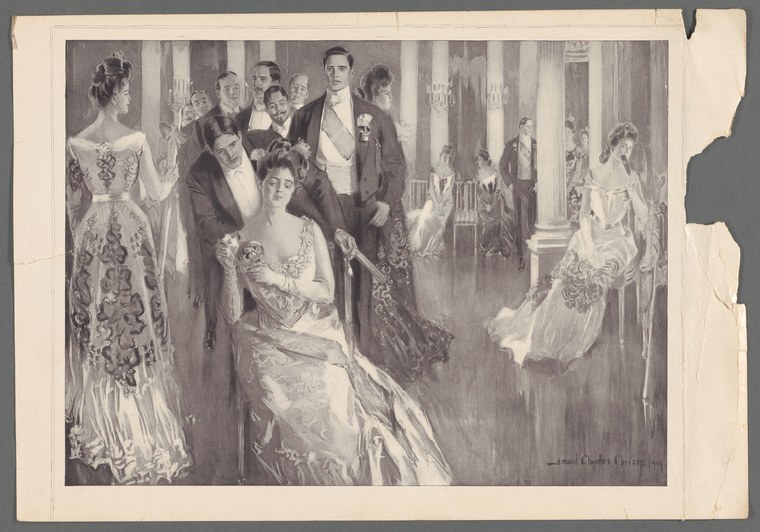
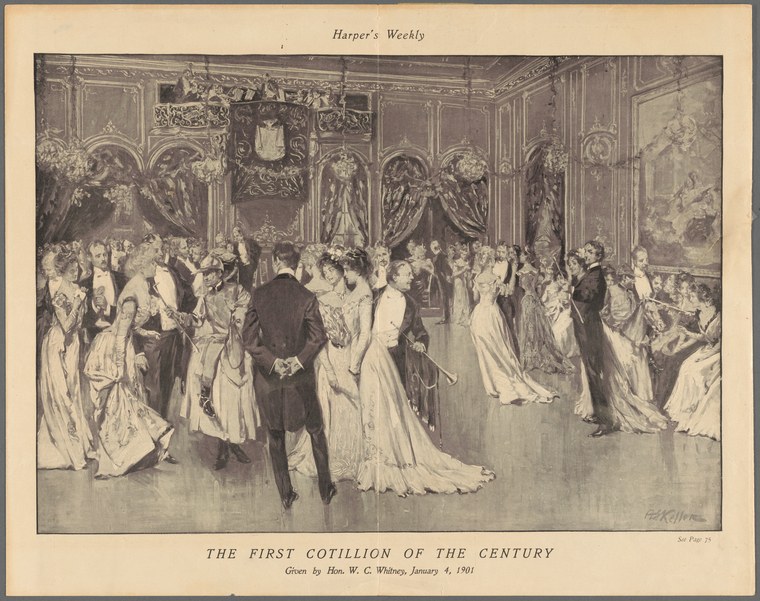
The first cotillion of the century, given by Hon. W.C. Whitney, January 4, 1901
Unknown artist
- Medium:
- Lithograph
- Dance:
- Cotillion
- Era:
- Late 1800s (Victorian Ballroom)
- Source:
- New York Public Library
- Rights:
- Public domain — free to use, share and adapt.
- Recorded as:
- public_domain
The cotillion was the defining social dance of the American Gilded Age, and this image documents one of its most celebrated instances. It shows not isolated couples but the cotillion as a large-scale, orchestrated social event requiring coordination, hierarchy, and vast resources—revealing how dance was woven into the exercise of wealth and class. Few images capture the physical density and energy of such a gathering, making this a rare documentary view of elite social dance in practice.
What you are looking at
A formal ballroom reception in full swing, rendered in a lithograph. A grand salon with gilded wall panels, decorative pilasters, and painted ceiling ornaments frames a crowd of several hundred guests in evening dress. The men wear dark tail coats; the women are in white ball gowns with long trains. Couples and small groups cluster throughout the floor space, some actively dancing in the center, others standing in conversation at the periphery. The lighting is warm and even, suggesting electric or gas illumination typical of a wealthy Gilded Age interior. The artist has captured the scene from a high vantage point, allowing a comprehensive view of the room's volume and the density of the gathering. The movement is neither frozen nor chaotic—some figures are mid-stride or mid-turn, while others stand stationary, creating the impression of a continuous social event rather than a single crystalline moment.
The dancing
The dancers visible in the center of the room are in closed hold—men's right hand on the woman's back, left hand holding her right hand at shoulder height—consistent with ballroom dance of the period. The women's long white gowns flow around them; several skirts are caught mid-swirl, indicating active turning and forward movement. The posture is upright and formal, with bodies held at a composed distance. Most couples are oriented toward the viewer's left, suggesting the direction of movement around the ballroom perimeter. The standing figures maintain the erect carriage and reserved spacing of Gilded Age etiquette.
The dance depicted
This is a cotillion, a formal ballroom dance and social institution of the Gilded Age. The cotillion was both a dance form—typically a sequence of figures performed by multiple couples in set formations—and an event: an exclusive evening reception. As the title states, this is the first cotillion of the new century, held on 4 January 1901. What the image captures is the cotillion as social event rather than as a choreographic sequence; the specific figures and formations are not legible from this distant view. The woman hosting this event, the wife of the wealthy businessman W.C. Whitney, was a prominent figure in New York society, and such cotillions were significant markers of social status and season.
How it was made
This is a lithograph, a planographic printing process that allowed for mass reproduction and wide circulation. The technique is evident in the subtle tonal gradations, the way line and wash create volume, and the characteristic slight graininess of the stone surface. The method was relatively economical compared to engraving and ideally suited to journalistic and periodical publication—indeed, this work appeared in Harper's Weekly, a major illustrated magazine with a circulation of hundreds of thousands. The lithographic process allowed the artist to capture fine detail in the architectural setting and the density of figures while maintaining overall legibility at the scale of a magazine page.
About this work
This is a journalistic record of a specific, celebrated social event: the opening cotillion of 1901, hosted by one of America's wealthiest families. The lithograph served as visual journalism for the Harper's Weekly audience, documenting not the dance itself in technical detail but the spectacle of Gilded Age social display. The image is important because it captures the cotillion as a social and cultural phenomenon—an institution through which elite power was exercised and displayed—rather than as a choreographic form. For dancers and historians, it provides direct evidence of the scale, formality, and social context of ballroom culture at the turn of the 20th century.
How to look at it
The artist chose a bird's-eye or high-angle view that prioritizes the architecture and the crowd density over the legibility of individual dancers' technique. This perspective is typical of journalistic illustration and emphasizes the social spectacle—the numbers, the formal setting, the exclusivity—rather than the choreography. Look at how the couples in the center are arranged: notice the consistent orientation, the way the women's white gowns create rhythm through the space, and the contrast between active dancers and standing conversationalists at the margins. This mixing of movement and stillness is what makes it a social event rather than a performance.
The period
The cotillion reached its peak in America during the 1880s and 1890s, particularly in New York society. It was a formal, choreographed sequence of dances performed by a select group of couples (often numbering in the dozens), typically led by a professional dance master who called the figures. The form was European in origin but took on distinctive American characteristics, becoming closely associated with Old Money families and debutante culture. By 1901, the cotillion was already beginning to decline, yielding to more informal ballroom styles and the emerging popular dances (waltz, foxtrot, one-step) that would dominate the early 20th century. The deliberate choice to photograph and publish this event in Harper's Weekly suggests its cultural significance even as the form was entering its twilight.
Where it lives
This lithograph is held by the New York Public Library and appeared as an illustration in Harper's Weekly, the influential American illustrated magazine founded by Fletcher Harper. Such works were part of Harper's Weekly's extensive coverage of high society events and were aimed at a broad, middle- to upper-class readership.
Dance in this work
Questions about this work
What is a cotillion?
A cotillion was a formal ballroom dance consisting of a sequence of choreographed figures performed by multiple couples, typically led by a professional dance master. In the Gilded Age, it was also a high-society event—an invitation-only evening reception—that conferred significant social status. The form was French in origin but became closely associated with American elite society in the 19th century.
Why was this particular cotillion important enough to illustrate in Harper's Weekly?
This was the first cotillion of the 20th century, held on 4 January 1901, and was hosted by W.C. Whitney and his wife—among the wealthiest and most prominent figures in American society. Such an event marked the social calendar and was considered newsworthy by Harper's Weekly's editors as a matter of cultural significance and celebrity interest.
Can you see the dance figures in this image?
Not clearly. The high vantage point and the density of the crowd prevent the artist from rendering specific choreographic detail. What is visible are individual couples in closed hold and formal posture, but the complex figured sequences that defined the cotillion are not legible. This image documents the event and its social context rather than the dance itself.
More Cotillion artwork