13 works in this view — arrow keys or swipe to move between them.
Dance in Art
Cotillion
Jeanne Paquin
- Dance:
- Cotillion
- Era:
- 1900-1920 (Ragtime/Early Jazz)
- Source:
- Victoria and Albert Museum
- Rights:
- Rights vary by item — check the source record before reusing this image. Source record ↗
- Recorded as:
- Check V&A creditLine
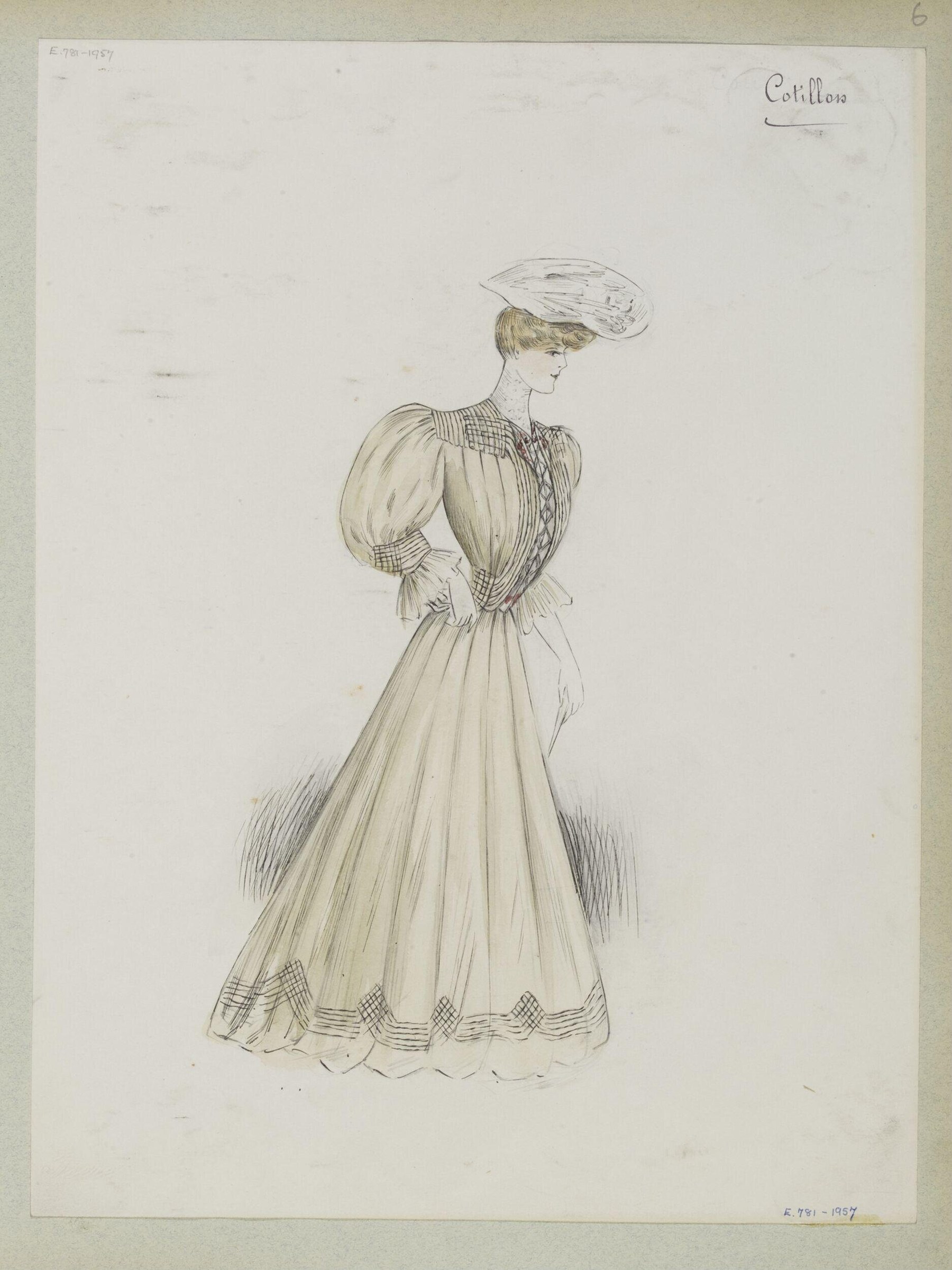
This work documents the inextricable link between fashion and ballroom dancing in Edwardian high society, showing that the Cotillion was as much about displaying wealth and status through dress as it was about the steps themselves. Paquin's illustration reveals how a couturier understood the ballroom not as a stage for movement but as a space where women's bodies were framed and constrained by fashion in ways that shaped what movement was possible and what was expected.
What you are looking at
A single figure of a woman dominates the composition, shown in profile facing right. She wears an elaborately constructed dress of the early 1900s: a high-necked, long-sleeved bodice with intricate pleating and geometric patterning, fitted at the waist with a pronounced S-bend silhouette characteristic of the period. The skirt falls in graceful vertical pleats to the floor, where a decorative geometric border of diamond shapes runs along the hem. The fabric appears sheer and delicate, with subtle shading suggesting its weight and drape. Her blonde hair is styled in the pompadour fashion of the era, crowned with a wide, ornately trimmed hat bearing feather or lace detail. The drawing is rendered in graphite with selective color wash—pale cream and ochre tones applied to the dress, with darker hatching to define the bodice's tucks and the skirt's volume. The background is plain, focusing attention entirely on the figure's silhouette and the exquisite detail of her costume.
The dancing
The woman's posture is upright and composed, her body held in an elegant contrapposto stance that conveys the formal bearing required of ballroom society. Her right arm rests at her side, her left hand positioned at hip level—a pose suggesting either a moment of pause between movements or the held position of a dance partner waiting to engage. The structured corseting and the width of the skirt dominate her physical presence; her visible arm shows no tension or extension, presenting instead the relaxed, refined deportment expected of a lady in formal dress. There is no sense of dynamic motion or strenuous movement; the figure is rendered as still, poised, and available for the social interaction the dance requires.
The dance depicted
This is a fashion study for the Cotillion, the formal ballroom dance that dominated European high society in the late 19th and early 20th centuries. The Cotillion was not a dance of vigorous steps but rather a choreographed procession of varied figures and formations involving multiple couples moving through intricate geometric patterns—processionals, circles, reversals, and partner exchanges. The woman shown here would be one participant in these group formations, her primary role to move with refinement, maintain proper carriage, and execute simple steps while the formal geometry of the dance unfolded around her. The dress itself is the subject and the evidence: the Cotillion required women of wealth and status to display themselves in the most current and elaborate fashion, and the exquisite detail of this costume indicates both the occasion's formality and the wearer's social position.
How it was made
This is a fashion illustration executed in graphite and watercolor or gouache on paper, a technique favored for costume design and fashion documentation of the period. The artist has used fine pencil work to establish precise architectural detail in the bodice's tucks and pleating, then applied selective color washes in cream, tan, and ochre to suggest the dress's fabric and volume while leaving much of the work in monochrome. This hybrid technique—part technical drawing, part aesthetic rendering—was standard practice for haute couture illustration in this era, allowing both the precise tailoring information a dressmaker required and the elegant presentation a fashion house desired. The approach emphasizes the costume's construction and silhouette over narrative or movement, treating the figure as a vehicle for displaying textiles and sewing technique.
About this work
This is a working fashion illustration by the couturier Jeanne Paquin, documenting the dress code and expected silhouette for participants in the Cotillion, the most formal and socially significant ballroom dance of Edwardian society. Paquin was among the leading fashion designers of the early 1900s, and this study demonstrates both her influence on how women moved through ballroom space and her understanding that fashion and dance were inseparable concerns in elite social life. The image records not the dance itself but the apparatus that made the dance possible—the costume that defined a woman's role and silhouette within the formal geometric figures and processionals of the Cotillion. For a dance historian, it reveals the material reality of ballroom participation: the woman depicted was literally corseted and weighted down by layers of fabric, and her physical capability was constrained by the very garment that announced her status and elegance.
How to look at it
Notice the extreme formality and stillness of the figure—this is not a moment of movement but a display of stance and costume. The viewer should attend to the bodice's intricate construction and how the S-bend silhouette shapes the figure's posture and weight distribution. The decoration along the hem of the skirt is particularly significant: it shows the level of handwork and material investment required for a single Cotillion dress, and it reminds us that these were garments made to be seen from a distance, in a room full of similarly dressed bodies executing synchronized formations. The artist's choice to show the figure in profile allows the viewer to see the full line of the dress and the exaggerated forward thrust of the bust and backward curve of the hips that defined the era's ideal silhouette.
The artist
Jeanne Paquin (1869–1936) was a pioneering French couturier and one of the first female fashion designers to achieve major commercial and critical success in Europe. She founded her own house in Paris in the 1890s and became famous for her refined, understated elegance and her innovation in cut and tailoring. Unlike some contemporaries, Paquin paid careful attention to how her designs functioned in the social contexts where they would be worn—the ballroom, the theater, the racing calendar—and her work was worn by actresses, aristocrats, and wealthy Americans. She was also one of the first major designers to patent her designs and to cultivate a brand identity, making her illustrations and designs valuable documents of high-end fashion practice.
The period
In the 1900s, the Cotillion had evolved from its 18th-century origins into a complex formal dance performed primarily by and for the aristocratic and wealthy merchant classes of Europe and North America. It was a dance of status and social hierarchy, and participation required both financial means—the cost of a proper costume and admission to an event—and social positioning. The S-bend silhouette shown here became the signature of early Edwardian fashion under the influence of designers like Paquin, Paul Poiret, and others; it required a specific posture, constrained movement, and signaled compliance with (and ability to afford) the most current fashion. The Cotillion remained popular through World War I but began to decline as social attitudes shifted and simpler, more active dances like the Foxtrot and Charleston emerged.
Where it lives
This drawing is held in the Victoria and Albert Museum's collection, where it is catalogued as a fashion illustration. The V&A's fashion collection includes working drawings, finished presentations, and documentary studies made by designers and houses across several centuries; this piece sits within the archive of early-20th-century haute couture and represents the kind of design document that circulated among the wealthy clients and international fashion houses of the period.
Dance in this work
Questions about this work
What was a Cotillion?
A Cotillion was a formal ballroom dance performed in geometric figures by multiple couples, popular in elite European and American society from the 18th through early 20th centuries. Unlike the waltz or polka, it involved complex choreography with frequent partner changes, reversals, and processions. It was the most formal and socially hierarchical of ballroom dances, often held to mark significant social occasions, and participation was a mark of social status and proper breeding.
Why does the dress look so restrictive?
The S-bend corset, visible in the extreme curvature of the bodice, was the dominant silhouette of the 1900s. It was created through tight lacing that pushed the hips back and the bust forward, creating an exaggerated hourglass figure. This silhouette was fashionable and desirable, but it genuinely did restrict movement—women in these dresses could not bend freely at the waist, could not raise their arms high, and had limited capacity for vigorous activity. This constraint was part of the point: it announced that the wearer did not need to do physical labor and could afford to move slowly and deliberately.
Who was Jeanne Paquin?
Paquin was one of the most influential fashion designers of the early 1900s and one of the first women to build an international couture house. She was known for refined tailoring, elegant simplicity, and designs that responded to how women actually moved and lived. She dressed actresses, aristocrats, and wealthy clients across Europe and America, and she was an early pioneer in branding and protecting her designs through patents.
Is this a sketch or a finished work?
This is a working fashion illustration—more finished than a sketch but more functional than a fine-art drawing. It was made as a design document for Paquin's house, to be used by seamstresses, shown to clients, or circulated in fashion journals. The combination of precise technical drawing and selective color application is typical of high-end fashion illustration of the period, which had to communicate both the aesthetic vision and the construction details.
More Cotillion artwork