13 works in this view — arrow keys or swipe to move between them.
Dance in Art · 2023
The cotillion
Unknown artist
- Medium:
- Lithograph
- Dance:
- Cotillion
- Era:
- Late 1800s (Victorian Ballroom)
- Source:
- New York Public Library
- Rights:
- Public domain — free to use, share and adapt.
- Recorded as:
- public_domain
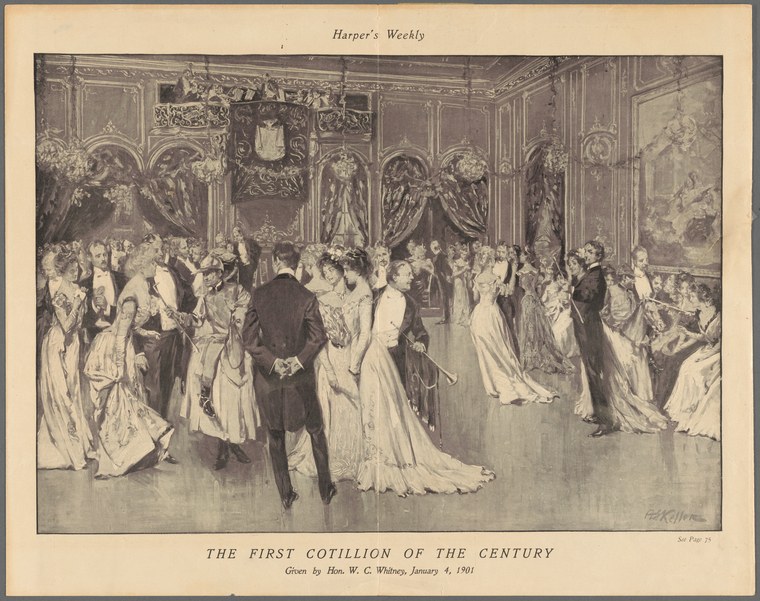
The cotillion is often overlooked in dance history in favor of the waltz and the quadrille, yet it was the dominant formal ballroom dance of the late nineteenth century and a crucial vehicle for social control and courtship ritual among the European and American elite. This image shows the dance not as a technique but as a social event, revealing how the dance functioned as a framework for managing propriety, partnership, and display in an era of rigid gender codes and hierarchical social structure.
What you are looking at
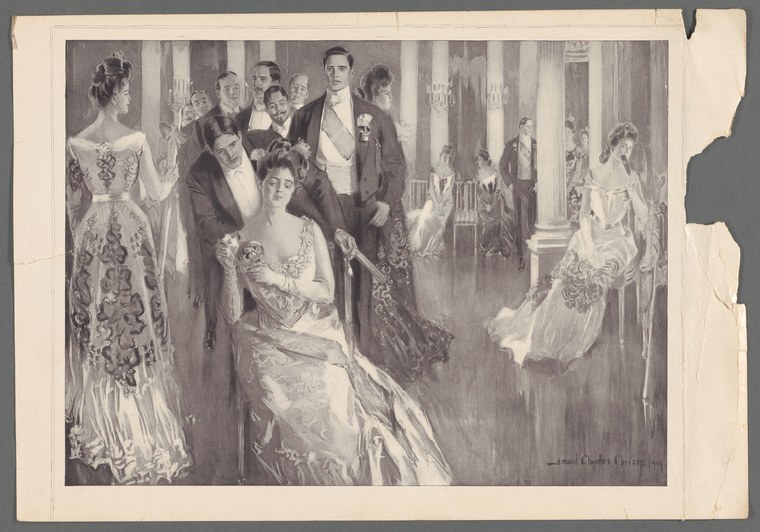
A grand ballroom scene rendered in grayscale lithograph, filled with formally dressed figures arranged across an elegant interior with tall columns and classical architecture. The foreground features a woman in an ornate white ball gown with elaborate embroidered or beaded decoration, her skirts voluminous and trained, seated or positioned prominently as a focal point. Around her, men in dark tailcoats and women in white gowns with elaborate trim occupy the space in loose formation—some in conversation, others in the formal posture of dancers. The lighting is soft and atmospheric, with deep shadows defining the architectural elements and creating an intimate yet grand feeling. The composition suggests the moment of arrangement before or during a formal cotillion: figures are positioned but not locked in obvious partnership, the energy poised between conversation and dance.
The dancing
The bodies throughout show the upright carriage and formal posture characteristic of nineteenth-century ballroom propriety. The woman at center displays the silhouette of the 1880s–1890s—tiny waist, high bust, full skirts—and her arms and shoulders are relaxed, not actively partnered. The men stand at courteous distance, several with hands at their sides or making gentle gestures of social engagement rather than dance frame. The overall composition avoids the locked closed holds of a waltz or a clearly defined dance line; instead, bodies are arranged in the looser social spacing of a formal assembly or the opening phases of a cotillion.
The dance depicted
This is almost certainly a cotillion, as the title indicates and the style of dress and formal ballroom setting confirm. The cotillion was a French ballroom dance that became fashionable in late-nineteenth-century American and European society, characterized by its role as a social orchestration rather than a continuous dance: figures danced in series, with frequent changes of partner, new combinations, and often a caller directing the progression. The image captures the social ceremony of the cotillion rather than a moment of active stepping—this is the assembly, the moment of greeting and arrangement that preceded or punctuated the dancing itself. The formality and the abundance of figures suggests an event of social consequence, likely from the 1880s or 1890s based on dress.
How it was made
This is a lithograph, a technique that allowed fine tonal gradation and considerable detail from a drawn stone, making it well-suited to capturing the subtleties of light and fabric in a ballroom interior. Lithography in the late nineteenth century was a primary medium for popular prints and illustration, allowing for relatively affordable reproduction of complex social scenes. The softness of the medium—the way shadow and highlight are suggested rather than harshly outlined—is part of what gives the scene its sense of gathering rather than dramatic action. This would have been a print for public circulation, likely from a magazine, newspaper, or popular illustrated edition.
About this work
This lithograph documents the social world of the late-Victorian cotillion, a formal ballroom dance that was as much a vehicle for social arrangement and etiquette as for actual dancing. The artist has chosen the moment of assembly—the gathered company before or between the figures of the dance—capturing the formality, the elaborate costume, and the social choreography that surrounded the cotillion. The scene shows dancers not in the midst of footwork but in the social framing that the dance required: positioned, formally dressed, attended to one another with the careful distance and gesture of high Victorian society. It is a document of a specific social practice: how the upper classes danced, how they dressed for it, and how they understood the dance as ceremony.
How to look at it
The viewer should attend to the studied informality of the composition: although the figures are gathered in a ballroom, they are not frozen in a moment of active dance movement. Instead, the artist has captured the before or between—the social arrangement that framed the dance. Notice the woman at center: she is the still point around which the other figures organize themselves, and her pose is one of composed waiting rather than active participation. The deep shadows and the soft architectural framing create a sense of intimate occasion within grand surroundings, which is exactly what the cotillion was—a formal dance that nonetheless required close social proximity and careful attention to one's partner and the figures being danced.
The period
The cotillion rose to prominence in the 1840s and became the signature ballroom dance of the Victorian and Edwardian eras. Unlike the waltz, which was danced as a continuous couple dance, the cotillion was organized into a series of figures, with frequent changes of partner and the intervention of a master of ceremonies or caller. It required considerable social knowledge—knowing the figures, the etiquette of partner selection and exchange, the proper distance and posture—and for that reason it was a marker of social class and refinement. In the visual culture of the late nineteenth century, ballroom scenes were popular subjects for illustration and fine art, reflecting both the social importance of these events and the public appetite for images of fashionable life. The lithographic technique allowed these scenes to be reproduced and distributed widely, making them a form of social instruction as well as documentation.
Where it lives
The work is held in the New York Public Library collection. It was likely created as an illustration for a newspaper, magazine, or popular illustrated edition documenting fashionable society of the Gilded Age.
Dance in this work
Questions about this work
What is a cotillion and how is it different from a waltz?
A cotillion is a ballroom dance organized into a series of figures or combinations, danced with frequent changes of partner and usually directed by a master of ceremonies. A waltz, by contrast, is danced as a continuous couple dance in a closed hold. The cotillion was more complex socially and technically, requiring knowledge of multiple figures and careful attention to etiquette and partner management.
Why does this image show people standing rather than dancing?
This is the social assembly before or between the figures of the dance. The cotillion was punctuated by periods of rest, conversation, and regrouping as dancers changed partners or prepared for new figures. The image captures the social choreography of the event, not just the footwork—an essential part of understanding how the dance actually functioned in society.
How do you know this is from the 1880s–1890s?
The dress is the primary evidence: the woman's gown shows the characteristic silhouette of the 1880s–1890s, with a tightly corseted waist, high bust, and voluminous trained skirt with elaborate beading or embroidery. The men's tailcoats and the overall style of the ballroom interior are also consistent with this period, though the lithograph could have been created slightly later as a historical or nostalgic image.
More Cotillion artwork