13 works in this view — arrow keys or swipe to move between them.
Dance in Art · 2019
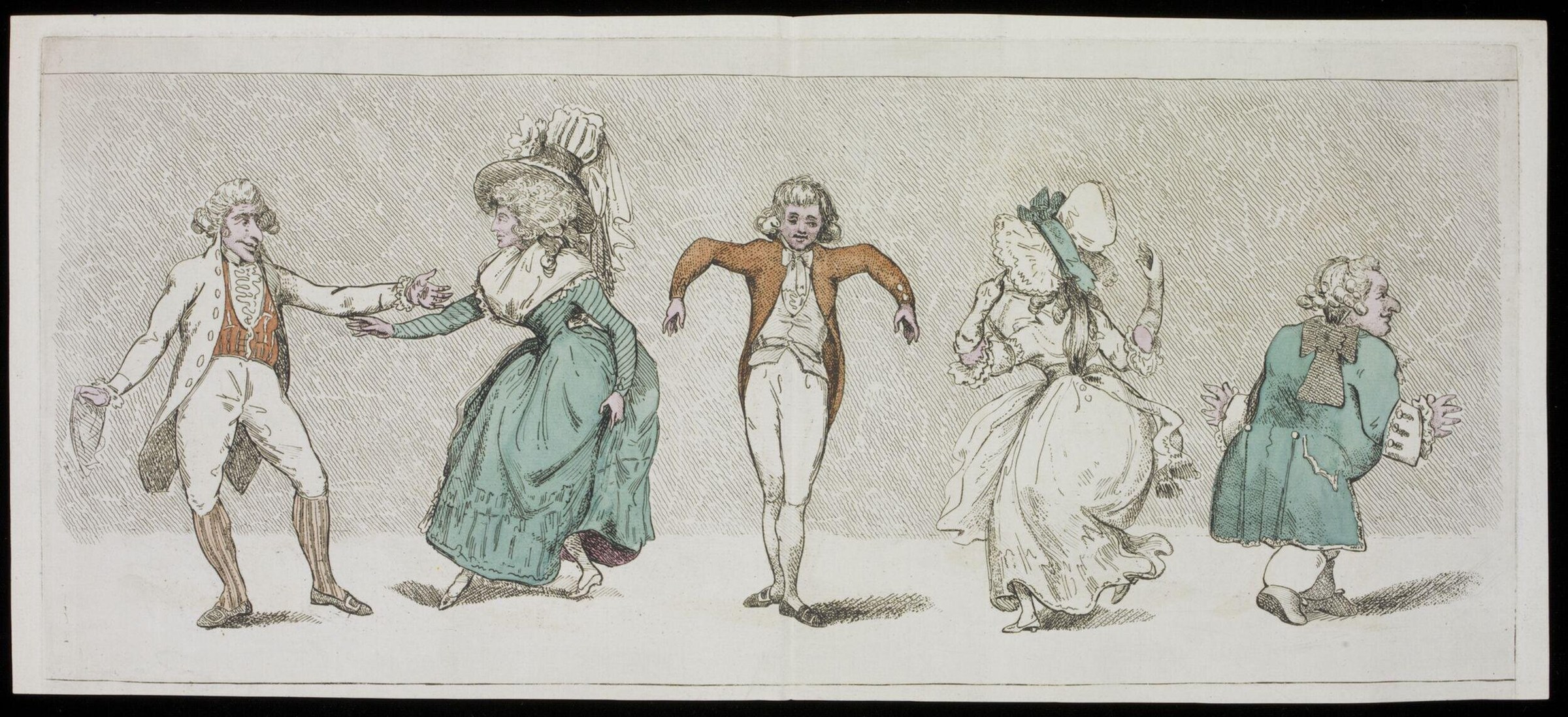
Dancing a cotillion
Unknown artist
- Medium:
- Lithograph
- Dance:
- Cotillion
- Era:
- Late 1800s (Victorian Ballroom)
- Source:
- New York Public Library
- Rights:
- Public domain — free to use, share and adapt.
- Recorded as:
- public_domain
Satirical images of dance reveal what the public found ridiculous, affected, or worthy of mockery in fashionable movement—often as much about class, gender, and pretension as about the dance itself. This print preserves the cotillion at the moment when it was becoming old-fashioned, offering insight into how different generations and social groups experienced and judged formal ballroom culture.
What you are looking at
Five figures are arranged in a line across the composition, each frozen mid-gesture in what appears to be a moment of social dancing instruction or demonstration. Reading left to right: a woman in a full-skirted dress with an elaborate headdress gestures toward a thin man in striped breeches and jacket; he faces her with one arm extended. The center figure is a woman in a high-waisted gown with feathered hair ornament and raised arms, seemingly in mid-turn. To her right stands a portly man in simplified dress, gesturing with one hand. At far right, a more elaborately dressed figure (possibly female, possibly in fancy dress or theatrical costume) wears a patterned coat or cape and decorated headpiece. The drawing style is linear and economical, with hatching for shading; the figures have the caricatured proportions and exaggerated features typical of satirical prints. The setting is abstract—no floor, walls, or furniture anchor the scene—which focuses attention entirely on the bodies and their positions.
The dancing
The dancers are shown in open or near-open positions rather than closed holds. Arms are raised, extended, or gesturing emphatically rather than maintaining frame. The poses suggest instruction, demonstration, or perhaps mockery: several figures point or gesture toward one another. Weight distribution is unclear from the simplified line work, but the stances suggest upright, formal carriage. The variety of body types and exaggerated proportions suggests this may be satirical—not a naturalistic record of skilled dancers but a comment on the social pretensions or absurdities of ballroom culture.
The dance depicted
The title identifies this as a cotillion, a formal group dance that was central to aristocratic and upper-middle-class balls in the eighteenth and nineteenth centuries. Cotillions involved couples in complex figured patterns, with leaders or directors calling or demonstrating the movements. The emphasis on gesture and demonstration here—multiple figures with raised arms, pointing—suggests the moment of instruction or the calling of a figure rather than the dance itself in full swing. The caricatured style and varied body types suggest the artist's satirical intent: mocking the pretense, affectation, or physical comedy of fashionable dancers attempting these formal movements.
How it was made
This is a lithograph, a planographic printing process in which an image is drawn on stone with a greasy medium and then inked selectively, allowing both fine line work and varied tonal effects. Lithography became widely accessible in the nineteenth century and was favored for social satire and humorous subject matter, as it permitted rapid production and wide circulation at modest cost. The linear, caricatural style here—exaggerated proportions, economical detail—is typical of the medium's use for social commentary. The technique allowed artists to reach a broad public audience, making this the kind of object that would be found in popular collections, periodicals, and satirical print shops.
About this work
This is a lithographic print depicting five figures in the poses and gestures associated with a cotillion, a formal ballroom dance of the eighteenth and nineteenth centuries. The cartoonish drawing style, exaggerated body types, and emphasis on gesture over naturalistic movement indicate that the print is satirical in intent—commenting on the absurdities or pretensions of fashionable ballroom dancing rather than celebrating it. The composition strips away setting and focuses entirely on the bodies and their interaction, making this a document of both the formal dance conventions and the popular attitudes toward them. As a mass-produced lithograph from the late Victorian period, it belongs to a rich tradition of satirical prints that used social dancing as a subject for comedy and social critique.
How to look at it
Notice the variety of body types and the caricatured proportions—the thin man, the portly figure, the elaborately dressed character at right. These are not idealized dancers but recognizable social types, which signals the satirical intent. Pay attention to the arms and hands: many are raised, extended, or pointing, suggesting the moment of instruction or direction rather than the flow of movement itself. The artist has frozen a moment of social performance where the formal rules and gestures of the cotillion are on display—and where they can be mocked. The open composition and abstract setting make the bodies themselves the sole focus, emphasizing the physical comedy or pretense of the scene.
The period
The cotillion reached the height of its popularity in the eighteenth century and remained a fixture of formal balls well into the nineteenth, but by the late Victorian era it was increasingly seen as old-fashioned or absurd—associated with an older generation's stiffness and formality. The rise of faster, more energetic dances (polka, waltz, galop) and the gradual relaxation of ballroom etiquette meant that the elaborate figures and formal deportment of the cotillion became material for satire. Lithographic prints of social dancing were a thriving genre in the nineteenth century, often used to mock fashion, affectation, and the foibles of courtship and social ambition. The exaggerated, caricatural style here is consistent with popular satirical prints of the period.
Where it lives
The work is held in the New York Public Library collection. It is catalogued as a lithograph from the Late 1800s (Victorian Ballroom) period, identified as depicting a cotillion. The artist is not recorded.
Dance in this work
Questions about this work
What is a cotillion?
A cotillion (also cotillon) is a formal ballroom dance that originated in France in the eighteenth century and became a standard feature of aristocratic and upper-middle-class balls. It involved couples arranged in lines or squares, moving through complex, predetermined figures—typically directed or called by a leader. The dance emphasized formal posture, precise footwork, and coordination among the dancers. By the late nineteenth century, when this print was made, the cotillion was considered old-fashioned or quaint, having been partly superseded by faster dances like the waltz and polka.
Why is this print satirical?
The caricatured proportions, varied body types, and exaggerated gestures signal that the artist is mocking rather than celebrating the dance. The figures are not idealized performers but recognizable social types—the thin, the portly, the overdressed—which suggests commentary on the social pretensions or physical absurdities of fashionable dancing. The emphasis on gesture and instruction rather than the grace of movement itself implies that the artist is amused by the effort and artificiality involved in maintaining ballroom decorum.
Who danced cotillions?
Cotillions were danced by the aristocracy and upper-middle classes at formal balls, assemblies, and private entertainments. They required instruction and practice, as the figures were complex and had to be executed in unison. The dance was thus a marker of social status and education. By the late Victorian period, cotillion-dancing had become associated with an older, more rigid generation, while younger dancers favored faster, less formal styles.
More Cotillion artwork