13 works in this view — arrow keys or swipe to move between them.
Dance in Art
A Cotillion
Kingsbury, Henry
- Dance:
- Cotillion
- Source:
- Victoria and Albert Museum
- Rights:
- Rights vary by item — check the source record before reusing this image. Source record ↗
- Recorded as:
- Check V&A creditLine
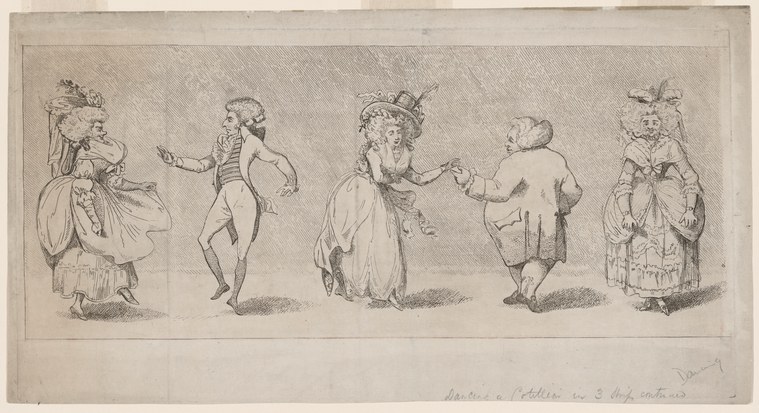
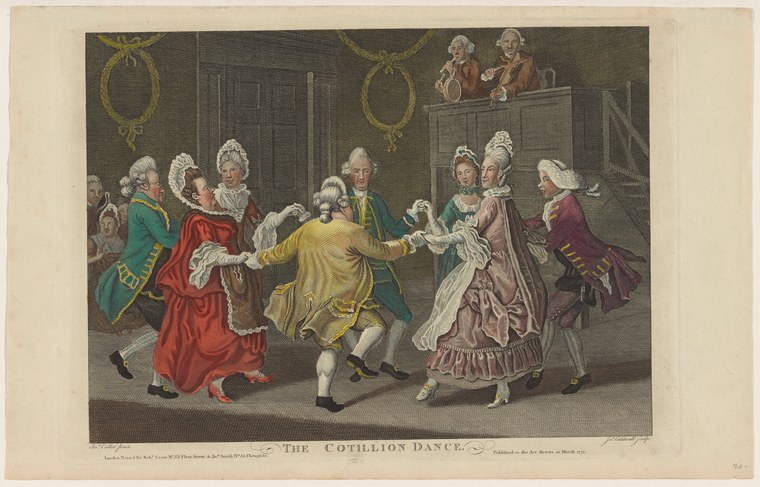
This engraving is primary-source evidence for how the cotillion was choreographed, dressed, and understood in the 18th century. For historians of social dance and ballroom culture, it offers rare visual documentation of actual positions and the spatial relationships between dancers in a regulated group form. For anyone studying the visual culture of dance—how dancers saw themselves and how their movements were recorded—this print shows the marriage of precision, fashion, and instruction that characterized print culture around dance.
What you are looking at
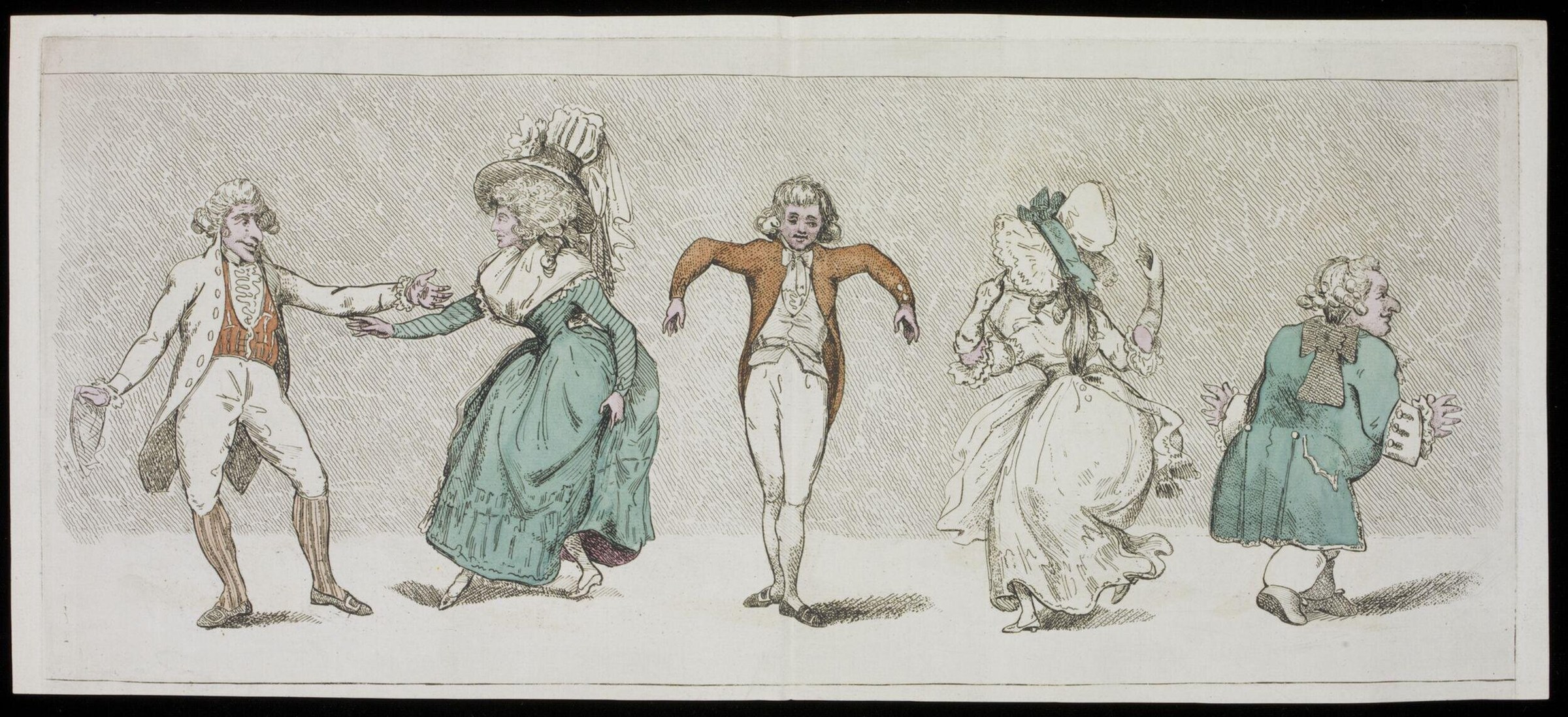
Six figures in 18th-century dress are arranged across a shallow stage space against a plain background, rendered in a hand-colored engraving. From left to right: a bare-chested man in a short brown jacket and breeches; a woman in a teal-green gown with gathered skirts and an elaborate upswept coiffure topped with feathers; a shirtless man in a brown jacket and pale breeches, posed with weight on one leg; a woman in pale muslin with flowing drapery and a large bonnet or headdress; and a smaller figure (possibly a child or young dancer) in teal-green. The figures occupy distinct positions across the composition but share an animated, gestural quality. Their poses suggest movement and social interaction—some with arms extended, others in attitudes of approach or flourish. The engraving technique, with its fine hatching and selective hand-coloring, suggests this was a printed design, likely circulated as a dance instruction print or satirical commentary on cotillion figures.
The dancing
The bodies show characteristic 18th-century ballroom posture: upright carriage, extended limbs, and open arm positions that read as courtly and formal. The women display the turned-out legs and weight distribution of court dance; the men show similar aristocratic bearing. Several figures have arms raised or extended in gestures of invitation or display, typical of cotillion choreography where partners acknowledge and move toward each other. The spacing is loose rather than in closed holds, consistent with the processional and figure-based nature of group dances of this era. The poses capture distinct moments in what may be a sequence—some figures moving toward each other, others in positions of rest or transition.
The dance depicted
The title and the catalogue label both identify this as a Cotillion, a French group dance form that became fashionable in European ballrooms in the mid-to-late 18th century. The cotillion was a structured social dance, typically performed by four or more couples in a formation, with figured movements, partner exchanges, and rhythmic patterns. This print appears to document or illustrate specific cotillion figures—the variety of poses and the way figures relate spatially suggests the artist was showing the sequence of positions dancers would assume. Cotillions were danced in court dress as shown here, and they required precision, coordination, and a knowledge of the choreographed patterns that distinguished them from improvisational couple dances.
How it was made
This is a hand-colored engraving, a printmaking technique that allowed for precise linework and rapid reproduction. The artist used fine parallel hatching to create modeling and shadow, with selective hand application of watercolor or gouache over the printed line. Engraving of this type was the standard method for publishing dance instruction plates, fashion plates, and satirical prints in the 18th century. The hand-coloring was applied after printing, which explains the slight irregularities in the color boundaries; this technique allowed publishers to issue both colored and uncolored versions at different price points. The quality of the line and the careful composition suggest a professional engraver, possibly someone with access to dance-world knowledge or court prints.
About this work
This engraving documents the cotillion, a structured group dance that dominated European ballroom culture in the 18th century. Six figures in contemporary court dress demonstrate or illustrate specific positions and figures from the choreography—the kind of instructional or commemorative print that circulated among dancing masters, nobility, and the aspiring middle classes who sought to master fashionable dances. The print captures a moment of social display: the formality of the dress, the precision of the poses, and the spatial relationships between figures all convey the cotillion's status as a dance of accomplishment, regulation, and courtly decorum.
As a dance record, the engraving is precise enough to suggest the artist understood the form. The body positions and the sequence implied by the arrangement tell a coherent story about how cotillion figures moved and related to one another. This is not a generic 'dance scene' but an attempt to fix in print the ephemeral experience of learning and performing a specific dance.
How to look at it
Pay attention to the spatial arrangement: the figures do not form a closed couple formation, but are spread across the composition in separate positions. This reflects the nature of the cotillion, where couples would move through a sequence of distinct figures and positions rather than maintain continuous contact. Notice the variety of arm positions and body angles—each figure is caught in a different attitude, suggesting the choreographic variety within a single cotillion. The engraver has also been careful to show the fashionable dress in detail: the women's elaborate skirts and coiffures, the men's jackets and stockings. These details are not incidental; they are part of the dance's meaning. The precision and lack of exaggeration in the line work suggest this is an attempt at documentary recording rather than satirical commentary.
The artist
Henry Kingsbury was an 18th-century English engraver active in London, known for work in the neoclassical and Rococo idioms. He produced both fine-art engravings and applied prints for fashion, architecture, and the decorative arts. Dance and entertainment prints were a commercial genre in which accomplished engravers could work, and Kingsbury's inclusion of this subject suggests either a commission from a dancing master, a publisher of dance instruction materials, or a market for satirical or documentary prints about fashionable social dances. The quality of the line and the compositional control visible in this print mark it as the work of a trained professional.
The period
The cotillion emerged in France in the 1750s and spread rapidly through European and American ballrooms, becoming the dominant group dance form of the late 18th century. Unlike the earlier minuet, which was a solo or couple-based display, the cotillion was collaborative and choreographed, with set figures that allowed large numbers of dancers to participate in an organized social activity. In the same period, the print and publishing industries were expanding, and dance prints—from instruction manuals to fashion-plate satire—became a significant commercial category. Engravers like Kingsbury benefited from this demand, producing images that served both instructional and entertainment purposes. The visual language of the cotillion in print—the formal dress, the ordered poses, the emphasis on spatial geometry—reflected Enlightenment values of reason, order, and improvement.
Where it lives
The work is in the collection of the Victoria and Albert Museum, which holds one of the world's largest collections of prints and drawings related to the performing arts and decorative arts. The attribution to Kingsbury and the cataloguing as a cotillion print suggests the museum acquired it as part of its systematic documentation of dance, fashion, and social history in the 18th century.
Dance in this work
Questions about this work
What is a cotillion?
A cotillion (or cotillon) is a structured ballroom dance for groups of four or more couples, typically with set figures and choreography. It originated in France in the mid-18th century and became fashionable throughout Europe and America. Unlike improvisational dances, cotillions required dancers to learn specific patterns and movements, making them a marker of social accomplishment and education.
How do we know this engraving is about a cotillion and not another dance?
The catalogue record identifies it as 'A Cotillion,' and the title was almost certainly printed on the plate or on accompanying documentation. The visual content supports this: the group formation, the mix of men and women, the formal 18th-century dress, and the variety of distinct poses all match contemporary descriptions and other prints of cotillions.
Was this print meant to teach people how to dance a cotillion?
Possibly, though more likely it served as a commemorative or documentary print—a record of a fashionable dance that could be purchased by dancers, dancing masters, or patrons interested in ballroom culture. Dance instruction in this period was primarily conveyed through notation (like Feuillet's system) or through personal instruction with a dancing master. Prints like this one functioned more as visual records than as step-by-step instructions.
Why are some dancers clothed and others not?
The men shown without shirts are displaying their breeches and stockings, which were essential to ballroom dress of the period. This was conventional in dance prints of the era—the male leg was an important visual element. It is not anatomical realism but a convention of illustration that clarified the line of the leg and the fit of the clothing.
More Cotillion artwork