42 works in this view — arrow keys or swipe to move between them.
Dance in Art · 2019
The Bengall minuet
Unknown artist
- Medium:
- Engraving
- Dance:
- Minuet
- Era:
- 1700s (Enlightenment/Minuet Era)
- Source:
- New York Public Library
- Rights:
- Public domain — free to use, share and adapt.
- Recorded as:
- public_domain
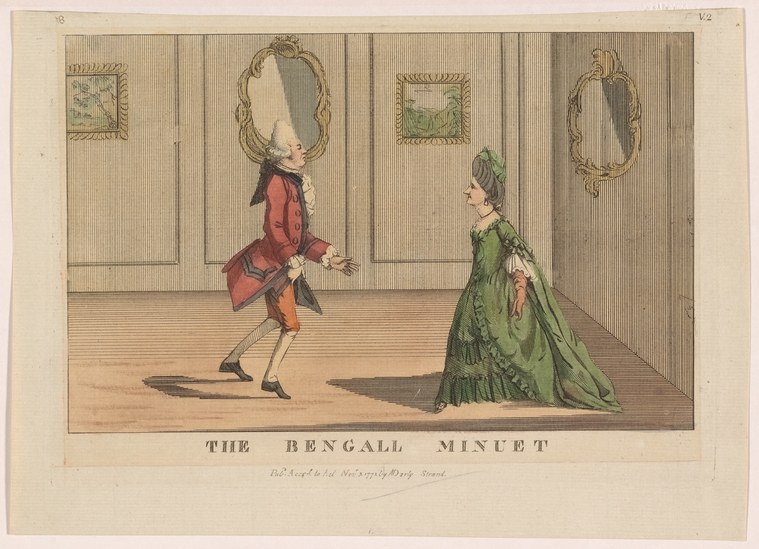
This engraving documents the gap between minuet ideology and practice: the gap between what the dance claimed to be (refined, restrained, symmetrical) and what critics or satirists saw (pretentious, prone to affectation, ridiculous). It also reveals 18th-century attitudes toward 'foreign' or colonial dance forms, presented here as objects of mockery. For historians of satire, gender, and courtship in visual culture, it is an unusually explicit depiction of male performative excess being judged by a female observer.
What you are looking at
An elegantly dressed couple performs in a rococo interior. The man, in a red coat with black trim and white stockings, strikes an exaggerated pose with one leg extended and his body twisted dramatically backward, his arms gesturing expansively. The woman, seated or kneeling in a flowing green gown with pink accents, looks toward him with an expression mixing amusement and bemusement. The setting is a formal room with vertical paneling, a polished floor, and three oval mirrors hung on the walls — one directly behind the man's head, two flanking the scene. The composition suggests a moment of courtship or theatrical flirtation, with the man's posture emphasizing display and the woman's restraint creating visual tension. The engraving's careful hatching and fine detail suggest this is a satirical or humorous depiction rather than a serious dance instruction.
The dancing
The man's body position is highly unorthodox for ballroom dance: he twists his torso sharply backward with legs in a wide, asymmetrical stance, one foot pointed behind him. His arms are raised and spread in an exaggerated theatrical gesture. The woman maintains an upright, composed posture, her body angled to address him while her expression suggests skepticism of his display. The spatial relationship — he performing, she observing — and the contrast between his wild gesticulation and her controlled bearing suggests this is satirizing male courtship display rather than depicting genuine dance partnership.
The dance depicted
The title claims this depicts a 'Bengall minuet,' but the man's posture and movement contradict minuet conventions entirely. The minuet, the dominant courtly dance of the 18th century, required symmetrical, controlled steps with a specific hold and frame. This figure's contorted twist, extended leg, and raised arms are closer to theatrical burlesque or exaggerated character dance. The image appears to be satirizing either a specific dancer's affectation, a colonial parody, or the pretensions of minuet performance itself. Without additional historical context about what a 'Bengal minuet' was — whether it was a real dance variant, a travesty, or an invention — we cannot identify the actual dance being depicted or mocked.
How it was made
This is an engraving, a printmaking technique that allowed for mass reproduction and wide circulation. The fine parallel lines (hatching) create tone and shadow, particularly visible in the background paneling and on the figures' clothing. Engravings of this period were commonly used for satirical social commentary and theatrical caricature, distributed through print shops to an educated urban audience. The technical precision of the line work and the careful composition suggest this was a commercial print of some circulation, not a unique work.
About this work
This is an 18th-century satirical engraving depicting an absurd male dancer in an elaborate red coat performing opposite a skeptical woman in a green gown. The title claims it shows a 'Bengall minuet,' but the man's contorted posture and theatrical gestures contradict everything the minuet actually was — a controlled, symmetrical court dance. The image appears designed to mock either a specific dancer's affectations, colonial pretensions, or the idea of 'exotic' dance variants. The woman's composed expression and seated position reinforce the satire: while he gestures wildly, she remains unmoved, inviting the viewer to join her in skepticism.
The work survives as evidence of 18th-century print culture's use of dance imagery for social satire. It tells us that minuets, despite their refined reputation, were considered a target for ridicule, and that humor about 'exotic' or 'foreign' dances — whether the Bengal reference is real or invented — circulated in fashionable circles.
How to look at it
Attend to the radical asymmetry of the man's body: his backward twist, his extended leg, his raised arms. None of these positions belong to minuet vocabulary, which prized symmetry and control. Then look at the woman: her stillness, her gaze, her posture. She is not his dance partner; she is his audience and judge. The artist has frozen the moment of his maximum display and her minimum reaction, inviting laughter at the contrast. The three mirrors on the wall may also be significant — reflecting the dancer back to himself, or inviting viewers to see themselves as observers of his folly.
The period
The minuet dominated 18th-century ballroom culture from court to urban assembly rooms. By mid-century, however, it was attracting criticism for its artificiality and slowness, and caricaturists frequently targeted minuet dancers for their exaggerated politeness, their excessive ornamentation, and their susceptibility to fashion. Simultaneously, European interest in exotic and colonial subjects was growing, often expressed through parody and burlesque. The reference to a 'Bengal minuet' likely exploits both trends: mocking minuet pretension while also making light of colonial difference. Satirical engravings were a major vehicle for this kind of social commentary in London and Paris.
Where it lives
The work is held in the New York Public Library collection and entered their records through their print and images department. It is catalogued as an engraving from the 1700s, circulated as a commercial print.
Dance in this work
Questions about this work
Is this actually showing a real 'Bengal minuet'?
Almost certainly not. The man's posture violates every rule of minuet dancing. The title is likely part of the joke — either satirizing European fascination with 'exotic' dances, or mocking a specific dancer's pretensions to have invented such a thing. No historical evidence suggests the Bengal minuet was a real or recognized dance form.
Why is the woman so still while he moves so much?
Because the image is satirizing male courtship display and inviting viewers to share the woman's skepticism. In an actual minuet, both partners would move symmetrically. Her stillness and composed expression mark his behavior as excessive, ridiculous, or untrustworthy.
What do the mirrors mean?
The three oval mirrors might simply indicate a fashionable drawing room, or they might suggest the dancer's narcissism — he is performing for his own reflection as much as for the woman. They also create multiple sight lines that make the viewer complicit in observing his absurdity.
Is this making fun of minuets or of 'exotic' dances?
Both, probably. The image satirizes minuet pretension and affectation, while the title 'Bengal minuet' allows it to also mock European fascination with foreign or colonial subjects by presenting such a 'dance' as ridiculous.
More Minuet artwork