35 works in this view — arrow keys or swipe to move between them.
Dance in Art · 2019
Ballroom dancing
Unknown artist
- Medium:
- Dance:
- Ballroom
- Source:
- New York Public Library
- Rights:
- Public domain — free to use, share and adapt.
- Recorded as:
- public_domain
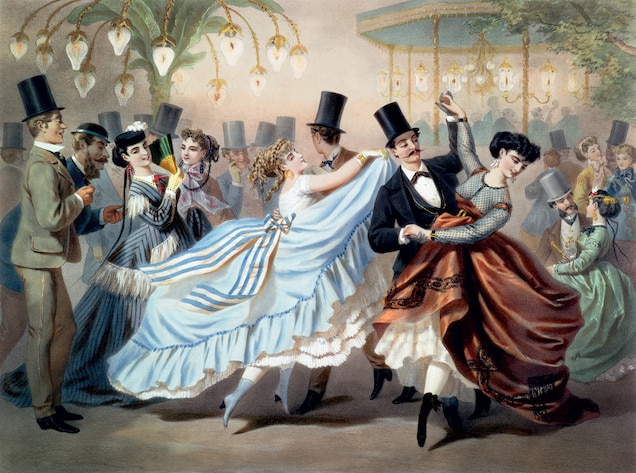
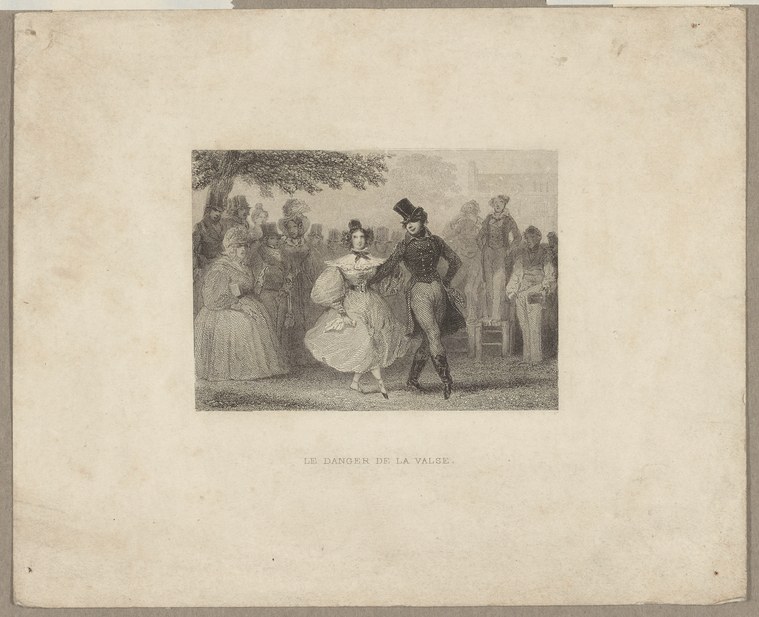
This is one of the primary visual documents of early Waltz culture and its social meaning. It captures the exact posture, costume, and performance context that made the Waltz so controversial and so central to Regency society. For dance historians, it is direct evidence of how the dance was executed and displayed; for art historians, it exemplifies the 'dances of the day' genre of Regency prints that recorded fashionable life.
What you are looking at
A social ballroom scene set outdoors under trees, rendered as a finely detailed engraving. A couple dominates the center: a woman in a white empire-waist gown with her skirt lifted and swirling mid-movement stands opposite a man in dark formal dress—tailcoat, fitted breeches, and a tall hat—in an animated pose. Around them stand spectators in Regency-era dress: women in high-waisted gowns and men in evening coats, some watching intently, others conversing. The composition captures a moment of social performance rather than mere technical instruction; the woman's raised skirt and the man's energetic posture suggest rapid, exuberant movement. Light and shadow are used to focus attention on the dancing couple, with the surrounding figures rendered in softer tones. The engraving's fine hatching and linear detail typical of 19th-century reproductive prints give the scene an air of social documentation.
The dancing
The lead dancer (male) stands in a striking attitude: upper body animated, one leg extended or about to step, posture suggesting forward momentum and directional intention. His partner holds her skirt aloft with one or both hands, creating the billowing volume visible in the engraving—a gesture that exposes the lower leg and ankle and was central to the performance of Regency-era social dances. Their bodies are separated but engaged; the spatial relationship and their body angles suggest a partnered dance in progress. The spectators' fixed gaze on the couple confirms this is a watched performance, not a casual embrace.
The dance depicted
This is almost certainly the Waltz, the defining couples' dance of the Regency era (c. 1811–1820). The evidence is composite: the close proximity of the partners, the woman's lifted skirt (a hallmark of waltz prints and paintings of this period), the formal ballroom setting with spectators, and the dynamic posture of both dancers. The Waltz scandalized conservative society precisely because of its speed, the closeness of the hold, and the visual effect captured here—the swirling skirt as a marker of rapid turning. This engraving documents how the dance appeared to contemporary eyes and why it provoked both fascination and moral anxiety.
How it was made
This is a finely executed engraving, likely hand-colored or designed for hand-coloring, as indicated by the soft tonal work and the delicate parallel hatching typical of early 19th-century print-making. The technique allowed for multiple impressions and wide circulation—images like this were distributed as popular prints to document fashionable life. The engraving's precision and the careful rendering of detail (fabric texture, facial expression, architectural elements) suggest this was a commercial or semi-commercial production intended for a middle- to upper-class audience interested in scenes of genteel society. The title inscribed below confirms its function as a documented 'view' of ballroom behavior.
About this work
This engraving documents the Waltz as it was performed and perceived in the Regency era, capturing not just the technical elements of the dance—the proximity of partners, the turning motion, the woman's lifted skirt—but also its social context: a watched, formalized performance at a fashionable gathering. The image serves as evidence of how the dance appeared, how it was dressed, and the social ritual surrounding it. The engraving's precision and circulation as a popular print made it an instrument of cultural documentation, recording a dance that was simultaneously celebrated as modern and condemned as scandalous.
How to look at it
Attend to the woman's posture and the position of her skirt: this lifted, swirling volume is the signature visual marker of the Waltz in period imagery and was controversial because it exposed the ankle and the lower leg. Note the spatial closeness of the partners and the direction of their bodies—the male dancer's forward momentum and the female dancer's weight distribution suggest the characteristic turning, traveling motion of the dance. Observe the spectators' expressions and body language: they are watching intently, which underscores that this is a performance, a display of fashionable skill and daring. The engraver has chosen to freeze a moment of maximum visual drama—the skirt at full swell, the man in an animated stride—rather than a neutral position.
The period
The Waltz arrived in England from continental Europe around 1810–1812 and provoked intense social debate. Conservative moralists objected to the dance's speed, the closeness of the male embrace around the woman's waist, and the resulting motion of her skirts. The dance became a symbol of modernity and continental sophistication among younger, fashionable society, while older generations saw it as morally dangerous. Prints like this one—depicting the Waltz in ballroom settings with spectators—became a popular way to document and disseminate images of the new dance to a broad audience. Such prints served both to celebrate fashionable innovation and, in their detailed documentation, to allow disapproving viewers to understand exactly what the fuss was about.
Where it lives
This engraving is held in the New York Public Library collections. It is a print document from a period when ballroom dances were widely recorded in visual form for popular circulation, making it an artifact of both artistic and social history.
Dance in this work
Questions about this work
Why is the woman's skirt lifted?
The Waltz involved rapid turning and traveling movement, and the woman's skirt, made of thin muslin or similar fabric, would naturally lift and swell with the motion. However, the raised skirt was also controversial: in earlier court dances, women's skirts remained still. The visible ankle and leg were seen by critics as immodest. Print artists emphasized this lifted skirt in Waltz imagery because it was visually striking and because it symbolized the dance's modernity and, to its opponents, its impropriety.
How was the Waltz different from earlier ballroom dances?
Earlier dances like the Quadrille and Cotillion involved formal lines, specific figures, and less physical contact between partners. The Waltz was fast (typically in 3/4 time), required partners to hold each other closely throughout, involved continuous turning and traveling, and was improvised rather than choreographed in advance. These qualities made it thrilling to its advocates and alarming to conservative observers. The engraving documents exactly why the dance provoked such intense reaction.
Who danced the Waltz?
By the Regency era, the Waltz was danced by fashionable society—the aristocracy and upper-middle class at balls and private assemblies. It was not a folk dance but a courtly, urbane form associated with Vienna and continental Europe. The engraving depicts precisely this world: a formal ballroom with well-dressed spectators and partners engaged in the display of social accomplishment and modernity.
More Ballroom artwork