34 works in this view — arrow keys or swipe to move between them.
Dance in Art
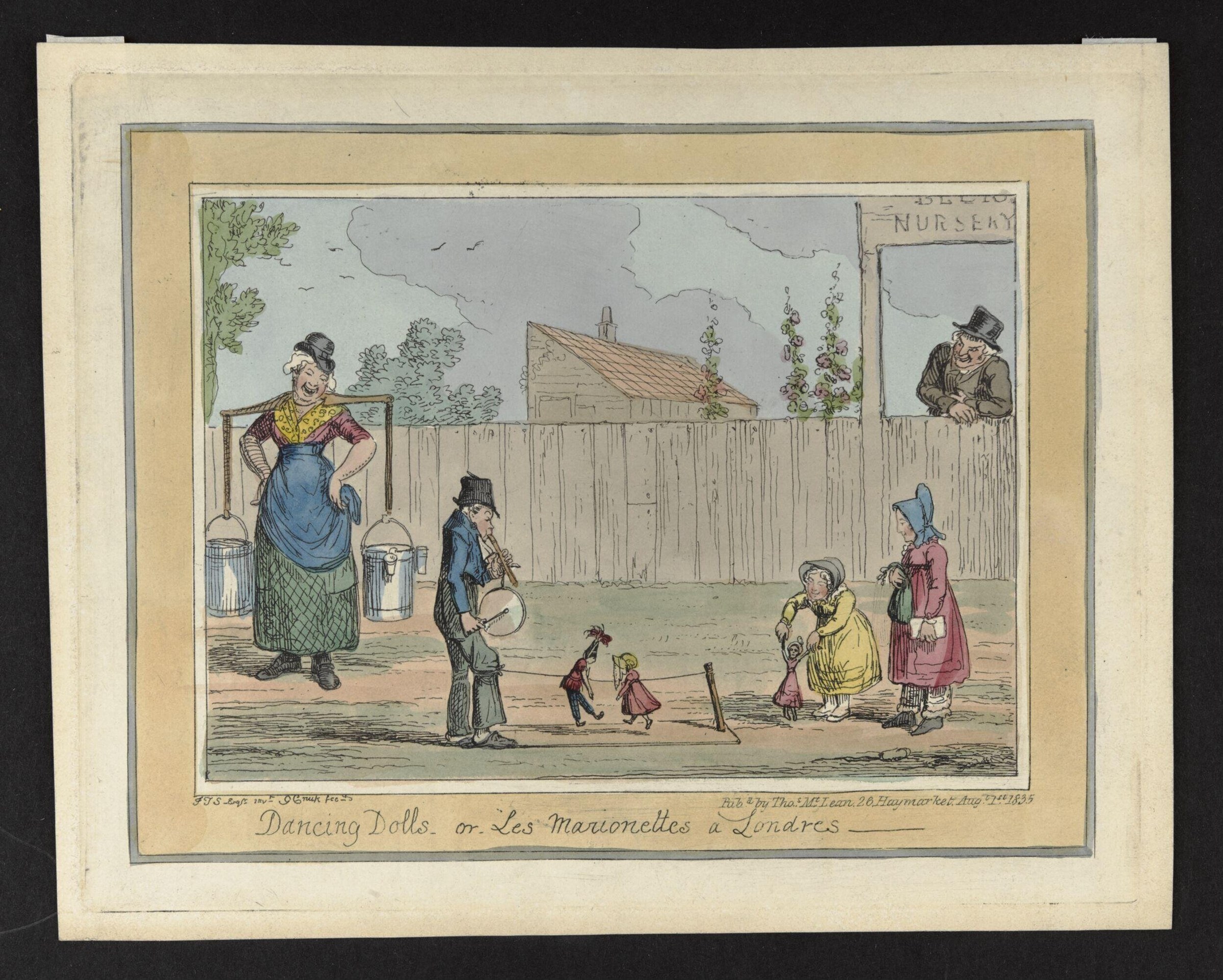
'Dancing Dolls, or, Les Marionettes a Londres'
Cruikshank, George
- Dance:
- Ballroom
- Era:
- Mid 1800s (Polka Era)
- Source:
- Victoria and Albert Museum
- Rights:
- Rights vary by item — check the source record before reusing this image. Source record ↗
- Recorded as:
- Check V&A creditLine
The print documents a now-vanished form of street theatre and reveals what captivated urban children in the 1830s. It also shows how the human appetite for watching bodies move was satisfied through multiple forms—not only by dancers but by puppeteers and mechanical performers. For historians of popular entertainment and urban social life, it is a rare contemporary record of a performance genre that left few other traces.
What you are looking at
A lively street scene in London, rendered in hand-coloured engraving, shows adults and children gathered in what appears to be a nursery or public garden bounded by a wooden paling fence. A woman in a blue dress and yellow bodice stands to the left holding two buckets, watching the action. In the centre, a man in dark coat and top hat operates a puppet show or barrel organ, his arm extended in demonstration. Before him, two small articulated dolls or puppets are suspended, dancing or being manipulated. Three children in period dress—one in yellow, two in pink and blue bonnets—stand to the right, clearly delighted by the spectacle. A second adult male in a brown coat and top hat peers over the fence from the right, observing the entertainment. Trees and a house with a red-tiled roof are visible in the background. The composition captures a moment of street entertainment, with the focus on the children's absorption in the dancing dolls.
The dancing
The puppets are shown in a sprightly pose, limbs splayed and bodies angled as if mid-leap or suspension. The operator holds them aloft with a single extended arm, suggesting articulation by string or rod. The children stand with rapt attention, their postures upright and engaged, bodies turned toward the dolls. The watching woman and second adult are static observers. No human dancers are present; the 'dancing' is entirely that of marionettes.
The dance depicted
This is not a depiction of human dance but of a street entertainment form—puppet theatre or marionette dancing—that was a common sight in early 19th-century London. The print documents the performance context rather than a codified dance style. The dolls are shown in exaggerated, gymnastic postures that exploit the freedom of articulated puppets to move in ways human bodies cannot easily achieve. This reflects the appeal of mechanical or puppeteered performance: the violation of natural weight and gravity. Children and servants were the primary audience for such street entertainment.
How it was made
Hand-coloured engraving, as indicated by the fine line work and the application of watercolour or gouache over the printed surface. The technique allowed rapid reproduction and distribution of topical scenes of urban life. The particular combination of precise linear engraving with selective colouring was standard for satirical and observational prints of the era, making them affordable for middle-class print collectors. The inscription at the base and the framing lines suggest this is a page from a print series or publication.
About this work
This work records a fleeting moment of street culture in Regency London: the puppet entertainer's performance for children. Cruikshank was a master satirist and social observer, and this print sits within his larger body of work documenting urban leisure and performance. The image is not about dance as a bodily practice but about the spectacle of puppetry as it was consumed and experienced in the city. It belongs in a gallery of dance in art because it captures how mechanical or suspended bodies were made to move, and because it records an audience's relationship to motion and entertainment.
How to look at it
Attend to the puppet operator's posture and the angle of suspension—Cruikshank has caught the moment of maximum extension, when the dolls are most fully splayed and animated. Notice the contrast between the rigid, geometric poses of the puppets and the softer, rounded poses of the watching children. The woman's bucket-holding stance and the second observer's fence-leaning suggest the social layering of the street: servants and children consume this entertainment while adults supervise or pause in passing. The artist has frozen the instant of entertainment to show not the puppets' motion but the children's reception of it.
The artist
George Cruikshank (1792–1878) was England's leading satirical and social engraver of his time. He worked prolifically across etching, engraving, and hand-colouring, producing thousands of prints on political, moral, and social themes. His work combined sharp observation of daily life with caustic wit. He was particularly interested in street culture, working-class leisure, childhood, and urban spectacle. This print exemplifies his documentary impulse alongside his comedic eye.
The period
The 1830s in London saw a flourishing of street entertainment and public amusements, from itinerant musicians and performers to the early development of popular theatre. Simultaneously, the Romantic era's investment in childhood and the child's perspective made scenes of children's delight a subject of artistic and commercial interest. Cruikshank's prints circulated widely and shaped how urban Londoners saw and understood their own city. This was also the era before photography, so engraved prints were the primary medium for capturing and disseminating images of contemporary life.
Where it lives
The work is held in the Victoria and Albert Museum collection, catalogued as a hand-coloured print. The inscription and framing suggest it was part of a larger publication or series documenting London life.
Questions about this work
Are the figures actually dancing?
No. The 'dancers' are articulated puppet dolls, operated by the entertainer via strings or rods. The title plays on this duality: they are dolls that dance, or marionettes, not human dancers. The work documents the puppet show as a form of entertainment rather than human choreography.
Where would you see this performance in 1835?
On London streets, in public gardens, or at fairs. The wooden fence suggests this may be a nursery or private garden where such entertainment was hired or appeared. Street puppeteers and barrel-organ operators were common sights in urban areas and were a cheap or free entertainment for working-class children and servants.
Why did Cruikshank choose this scene?
Cruikshank was fascinated by street life and childhood experience. The scene combines two of his interests: the visual comedy of exaggerated puppet movement and the delighted, absorbed expressions of children. It is both a record of social reality and a gentle satire on entertainment and gullibility.
What does the hand-colouring tell us?
The colouring was applied by hand after printing, a labour-intensive process that added cost and made the print more desirable as a collectible. It suggests this was a relatively high-status print intended for middle-class collectors rather than the cheapest penny prints for mass distribution.
More Ballroom artwork