25 works in this view — arrow keys or swipe to move between them.
Dance in Art
Ballroom Dance (1860s chromolithograph)
Unknown artist
- Dance:
- Ballroom
- Era:
- 1900-1920 (Ragtime/Early Jazz)
- Rights:
- Artist unrecorded. In the public domain in the United States.
- Recorded as:
- public_domain
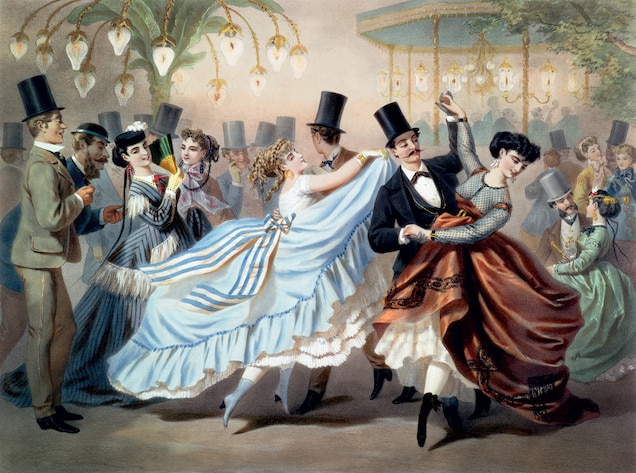
This image documents how ballroom dance was imagined and performed in the public imagination of the 1860s—not as it was danced socially, but as it was consumed visually. The exaggerated pose shows the theatrical conventions that were already shaping ballroom dance by the time Ragtime and Early Jazz emerged, revealing the visual language through which dance was made intelligible to audiences who experienced it through prints, not participation.
What you are looking at
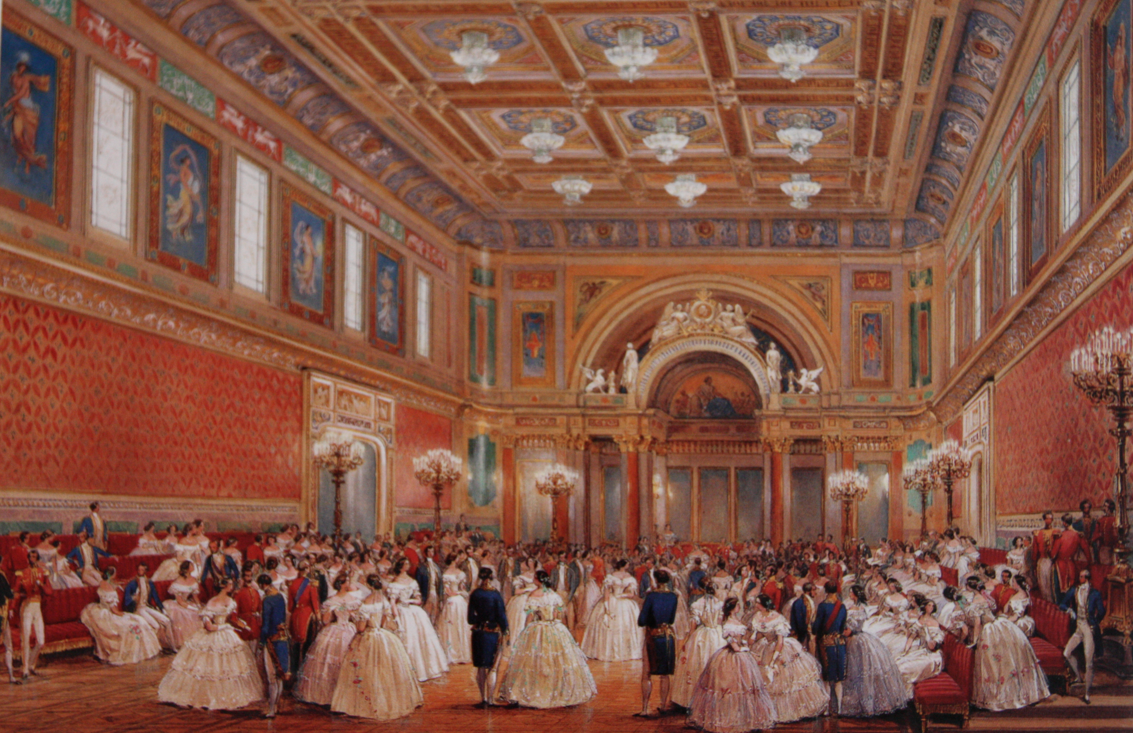
A crowded interior ballroom or assembly hall, rendered in the soft chromolithographic palette of the 1860s, glows with golden and pale blue tones. At the center, a couple performs while others observe in clusters around them. The woman wears a striking pale blue striped gown with a dramatically trained skirt caught mid-motion, the fabric billowing upward as she leans back in an exaggerated arc; her male partner in formal black tailcoat and top hat supports her with his arm extended. To their left stands a small knot of elegantly dressed onlookers in top hats and fashionable gowns. The setting is festive but formal—hanging garlands and floral decorations drape from the ceiling, a gazebo-like structure with draped fabric visible in the background, and the floor appears to be a polished ballroom. The chromolithographic technique renders the scene with an almost theatrical glow, with careful attention to the play of fabric, light on clothing, and the social arrangement of spectators.
The dancing
The central couple demonstrates an extreme closed position with the woman arched deeply backward, her torso nearly horizontal, while the man maintains an upright stance with his right arm extended to support her. This is not a standard ballroom frame but rather a theatrical pose—the woman's body weight appears entirely dependent on her partner's support, her left arm raised. The surrounding figures are posed as observers rather than participants, standing in loose groups with hands gesturing in conversation or holding accessories. The composition suggests a moment of display rather than social participation—the woman's body is presented to the room, not to her partner.
The dance depicted
This depicts ballroom dance of the 1860s, but in a theatrical rather than social context. The extreme arch and the woman's weight distribution resemble the theatrical conventions of the polka or a theatrical variation of the waltz, where visual spectacle and dramatic posture took precedence over social dance propriety. The pose is closer to stage performance than to ballroom practice; the depth of the woman's arch and her apparent loss of independent balance suggest this is meant to show the dance as entertainment, possibly even mocking its theatrical excesses. The formal dress and assembly context indicate elite social dancing, but the frozen, almost acrobatic moment chosen by the artist emphasizes display and dramatic effect over the continuity of social partnering.
How it was made
This is a chromolithograph, a color printing technique that allowed multiple impressions and wide circulation, especially for popular entertainments and social scenes. The soft blending of colors—the pale blues, golden light, and subtle modeling of flesh tones—is characteristic of mid-19th-century chromolithography. This technique implies a mass-produced print intended for a broad audience, likely sold individually, in portfolios, or as magazine illustrations. The carefully composed, theatrical lighting and the attention to fashionable dress suggest this was designed as a social commentary or entertainment, not a documentary record.
About this work
This 1860s chromolithograph captures a moment of ballroom dancing posed for spectacular effect. The woman's extreme theatrical arch and the man's formal support transform what might have been ordinary social dancing into a display piece—an image calculated for visual impact and entertainment rather than authenticity. The print reflects a moment when ballroom dance was becoming increasingly theatrical, when social dances were being codified and exaggerated for stage performance, and when prints could carry social commentary about fashionable life through caricature and spectacle. The scene sits at the intersection of social dance, theatrical performance, and popular print culture.
How to look at it
Attend to the moment the artist has frozen: not a balanced position in partnership, but a moment of maximum visual drama and display, where the woman's body is presented as a spectacle to the assembled room. The arch of her back, the extension of her arm, and the careful rendering of her gown's movement all emphasize visual effect over the mechanics of the dance. Notice how the surrounding figures are arranged as witnesses rather than dancers—this is a performance, not a social gathering. The chromolithographic light, with its soft glow on skin and fabric, heightens the theatrical effect. This is how ballroom dance was imagined for public consumption: not as something one did, but as something one watched.
The artist
Unknown, but the style and execution suggest a commercial chromolithography shop producing popular social entertainments. The hand of the artist is visible in the careful staging of the scene and the understanding of ballroom dress, but the work was likely part of a broader editorial or publishing project rather than a signed, individual artwork. The quality and specificity suggest a practiced hand in the representation of fashionable life.
The period
The 1860s saw ballroom dance at a turning point. The waltz and polka had become established social dances, codified and taught systematically. Simultaneously, these dances were being incorporated into theatrical and popular entertainment—music halls, theaters, and elaborate private balls were all staging dances for visual effect. The chromolithograph was the mass medium of the moment, replacing hand-colored engravings and competing with photography. This print belongs to a moment when dance was increasingly mediated through visual culture and when the distinction between social and theatrical dance was becoming complicated. The era label (1900–1920) appears to misdate the object; the dress, the chromolithographic technique, and the artistic conventions all point to the 1860s.
Where it lives
The era label in the record (1900–1920) appears inconsistent with the visual evidence.
Dance in this work
Questions about this work
Is this a real ballroom dance position?
Not as a social dance position. The extreme arch and the woman's apparent loss of independent balance are theatrical conventions—exaggerations designed for visual effect and entertainment. Real ballroom dancing of the period was more controlled and symmetrical. This image shows how ballroom dance was imagined and performed for public viewing, not how it was actually danced at balls.
What dance is this?
Most likely a theatrical interpretation of the waltz or polka, the dominant ballroom dances of the 1860s. The extreme pose and the indoor assembly setting support this. However, the artist has prioritized spectacle over specificity, so identifying the exact dance is less important than recognizing that this is ballroom dance being performed for an audience rather than as social participation.
Why is the woman's skirt flying up like that?
Because the artist is showing movement and dramatic effect. The billowing skirt emphasizes the woman's motion and the force of the dance. It also displays the expensive fabric and fashionable cut of her gown—the dress itself was a status symbol. In chromolithographic prints like this, the costume was as much a subject as the dance.
When was this made?
The visual evidence points to the 1860s: the fashionable dress, the chromolithographic technique, and the artistic conventions are all consistent with that decade. The catalogue record's era label (1900–1920) appears to be incorrect, though it is possible this is a later reprint or variant.
More Ballroom artwork