35 works in this view — arrow keys or swipe to move between them.
Dance in Art
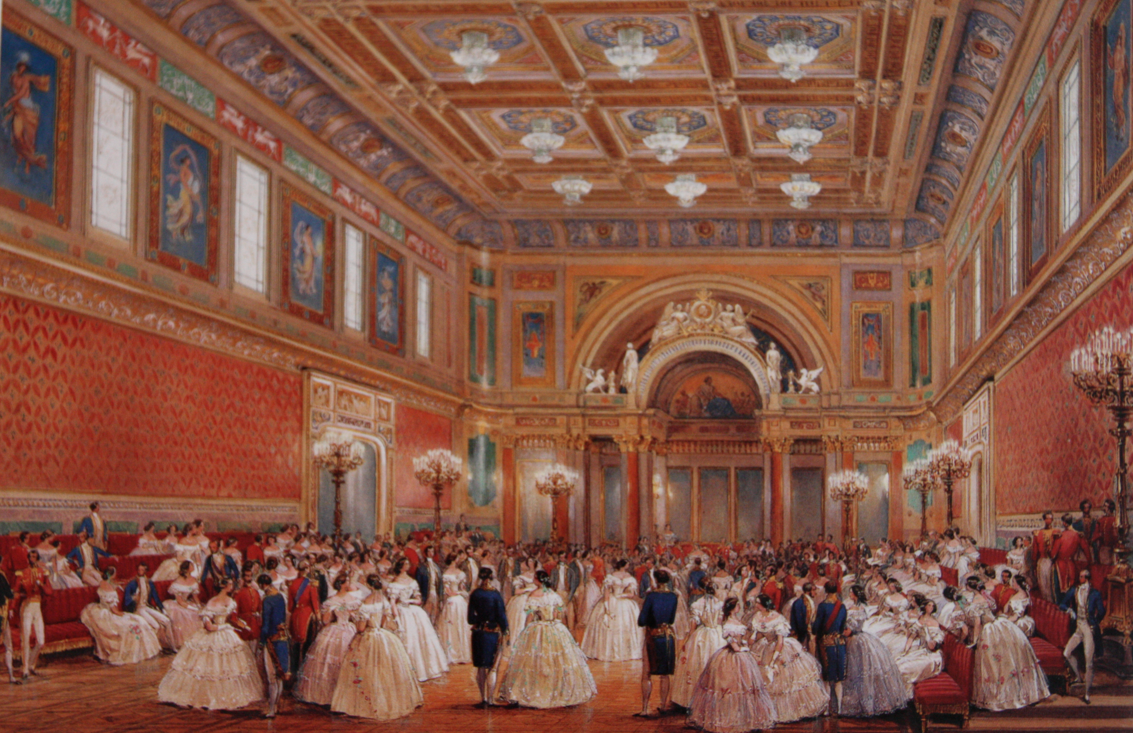
The Ballroom, Buckingham Palace
Louis Haghe
- Medium:
- Lithograph
- Dance:
- Ballroom
- Era:
- Late 1800s (Victorian Ballroom)
- Source:
- Wikimedia Commons
- Rights:
- Public domain — free to use, share and adapt.
- Recorded as:
- public_domain
This image is one of the few surviving visual records that show social ballroom dance in actual use at the highest level of British society, rather than as an idealized or theatrical subject. It demonstrates convincingly how costume, architecture, and social protocol worked together to shape the dancer's body and the meaning of the movement. For anyone seeking to understand how the waltz and quadrille were actually performed in the period that codified them, this image provides necessary evidence: the verticality of the frame, the restraint of the lower body, the formal spacing of couples, and the dominance of processional over rotational figures.
What you are looking at
A grand formal ball fills an ornate ballroom in a scene of coordinated social spectacle. The space is defined by its architecture: a coffered and painted ceiling with gilded trim spans the length of the room, supported by pilasters and punctuated with white ceiling roses; tall windows with white frames line one wall; and a monumental arched recess dominates the far end, flanked by white sculptural figures and topped with gilt ornament. The walls are papered in a rich coral-red damask, broken by green pilasters and rectangular painted panels above the dado. Crystal chandeliers hang throughout. The floor is a polished wood parquet.
On this floor, dancers and their attendants move in patterns of controlled sociability. Women wear pale gowns—white, cream, pale pink, pale lavender—many with full skirts that read as crinolined and white or pale gloves to the elbow; men wear dark formal dress, many in navy or black coats with pale trousers. The women's hair is styled close to the head, a period convention. The figures cluster and disperse across the floor in small groups of three to six, some pairing off to dance, others standing in conversation. The disposition is formal but animated: there is clear spatial hierarchy, with the periphery reserved for attendants and chaperones and the center of the floor as performance space. A few figures in distinctly richer red fabrics—suggesting household officers or military dress—maintain positions of authority at the edges. The whole presents an ordered pageant of elite courtship and alliance-making.
The dancing
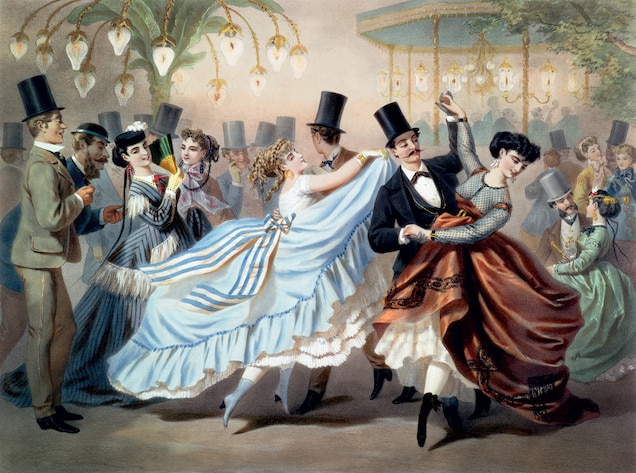
The dancers visible mid-movement show the closed frame characteristic of the period's ballroom dances: couples stand approximately face to face or in three-quarter profile, the man's right hand on the woman's back or waist, their left hands joined or held at shoulder height. Weight appears to be vertical and controlled; there is no sense of deep knee bends or dramatic inclination. The women's full skirts constrain legwork to small traveling steps; the silhouette depends on the dress rather than on footwork. Most of the visible pairs are in stationary or promenade positions rather than turn, suggesting waltz, quadrille, or cotillion figures that emphasize processional and geometric arrangement over rotational speed. The groups standing apart show the formal posture expected of spectators—upright, attentive, engaged in conversation but never leaning or at ease.
The dance depicted
The scene depicts a formal court or aristocratic ball of the mid-to-late Victorian era, in which multiple social dances would have been performed in sequence—most likely including the waltz, quadrille, polka, and other ballroom standards of the period. The artists has chosen to show a mixed moment: several couples actively dancing in closed hold, others waiting or promenading, and a larger proportion simply present as spectators, which was the norm for a ball where not all guests danced. The prominence of the formal pairs and the geometry of their spacing across the floor suggest this is waltz or quadrille in motion. The scene does not depict a single dance type in isolation but rather the whole social institution of the Victorian ballroom, in which dance was only one of several social performances.
How it was made
This is a hand-colored lithograph, a technique that allowed for efficient reproduction of architectural interiors and social scenes for a middle-class market hungry for images of aristocratic life. Lithography's characteristic soft tonal range and ability to render large flat areas of color (such as the papered walls and painted ceiling) made it ideal for depicting interior space with depth and atmosphere. Hand-coloring was applied after printing, accounting for the somewhat uneven finish of the reds, greens, and golds, and the occasional variations in intensity across the page. The technique implies this was a popular commercial print, likely issued as part of a series of palace or institutional interiors, and would have circulated among middle-class households unable to enter such spaces themselves. The lithographic surface also allowed the artist to capture fine detail—the individual panes of the windows, the ornamental schemes of the ceiling—that reinforced the aspirational documentary quality.
About this work
This hand-colored lithograph records a formal ball in the ballroom at Buckingham Palace, the London residence of the British monarchy. It captures not a single dance in progress but the complete social apparatus of a Victorian court ball: multiple couples in the closed positions of waltz or quadrille, a large population of onlookers and attendants maintaining the social structure, and an architecture of such ornament and scale as to subordinate the human figures to the grandeur of the space itself. The artist has rendered this as a scene of disciplined sociability—every figure is precisely placed, every posture regulated by etiquette—yet also conveyed the vivacity of the event through color, the distribution of figures, and the sense of coordinated motion.
The work sits at the intersection of three historical preoccupations: the Victorian appetite for images of aristocratic life; the development of lithography as a commercial medium for social reportage; and the refinement of the ballroom as a space for the regulation and display of courtship and political alliance among the elite. For a dance historian, it documents both the physical grammar of mid-Victorian social dance—the frame, the costume, the spatial protocol—and the broader context in which dance functioned as an instrument of social hierarchy and control.
How to look at it
The artist has composed the scene to emphasize both motion and order: couples are distributed across the floor in a pattern that suggests simultaneous rotation around multiple centers, while the architecture frames and contains this movement within a space of overwhelming permanence and grandeur. Look closely at the nearest couples to see the specific frame of the dance: the closed hold, the woman's posture, the engagement of the arms. Notice how many figures are standing still—the work is as much about the social infrastructure of the ball as about the dance itself. The precision of the architecture and the formality of the dress code the scene the dance firmly in the aristocratic ritual of the mid-Victorian period; this is not a public dance hall or a romantic tableau, but an institution.
The artist
Louis Haghe (1806–1885) was a Belgian-born lithographer and watercolorist who became one of the most prolific and successful architectural illustrators of the Victorian era. He had trained in Bruges and Brussels before moving to London in the 1820s, where he established himself as a specialist in the lithographic reproduction of historical monuments, palaces, and grand interiors. His work was widely disseminated through commercial print publishers, making his images of British palaces and institutions among the most familiar visual documents of aristocratic spaces for the Victorian middle class. Haghe also worked as a topographical artist and had a long association with London art institutions; his skill lay in rendering architectural ornament with both technical accuracy and atmospheric depth, a combination that made him invaluable to the commercial market for images of places the public could not enter.
The period
This lithograph dates to the mid-to-late Victorian period, an era of unprecedented growth in commercial lithographic printing and a corresponding appetite for images of court life and aristocratic ceremony. The waltz had become the dominant ballroom dance of elite society following its adoption in the early 19th century, though the quadrille, cotillion, and other set dances remained standard parts of a ball's program. By mid-century, the Victorian ballroom had evolved into a highly formalized space governed by strict rules of dress, comportment, and participation; a ball at Buckingham Palace would have been the pinnacle of the social season, attended by hundreds and subject to intense public curiosity. Lithographic prints of such events—often issued shortly after they occurred or in commemorative series—fed this curiosity and allowed those outside court circles to visualize elite social practice. The ballroom itself, with its monumental proportions and ornamental excess, had come to embody the power and permanence of the aristocratic order.
Where it lives
The source record indicates this work is from Pinterest, with no institutional holding recorded. This suggests it may be from a dispersed print collection or held in a private archive. As a commercial lithograph by an established artist, it likely survives in multiple examples; the absence of an accession number in the available record makes its current location uncertain.
Dance in this work
Questions about this work
What dance are they doing?
The scene shows multiple dances likely being performed simultaneously, as was standard at a Victorian ball. The visible couples in closed hold are most likely waltzing or performing figures of the quadrille. We cannot determine a single dance type from this image, as the artist has captured the ball as a whole social event rather than isolating one dance.
Why are so many people just standing around?
At a formal Victorian ball, not everyone danced at every moment. The ball was a social event where dancing, conversation, refreshments, and the display of rank and alliance all occurred simultaneously. Many attendees would have spent the evening standing, watching, or in conversation—participation in the dance floor was reserved for those invited to dance by a partner of appropriate rank.
How do we know this is Buckingham Palace?
The catalogue record identifies the location. We can verify that the architecture depicted—the scale of the room, the ornamental scheme, the distinctive ceiling treatment—is consistent with 19th-century photographs and descriptions of royal palaces, though we cannot independently confirm this is Buckingham Palace from the image alone.
Is this a photograph or a drawing?
This is a hand-colored lithograph, a printing technique that allowed the artist to work from observation or architectural drawings and then produce multiple copies. The soft tonal quality, the slight irregularities in the hand-coloring, and the flattened perspective are characteristic of the medium. It is not a photograph, which would not have been used for such a scene at this date.
More Ballroom artwork