35 works in this view — arrow keys or swipe to move between them.
Dance in Art
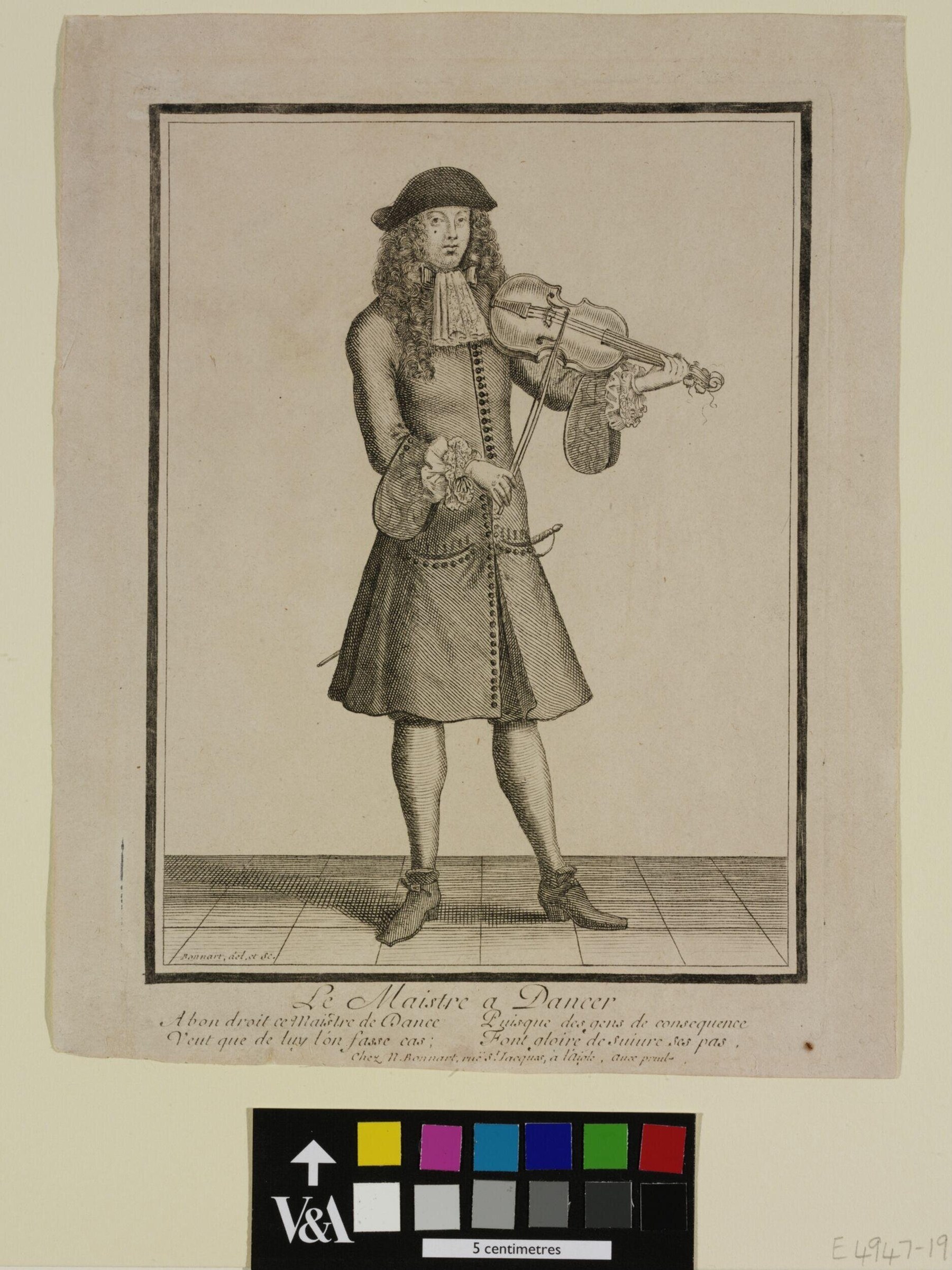
Le Maistre a Dancer
Bonnart, Nicolas
- Dance:
- Ballroom
- Source:
- Victoria and Albert Museum
- Rights:
- Rights vary by item — check the source record before reusing this image. Source record ↗
- Recorded as:
- Check V&A creditLine
This engraving documents the dance world's infrastructure—the teaching masters and musicians who enabled courtly dance practice—at a moment when such figures were beginning to be recorded and celebrated as individuals. It is evidence that dancing masters and musicians held recognized status and were subjects worthy of printed portraiture, suggesting the cultural value of dance expertise in late 17th-century France.
What you are looking at
A young man in elegant court dress stands alone against a plain ground, holding a violin raised to playing position. He wears a dark coat with buttons down the front, a white lace cravat at the neck, and knee breeches with stockings and heeled shoes typical of late 17th-century aristocratic fashion. A long curled wig frames his face. His posture is upright and formal, weight settled on both legs in a composed stance. The engraving is rendered in fine parallel hatching that builds volume and texture across the fabrics and the figure's form. A ruled baseline grounds the figure, and the whole composition sits within a double-ruled border. The title below identifies him as 'Le Maistre a Dancer' and includes an inscription in French.
The dancing
The figure stands in a relaxed but dignified position, feet roughly shoulder-width apart, knees slightly softened. The left arm holds the violin at an angle suited to playing, while the right arm hangs at the side. The body shows no dynamic tension or extended line; the weight is centred and the carriage upright but natural, not the turned-out formal frame one sees in dancing masters' portraits of the period. The pose is that of a musician at rest, not in the moment of dance.
The dance depicted
The title 'Le Maistre a Dancer' (The Master as Dancer) is ambiguous—it may refer to a dancing master, a musician who accompanied dance, or a performer skilled in both. However, the figure is shown with a violin, not in a dancing pose. If this is indeed a dancing master, the engraving documents him in his role as musician rather than as a practitioner of the choreography he may have taught. The late 17th-century court context and the reference to 'Maitre' suggest a figure of status in the entertainment professions, but the image itself records a violinist, not a dancer in action.
How it was made
This is a copper-plate engraving, identified by the fine parallel hatching (cross-hatching and directional lines) that model form and light across the figure and garments. The technique allowed for precise detail in the lace cravat, the buttons and seams of the coat, and the curl of the wig, as well as precise line work in the architectural border. Engravings were labour-intensive but produced clean, repeatable impressions suitable for collecting and circulation among educated audiences. The signature or mark visible in the lower left indicates the hand of a professional printmaker, likely Nicolas Bonnart or his workshop.
About this work
This is a single-figure portrait engraving of a court musician or dancing master from the late 17th century, identified in the title as 'Le Maistre a Dancer.' The work captures the dress and bearing of a professional entertainer in the milieu of aristocratic dance and music instruction. Although titled as a dancer, the figure is shown holding a violin in a relaxed pose, documenting the musician's role as an accompanist or performer rather than the choreography he may have taught. The engraving belongs to a tradition of costume and character studies that circulated in prints, recording the professions, dress, and social status of the period's performers and teachers.
The work is significant as evidence of the close relationship between violin music and dance instruction in the French court tradition, and as a portrait of an individual whose name and status merited publication. It shows a figure of professional standing, groomed and dressed for court or noble households, in a moment of professional display rather than performance.
How to look at it
The engraving presents the figure in a formal portrait mode rather than a moment of action—the stance is composed and the instrument held at rest. Note the precision of the engraver's line work in rendering the texture of the wig, the delicate lace of the cravat, and the seaming of the coat; these details establish social status and professional identity as much as any inscription. The title's ambiguity—is he a dancer, or a master of dance, or a musician?—mirrors a historical reality: the boundaries between these roles were fluid, and a successful entertainer in the court world was often trained in multiple skills.
The artist
Nicolas Bonnart (c. 1636–1718) was a French engraver and printmaker active in Paris, known for costume studies, character portraits, and theatrical subjects. He produced a large body of engravings documenting the dress, social roles, and entertainments of the court and professional classes. His workshop was prolific and his prints widely distributed, making him a major visual recorder of late 17th-century French society and culture.
The period
This work dates to the period when Louis XIV's court at Versailles was the centre of European aristocratic culture and when court dance—ballet à cour—was a central courtly accomplishment and entertainment. Violin music was the standard accompaniment for social and theatrical dance. Dancing masters held positions of authority in noble households and at court, and some achieved considerable fame and wealth. Bonnart's engravings of costume and character were part of a broader market for printed images that recorded and circulated knowledge of court fashion, professional roles, and theatrical types across a reading and collecting public beyond the court itself.
Where it lives
The work is held in the Victoria and Albert Museum collection. It is a print from a series of costume and character studies by Bonnart, part of a larger body of engravings documenting French court life and entertainment in the late 17th century.
Questions about this work
Is this person actually dancing?
No. The figure is shown standing at rest with a violin, not in a dancing posture or in the moment of movement. Despite the title's reference to 'Dancer,' the engraving records him as a musician or as a dancing master in his professional role as a violinist, not as a dancer in action.
What is a dancing master in this period?
A dancing master was a professional teacher and choreographer employed by noble or royal households to instruct courtiers in fashionable dances, compose new choreography, and sometimes perform. They held positions of significant status and authority. Some, like this figure, may have doubled as musicians or worked closely with violinists who provided the music for dance practice and performance.
Why was this portrait printed and circulated?
Engravings like this were part of a market for images of fashionable dress, professional types, and celebrated entertainers. They educated viewers about court costume, social roles, and cultural accomplishment. Bonnart's series documented the people and professions of French court life for a reading public of collectors, courtiers, and the educated classes.
More Ballroom artwork