26 works in this view — arrow keys or swipe to move between them.
Dance in Art
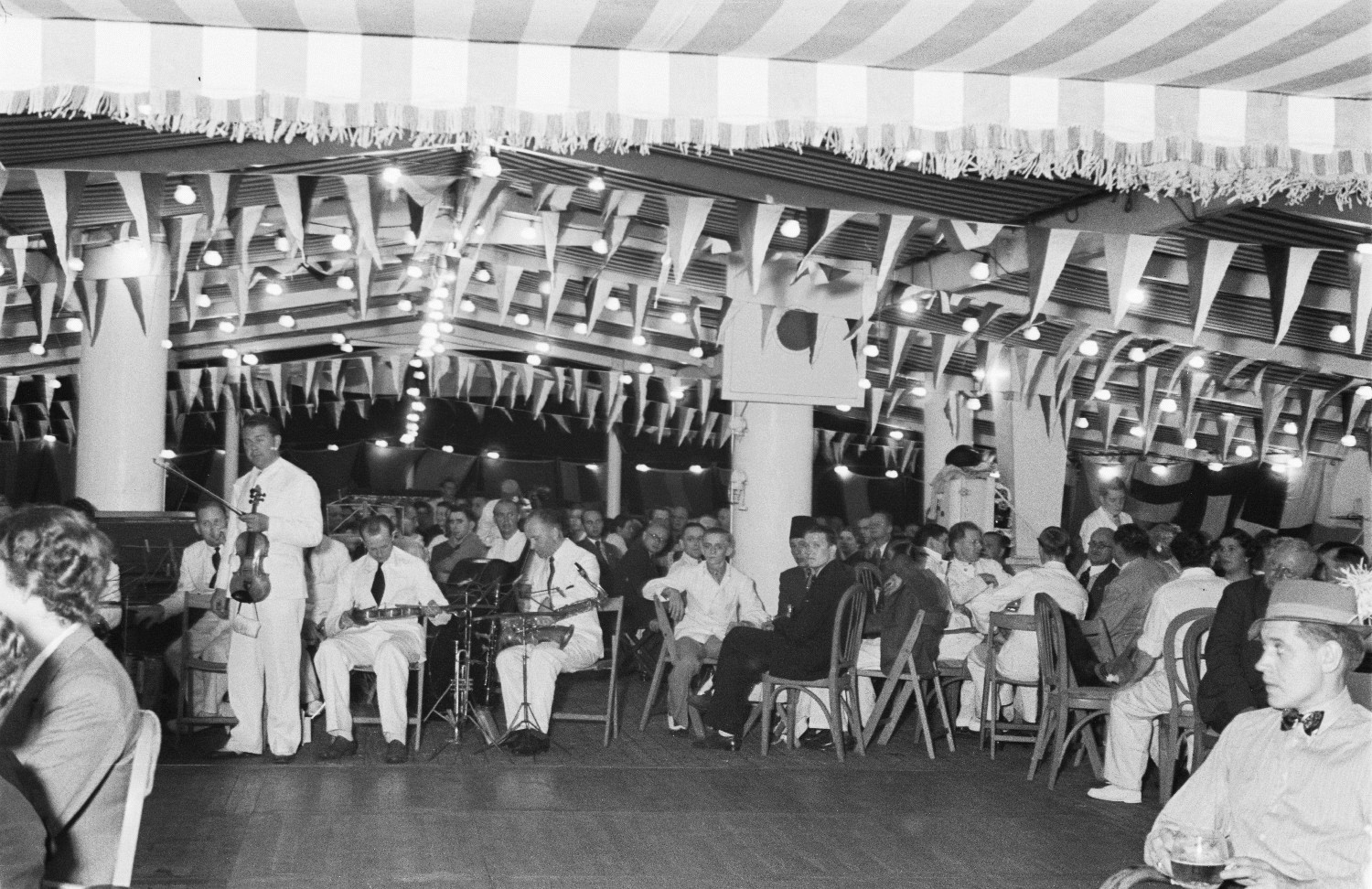
Onboard life Milwaukee Broth- party ballroom with music ba 437 item FKDGK
Unknown artist
- Dance:
- Ballroom
- Rights:
- Not recorded. Do not assume this image is free to reuse — check the source record.
This photograph shows ballroom dancing not as a theatrical or competitive practice, but as embedded in ordinary American social ritual—a record of how ordinary people used formal dance to mark community occasions. It is one of relatively few documentary photographs showing the real social context and scale of ballroom dancing outside studios and competitions, revealing the infrastructure (band, venue, dress codes, mixed-gender socializing) that made ballroom a living social practice rather than a historical artifact.
What you are looking at
A lively ballroom scene photographed in black and white, likely from the 1930s–1950s. The setting is a decorated indoor venue with a beamed ceiling, draped fabric panels with fringe trim, and strings of small lights creating a festive atmosphere. A live band of five musicians in light-colored suits occupies a raised platform at the left, including a violinist standing, a drummer, and other instrumentalists. Below and around them, a mixed crowd of several dozen people in formal attire—men in suits and hats, women in light-colored dresses—mingles, watches, and dances. Many are seated on folding chairs arranged in loose groups; others stand or move in the open floor space. The overall impression is of a social gathering, likely a fraternal organization party, wedding reception, or community dance, with the band as the focal point and informal groupings throughout suggesting active socializing alongside the dancing.
The dancing
The dancers visible are not in closed holds or formal positions. Most figures stand or sit casually; one or two couples appear to be in motion in the open floor, but their posture and arm positions are not clearly distinctive of any particular ballroom style. The standing figures maintain upright posture typical of formal social wear. The lack of close partnership frame and the scattered, mingling quality of the gathering suggest social dancing rather than competitive or highly structured ballroom technique. Many attendees are observers rather than active dancers.
The dance depicted
This is a social ballroom gathering, likely featuring American popular dances of the era—probably waltzes, fox trots, or two-steps given the live band format and the formal dress. The informal, mingling character and the mix of dancing, socializing, and seated observation is typical of mid-twentieth-century American community dance events, lodge parties, or wedding receptions rather than exhibition or competitive ballroom dancing. The specific dance styles are not distinctly evident in the postures captured, but the context and instrumentation point to American smooth and American rhythm dances as most probable.
How it was made
This is a black-and-white photograph, likely taken with documentary or journalistic intent. The image shows motion blur in some figures and sharp focus in others, typical of handheld photography under indoor lighting conditions of the era. The print quality and composition suggest it may have been a press or professional documentation photograph, possibly intended for a newspaper, yearbook, or organizational record. The archival preservation and digital transfer to Europeana indicates it has institutional significance as a record of social and cultural history.
About this work
This photograph documents a mid-century American social ballroom gathering, capturing the context and atmosphere of community dance rather than the technique of any single style. The image is valuable as a record of how ballroom dancing functioned in everyday American social life—not as a performance art or competitive sport, but as a central activity of fraternal, civic, and family events. The band-centered layout, the casual dress and mingling, and the mix of active dancers and observers reveal the integrated role of ballroom dancing in American social culture during this period, when formal ballroom events were routine gatherings rather than specialized activities.
How to look at it
Attend first to the overall composition and scale: this is a crowd event, not an exhibition, and the dancers are secondary to the social gathering itself. Note the band placement and the architectural framing of the space—the venue and instrumentation are as much the subject as the dancing. Look at the dress code, the lighting, and the posture of attendees to date the photograph and place it in American culture. The lack of visible footwork or specialized frame means this photograph values the social context of dancing over its technical display—a very different purpose from most dance imagery.
The period
The photograph dates to the height of American swing and big-band culture, likely 1935–1955, when live dance bands and formal ballroom gatherings were routine features of American social life. Fraternal organizations, civic groups, and family celebrations regularly held dances, and the etiquette and formality of ballroom dancing—men in suits, women in formal dress, live instrumentation, mixed-gender social pairing—was normative for American entertainment and courtship. This was also the era in which American Smooth and American Rhythm styles were being codified in competition, though social dancers would have been largely unaware of or indifferent to these formal categories.
Where it lives
The work is held in the Europeana digital collection, a European cultural heritage aggregator. The catalogue entry identifies it as a photograph from a Milwaukee Brothers social event or ballroom gathering, suggesting it may have originated as a press photograph, organizational record, or family documentation and was subsequently digitized and contributed to Europeana from an unspecified holding institution.
Dance in this work
Questions about this work
What dance style is being shown here?
The specific style is not visually distinct in this photograph. The live band, formal dress, and social setting indicate American Smooth or American Rhythm dances of the mid-twentieth century—likely waltzes, fox trots, or two-steps. The informal, scattered dancing and prominent socializing suggest this is social ballroom dancing rather than exhibition or competitive ballroom, where technique would be more visibly specialized.
When and where was this photograph taken?
The catalogue record indicates it is from a Milwaukee ballroom or social gathering, and the photograph style, clothing, lighting, and decoration suggest a date between roughly 1935 and 1955. The exact date and venue are not specified in the available record.
What was the Milwaukee Brothers gathering?
The catalogue record refers to it as a 'Milwaukee Broth- party ballroom,' suggesting a fraternal organization or civic group gathering. Specific details are not available, but such events were typical venues for formal ballroom dancing in mid-century American communities.
More Ballroom artwork