35 works in this view — arrow keys or swipe to move between them.
Dance in Art · 2019
Ballroom dancing
Unknown artist
- Medium:
- Dance:
- Ballroom
- Source:
- New York Public Library
- Rights:
- Public domain — free to use, share and adapt.
- Recorded as:
- public_domain
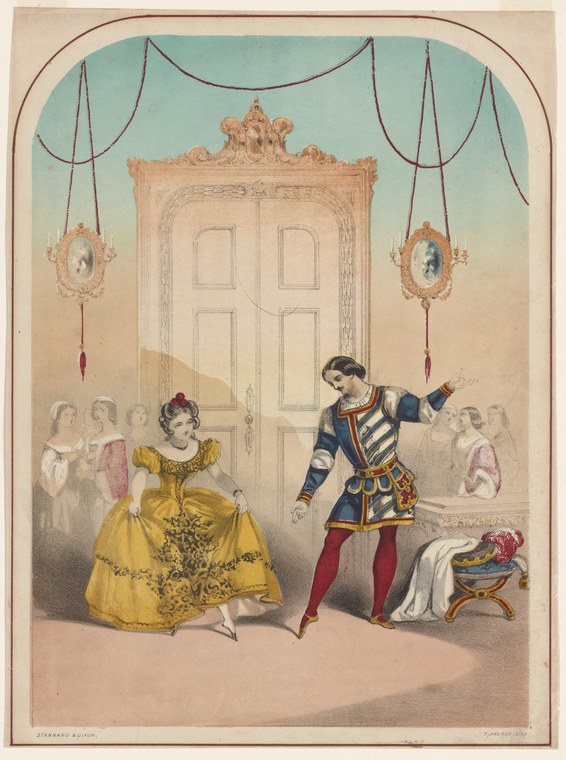
This image captures the social and sartorial context of ballroom dance at a moment when such dancing was inseparable from courtship, social hierarchy, and theater. The painting-like composition and romantic tone show how dance was represented in popular commercial imagery—not as technique but as spectacle and courtship narrative. For dance historians, the image documents the open postures, expressive gesture, and formal spacing of 19th-century court and ballroom practice.
What you are looking at
A theatrical scene set in an ornate interior with a tall paneled door as the architectural focus. A woman in a voluminous golden-yellow gown stands at left-center, her skirt decorated with elaborate beaded or embroidered patterns; she gestures expressively toward a man in military dress—a blue coat with gold trim, red breeches, and armor-like breastplate—who stands to her right in a contrapposto stance. The pair occupy the foreground of a formal ballroom or palace chamber. The background is populated with pale, ghostly figures of courtiers or attendants arranged in loose groups. Overhead hangs an ornamental swag with pendant medallions containing portraits, suspended by slender chains. The color palette is soft—muted golds, teals, and pinks—and the composition emphasizes theatrical depth and hierarchical arrangement of the figures. The tone is courtly and romantic, suggesting a moment of social interaction or romantic encounter set in high society.
The dancing
The woman's body is angled toward the man, her right arm raised and extended in an expressive gesture while her left hand grasps her skirt; her posture suggests animated conversation or a moment of surprise or delight. The man is poised in a relaxed but dignified stance, one arm extended downward and forward in a courtly gesture of acknowledgment or invitation. Neither figure is in a closed dance hold; instead, they are positioned in the social proximity and open frame typical of court etiquette. Their spacing and the direction of their gaze suggest they are the principal figures of attention in an assemblage.
The dance depicted
This appears to be a scene of courtly social interaction rather than a depiction of active dance steps. However, the theatrical staging, formal dress, and the man's military attire suggest the context of a court ball or aristocratic entertainment of the 18th or 19th century. The open posture and expressive arm movements evoke the stylized gesture and deportment expected in historic ballroom or court dance settings, where social encounter and formal presentation were as important as footwork. The image captures a moment of courtship or formal social exchange rather than a specific dance in progress.
How it was made
This is a hand-colored engraving or lithograph—likely produced commercially for popular consumption in the 19th century. The technique allowed for fine detail in the architectural setting and costume embellishment while permitting the soft, diffused color application visible in the background figures and sky. The hand-coloring, applied after printing, accounts for the watercolor-like transparency and slight variations in tone. This format indicates a work made for a broad audience—likely theatrical, narrative, or satirical in intent—rather than a unique fine-art object. The print's careful composition and legible theatrical content suggest it was produced for theatrical promotion, narrative illustration, or popular entertainment.
About this work
This is a commercial hand-colored engraving depicting a moment of formal social interaction in a ballroom or palace setting, likely from the 19th century. The scene shows a woman and man in courtly dress engaged in a charged moment of acknowledgment or conversation, set against a backdrop of attendants and ornate architecture. Though labeled as ballroom dancing, the image captures a moment of courtship and social presentation rather than active dance; it is documentary of the theatrical and social conventions surrounding formal dance and courtly entertainment in the period. The work belongs in a gallery of dance in art because it reveals what mattered in 19th-century ballroom culture: the formal encounter, the display of dress and status, and the ritualized gestures of aristocratic courtship.
How to look at it
Look first at the woman's raised arm and open posture: she is not in a dance frame but in a gesture of social presentation or invitation. Notice how her golden gown dominates the composition—the dress itself is a kind of spectacle, more prominent than footwork. Observe the man's contrapposto stance and his extended arm: together with the woman's gesture, these create a moment of social acknowledge rather than choreographed movement. Finally, note the pale, distant courtiers in the background: the image is organized to center the couple as a romantic pair in a world of observers, reflecting the ballroom's function as a stage for courtship and display.
The artist
The artist is unknown. The work was likely produced by a commercial print shop or theater-related publisher and hand-colored by workshop artisans. Prints of this type were staples of 19th-century entertainment publicity and popular illustration, often drawn from theatrical productions or created to capitalize on fashionable interest in ballroom culture. The style and format suggest professional commercial production rather than the work of a named fine artist.
The period
This work was made during the 19th century, when ballroom dance was at the height of its social and theatrical prominence in European and American aristocratic and middle-class life. The Romantic era (roughly 1820–1880) saw ballroom dancing celebrated as a central site of courtship, fashion display, and social performance. Simultaneously, commercial theater and lithographic printing were expanding audiences for theatrical imagery; scenes of ballroom life were popular subjects for engravings and hand-colored prints sold to the public. The formal architecture, the military dress, and the hierarchical arrangement of figures reflect the rigid social stratification of the Victorian or late Romantic period. Dance in this era was not primarily about virtuosic technique but about the orchestration of desire, display, and decorum.
Where it lives
This work is held in the New York Public Library collection and was accessed through their digital holdings. It is a commercial hand-colored engraving or lithograph of the 19th century, typical of the popular theatrical and entertainment imagery produced and distributed during this period. The NYPL catalogue records it simply as depicting ballroom dancing.
Dance in this work
Questions about this work
Are these two people actually dancing?
Not in the strict sense. The image shows a moment of courtly social interaction—courtship, acknowledgment, or formal presentation—set in a ballroom context. Both figures are in open, expressive postures rather than closed dance holds or in the middle of steps. The theatrical framing and costume emphasize the social and romantic dimensions of ballroom culture rather than technique.
What do the clothes tell us?
The woman's elaborately beaded golden gown and the man's military dress—coat, breastplate, and red breeches—indicate that this is a scene of aristocratic or high-society entertainment. The man's uniform suggests either a military officer or a theatrical character. Both indicate that this is a formal, state occasion or theatrical performance, not an everyday social dance.
Why are the other people in the background so pale?
They are rendered as ghostly or secondary figures to emphasize the prominence of the central pair. The technique of diminishing background figures was common in theatrical and commercial prints to guide the viewer's eye to the principal characters and the narrative moment they embody. It also creates spatial depth, making the foreground couple appear closer and more dramatically charged.
What period is this from?
The style, costume, and commercial engraving technique place this work in the 19th century, likely the mid-to-late 1800s. The Romantic era's celebration of courtship, the theatrical presentation, and the fashion of the garments all support a dating in this period when ballroom culture was at its social and artistic peak.
More Ballroom artwork