27 works in this view — arrow keys or swipe to move between them.
Dance in Art
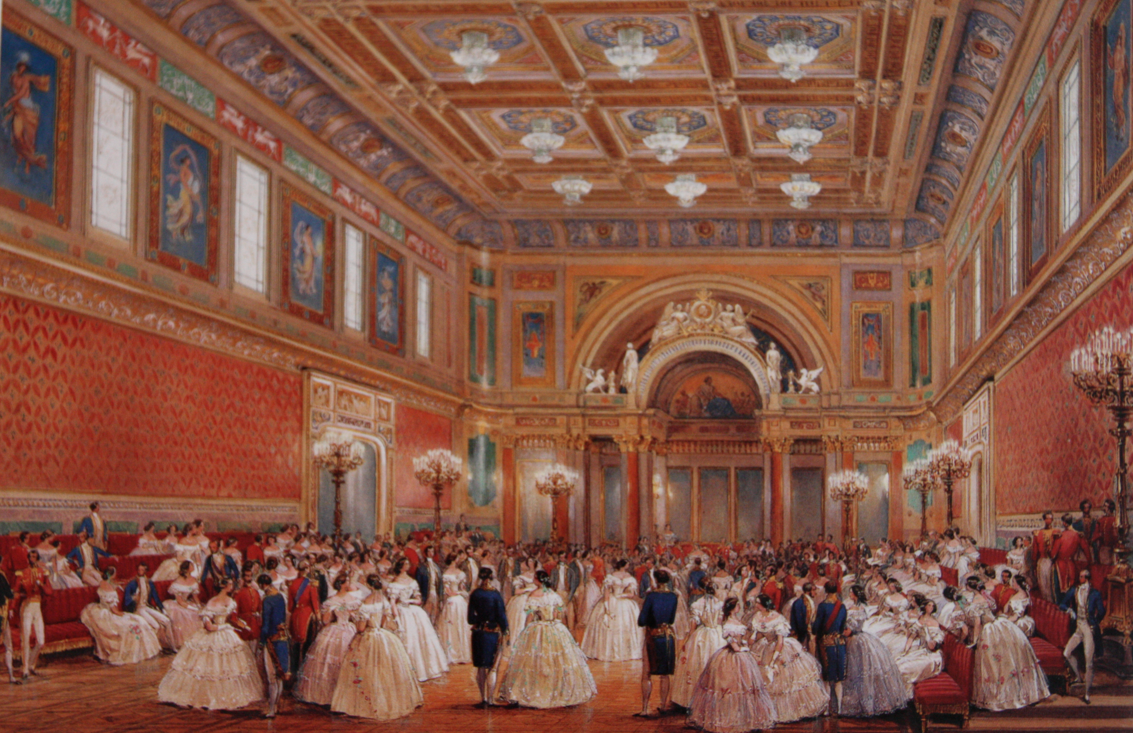
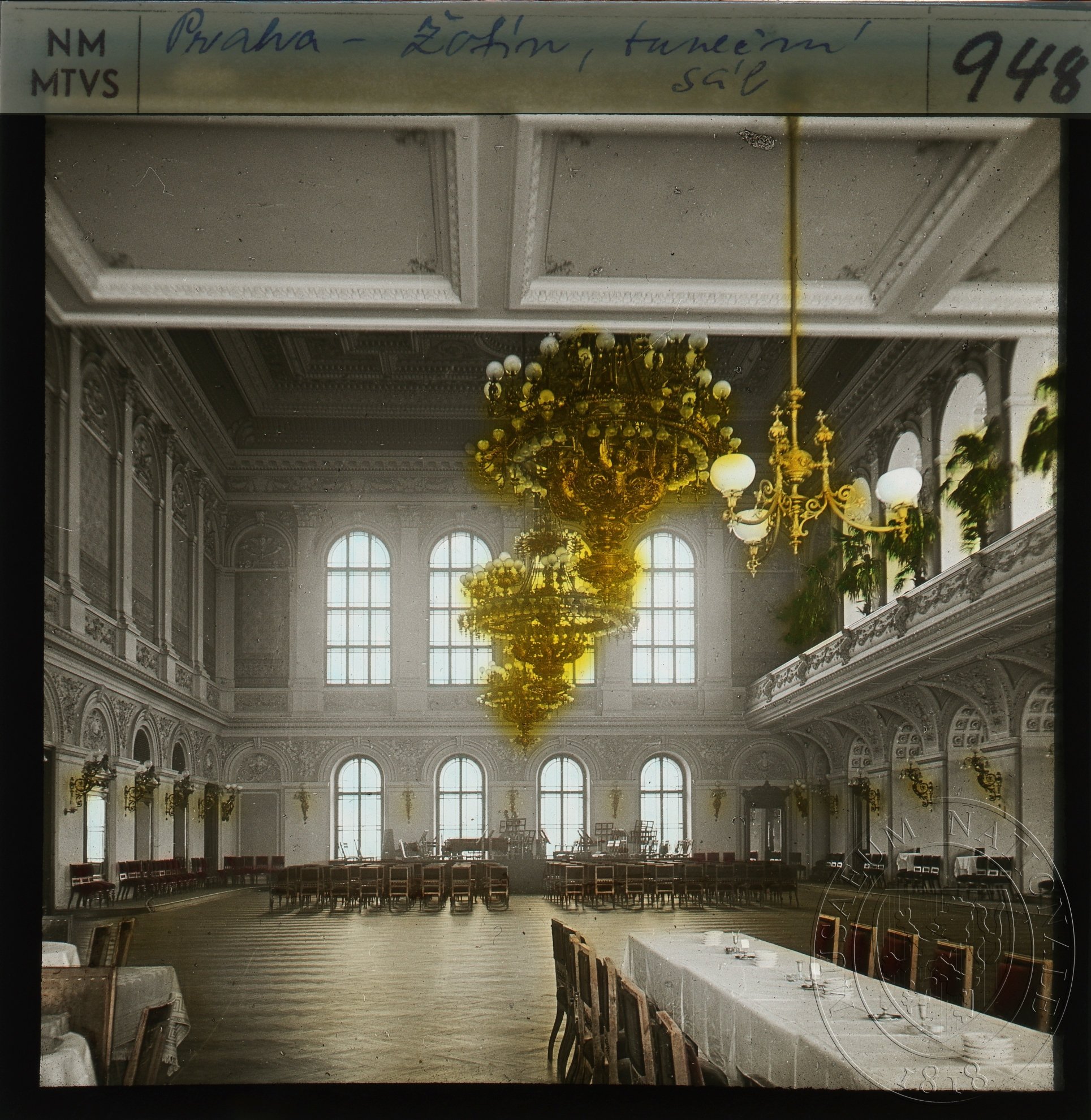
A jewel Ballroom
Unknown artist
- Dance:
- Ballroom
- Rights:
- Not recorded. Do not assume this image is free to reuse — check the source record.
Ballroom dancers and historians study not only how bodies moved but where and how such spaces were designed to display them. This photograph preserves the exact dimensions, lighting, floor quality, and social arrangement of a ballroom from the era when Waltz and other ballroom dances were at their cultural peak. It is a primary source for understanding the relationship between architecture, decor, and the social choreography of elite dancing.
What you are looking at
A grand ballroom of the Gilded Age, photographed in color (a hand-tinted or early color process). The space is defined by a coffered ceiling with ornamental plasterwork and tall arched windows set high on the walls, flooding the room with daylight. The dominant feature is an enormous gilt chandelier hung at center, its crystals catching light. The walls are paneled and decorated in the neoclassical style with applied ornament. The floor is polished parquet. The room is set for a formal event: small wooden chairs with rush or woven seats are arranged in loose clusters around the perimeter and at the far end, and a long dining or refreshment table draped in white cloth sits in the immediate foreground on the right. Potted plants and garland swags of greenery hang from the walls at intervals. The room is empty of dancers at this moment—this is a documentation of the space itself rather than a captured performance.
The dancing
No dancers are visible in active motion. The room is documented as an architectural and decorative space. Chairs are arranged as if for spectators or between dances. The scale of the room relative to the furnishings suggests this was designed for large formal gatherings.
The dance depicted
This is not an image of dance in progress, but rather a photograph of a ballroom interior. The catalogue identifies it as 'A jewel Ballroom' and tags it as 'Ballroom' dance, which here refers to the type of room rather than the capture of a specific dance style. Such spaces hosted Waltz, Quadrilles, and other fashionable ballroom dances of the late 19th and early 20th centuries, but no dance movement is depicted.
How it was made
This is a hand-colored photograph or early autochromes, likely from the 1910s–1920s based on the naturalistic color treatment and photographic process. The color application is soft and even, particularly visible in the gilt tones of the chandelier and the pale green of the wall decorations. The technique allowed for precise documentation of the architectural interior and decorative scheme in a way that black-and-white photography or painting could not, and the choice to hand-color it suggests this was a valuable record, possibly for architectural, hospitality, or historical documentation.
About this work
This is a architectural and decorative photograph of an elite Gilded Age ballroom, the type of space in which fashionable social dances took place. Rather than capturing dancers mid-performance, the image documents the room itself—its proportions, ornament, lighting, and arrangement—as a historical record of where ballroom dancing occurred. The photograph is evidence of the material setting and social context of ballroom culture at its height, showing the scale, expense, and aesthetic conventions that framed the practice of dance. For historians and dancers, it is valuable not as a depiction of movement but as documentation of the architectural stage on which that movement took place.
How to look at it
Attend to the scale and proportion of the space: the ceiling height, the distance between walls, the relationship between the size of the chairs and the vastness of the floor. These proportions determined how dancers moved and how their bodies were seen. Note the light, entering from the tall windows and amplified by the chandelier, which would have illuminated dancers from multiple angles. Observe the arrangement of seating around the perimeter—a period convention that allowed spectators to observe dancers in the center. The emptiness of the floor in this photograph is itself meaningful: it documents the stage before or between performances.
The period
This photograph was taken during or shortly after the final flourishing of the formal ballroom as a space for elite social dancing. By the 1910s–1920s, ballroom culture was well-established in Europe and North America, with standardized dances (Waltz, Foxtrot, Tango, Quickstep, and others) taught and performed in such rooms. The architectural style visible here—neoclassical ornament, coffered ceilings, tall windows, and gilt chandeliers—reflects late 19th-century or Edwardian taste. The photograph itself belongs to a moment when color photography was becoming a tool for architectural and interior documentation, before such rooms began to decline in importance for elite social life.
Where it lives
The work is held in a Europeana digital collection. It is identified as a photograph (though the specific archive or institution is not named). Europeana gathers cultural heritage materials from European institutions; this image likely came from a national or municipal archive with holdings in architectural or interior design documentation.
Questions about this work
What dances would have been danced in a room like this?
In the Gilded Age and early 20th century, a ballroom of this scale and formality hosted Waltz, Foxtrot, Quickstep, Tango, and formal Quadrilles. These were social dances for the elite, taught by dance masters and performed at balls, subscription dances, and private events. The arrangement of chairs around the perimeter allowed couples to dance in the center while others watched and waited their turn.
How do I know when this photograph was taken?
The photograph is hand-colored, a process common from the 1890s through the 1930s. The style of the architectural ornament—neoclassical in taste—and the decorative elements (potted plants, garland swags) suggest the period of approximately 1910–1925. The color process itself, with its soft, even tones, is consistent with autochrome or hand-tinted gelatin silver print of that era.
Why is the room empty?
This is an architectural photograph, not a performance document. Its purpose was to record the room itself—its design, materials, scale, and arrangement—for posterity, publication, or the records of the institution that built it. Such photographs often were taken before an event or outside of performance hours.
More Ballroom artwork