49 works in this view — arrow keys or swipe to move between them.
Dance in Art · 2019
Shaker dancing
Unknown artist
- Medium:
- Source:
- New York Public Library
- Rights:
- Public domain — free to use, share and adapt.
- Recorded as:
- public_domain
Shaker ecstatic movement was a living, embodied theology practiced by thousands, yet it left almost no choreographic notation or systematic record. This engraving is one of the few visual documents that attempts to capture the physical reality of the practice. For historians of American dance, religion, and the body, it is crucial evidence of a movement tradition that influenced later American modern dance and continues to raise questions about how sacred movement is documented and perceived.
What you are looking at
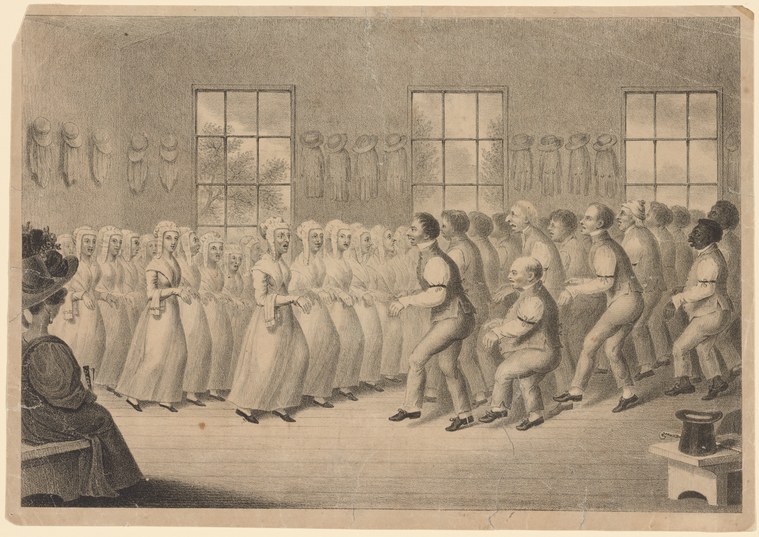
This engraving depicts a large gathering of Shakers engaged in ecstatic group movement within a sparse interior space. The room is defined by three tall sash windows set high in the wall and a minimal architectural frame. A dense crowd of figures fills the composition: on the left, a closely packed line of Shaker women in long white shifts and caps stands with arms at their sides or slightly raised; in the center and right, a crowd of nude or semi-nude figures moves with abandon—some with arms raised overhead, others in dynamic lunging postures, a few crouching or bending sharply. The engraving technique creates a grey monochromatic tonality with strong linear hatching that emphasizes the mass of bodies and the intensity of movement. The lighting is even and frontal, casting no shadows. In the lower left corner, a seated observer in dark robes watches the scene, providing scale and a point of non-participation that frames the frenzy of the dancers.
The dancing
The bodies are arranged in two distinct groups separated by dress and deportment. The fully clothed Shaker women on the left maintain vertical alignment and restrained arm positions, suggesting controlled participation or supervision. The right side shows nude or partially dressed figures in extreme attitudes of exertion: torsos twisted, legs splayed in deep lunges, arms flung upward or outward, and several bodies pitched forward at steep angles. The postures are asymmetrical and individual rather than synchronized; each body is energized differently. No partner contact or hold is evident; the movement is solitary and centrifugal, with bodies extending outward from their centers.
The dance depicted
This is a historical document of Shaker ecstatic practice, likely from the late 18th or 19th century based on the documentary engraving style. Shaker religious movement was characterized by intense, spontaneous bodily expression during worship—trembling, turning, jerking, and improvised movement that practitioners understood as divine possession. The image captures the peak of this ecstasy: the contrast between the ordered ranks of clothed women and the abandonment of the nude dancers reflects the Shaker experience of the Spirit's overwhelming of rational bodily control. This is not choreographed dance but spiritual spontaneity given visible form. The engraving's perspective and composition suggest it was made by an outsider or observer rather than a Shaker practitioner, offering an early 19th-century non-believer's view of what contemporary accounts called 'dancing in the Spirit.'
How it was made
This is an engraving, a print medium made by incising lines into a copper plate and inking the grooves. The technique allowed for wide circulation and made it an ideal vehicle for documenting or sensationalizing the Shaker movement for a public audience. The fine linear hatching and regular tonal gradations are characteristic of refined engraving practice. The medium's reproductive capacity meant this image could reach hundreds or thousands of viewers and likely shaped popular understanding of Shaker worship as exotic spectacle. The stark black-and-white register and formal composition lend an air of documentary authority even where the subject matter is transgressive.
About this work
This engraving documents Shaker ecstatic worship during what adherents called 'moving in the Spirit'—a form of embodied religious expression distinct from theatrical or social dance but central to Shaker identity and theology. The print captures the moment of peak intensity, showing the contrast between the restraint of clothed believers and the abandonment of those overcome by what they experienced as divine possession. As a historical artifact, the image is both a record of Shaker practice and an artifact of how outsider artists and audiences perceived and mediated that practice for public consumption.
The work sits at the intersection of religious history, social history, and the visual culture of ecstasy. It preserves a form of movement that was central to American religious life in the 19th century but left few other visual traces. The engraving's formal composition and documentary framing raise questions about how the body in religious extremity is represented, commodified, and understood by those outside the faith community.
How to look at it
Attend first to the compositional divide: the vertical restraint of the clothed line on the left versus the explosive diagonals and contortions of the nude dancers on the right. This is not a coincidence but a deliberate statement about sacred frenzy overwhelming bodily order. Notice the engraver's choice to render the nude figures with careful anatomical attention to muscular tension and extension—this is not prudery but a formal commitment to showing the body under extreme stress. Look at the seated observer in the lower left, whose stillness and darkness frame and mediate the viewer's relationship to the scene: we are invited to watch as this figure watches, maintaining a detached, almost anthropological distance from what we see.
The period
The Shaker movement emerged in the 1770s and reached its numerical and cultural peak in the early 19th century. Shaker worship was famously transgressive to outside observers: their ecstatic shaking, whirling, and bodily abandon violated both Puritan restraint and Enlightenment rationalism, making them targets of curiosity and mockery. This engraving was likely produced during the height of popular fascination with Shakerism, when the movement's theology and practice were subjects of both serious theological debate and sensationalist reportage. By the mid-19th century, popular prints like this one shaped the public's understanding of Shaker worship as spectacle—intense, exotic, and otherworldly.
Where it lives
This engraving is held in the New York Public Library collection. It is catalogued as 'Shaker dancing' with no artist attribution and limited provenance information. As a print, it was likely produced for circulation in the 19th-century periodical press or as a standalone image sold to satisfy curiosity about American religious communities.
Dance in this work
Questions about this work
Were Shakers trained dancers? Did they have choreography?
Shaker ecstatic movement was not choreographed or systematically trained in the balletic sense. Movement was understood as spontaneous and Spirit-driven; individual bodies responded to the experience of divine possession with trembling, whirling, and improvised gestures. Over time, certain forms (like the 'square order shuffle') became more regularized, but the ideal remained one of immediate, unmediated physical expression. This image captures the movement's claimed spontaneity.
Why are some figures clothed and others nude?
The engraver appears to have depicted different states of disrobement as a visual representation of the intensity of the experience—those most fully overcome shed their garments, while others remain more restrained. In actual Shaker worship, believers would have worn modest dress. The engraving may reflect lurid outside accounts or the artist's own dramatization of the practice for sensational effect.
Is this document historically accurate?
This image offers valuable evidence of how Shaker worship was perceived and represented by outsiders, but it should not be taken as literal documentation of practice. The nude figures, in particular, likely reflect the engraver's sensationalism rather than historical fact. Contemporary written accounts from Shakers themselves and sympathetic observers provide more reliable information about the actual nature and theology of their movement.
What influenced the Shaker movement?
The Shaker movement emerged from 18th-century English Quaker revivalism and was transplanted to America by Mother Ann Lee and her followers. Their practice of ecstatic worship—trembling, shaking, glossolalia, and movement—drew from Pentecostal and mystical Christian traditions. The movement reached America just as revivals were sweeping the country, and Shaker worship adapted to and competed within that landscape.
More dance artwork