30 works in this view — arrow keys or swipe to move between them.
Dance in Art
Polka and mazurka
Unknown artist
- Medium:
- Lithograph
- Dance:
- Polka
- Era:
- Late 1800s (Victorian Ballroom)
- Source:
- New York Public Library
- Rights:
- Public domain — free to use, share and adapt.
- Recorded as:
- public_domain
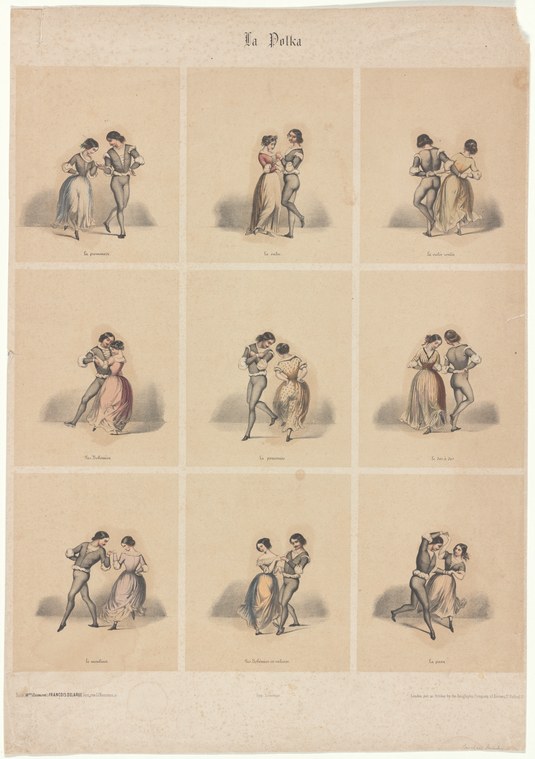
For historians and dancers alike, this print is invaluable as a technical record of how bodies moved in ballroom settings before mechanical recording existed. It shows not just that polka and mazurka were danced, but *how*—the frame, the posture, the rotation of the torso, the relationship between partners—making it possible to understand and reconstruct these dances with genuine historical accuracy. The work also illustrates the profound social importance of ballroom dancing in the 19th century: such elegant, instructional prints would not have been produced and preserved unless learning to dance well was a serious concern of the middle and upper classes.
What you are looking at
This lithograph presents nine instructional vignettes of ballroom dance, arranged in a three-by-three grid beneath a title reading "la Polka." Each panel isolates a pair of dancers at a different moment or position within the polka and mazurka. The figures are rendered in a delicate hand-colored style typical of 19th-century dance instruction prints: the women wear full-skirted dresses with fitted bodices and small bonnets or hair ornaments, while the men are dressed in tailcoats with dark trousers. The dancers are positioned on neutral grounds with soft shadow beneath them to suggest depth. The compositions progress through the fundamental steps and holds: opening positions, turning figures, promenade steps, and closed-hold rotations. Each panel is labeled in French, indicating this was likely produced for an educated European audience learning ballroom technique. The overall effect is a systematic visual grammar of two of the era's most popular social dances.
The dancing
The dancers throughout maintain the upright posture and formal frame expected of 19th-century ballroom dancing. Most pairs employ a closed ballroom hold with the man's right hand placed at the woman's back and her right hand resting in his left; their bodies remain vertical and well-separated at the torso, typical of the period. The women's full skirts dominate the visual space and are shown catching in motion—some panels freeze them mid-swirl, others show them wrapped close to the body. The artists have paid careful attention to the angle of the torso and the turn of the head, suggesting these are meant as technical references. Several positions show the couple side-by-side in promenade, the man's arm around or guiding the woman's waist.
The dance depicted
The work documents the polka and mazurka as they were danced in Parisian ballrooms, likely in the 1860s–1880s. The polka was a fast, sprightly couple dance originating in Bohemia in the 1840s, characterized by a distinctive hop-step pattern and a closed-hold frame; it had become wildly fashionable across Europe by mid-century. The mazurka, by contrast, was a stately Polish processional dance in triple meter, often danced by groups in formation, though here shown in couple format. Both dances are represented through a sequence of foundational figures—basic steps, turns, and transitions—suggesting this print served as a teaching aid or reference guide for dance masters or aspiring dancers learning at home.
How it was made
This is a hand-colored lithograph, a technique that allowed for rapid, economical production and wide distribution in the 19th century. The outlines are printed in a fine black or dark gray stone, with the coloring applied by hand afterward—visible in the soft washes of pink for the women's dresses, blue-gray for the men's coats, and subtle shadows. Lithography, invented in the 1790s, made illustrated publications far cheaper than engraving and was ideal for instructional and popular prints. The presence of hand-coloring indicates this was produced for a genteel rather than mass market, and its survival in a collection like the New York Public Library suggests it circulated among educated Americans as well as Europeans.
About this work
This is an instructional lithograph documenting the polka and mazurka as taught and danced in mid-to-late 19th-century ballrooms. Rather than capturing a single dramatic moment, it functions as a visual manual, breaking down each dance into its component figures and positions. The work belongs in a dance gallery both as a primary historical document of ballroom technique and as evidence of how dance knowledge was transmitted before photography and film—through prints that dancers could study alone or with a teacher. The careful rendering of posture, the progression through steps, and the bilingual labeling all point to a pedagogical purpose: to instruct the viewer in the proper execution of fashionable dances.
How to look at it
Study the progression of the nine panels from left to right, top to bottom: they move from simple opening positions to increasingly complex turns and promenade steps. Notice how consistently the artist has rendered the vertical alignment of the spine and the proper distance between the partners—these conventions signal what the ballroom of the 1870s–1880s considered correct form. Examine the women's skirts closely: the way they are drawn catching and swirling shows the artist understood the actual physics of movement in heavy fabric, a detail that would help a dancer visualize what her own dress would do. The soft modeling and the careful rendering of hands and faces suggest these are not caricatures but earnest instructional diagrams.
The period
The polka emerged as a fashionable dance in the 1840s and achieved peak popularity during the mid-Victorian era, dominating ballrooms across Europe and America by the 1860s. The mazurka had enjoyed sustained aristocratic favor since the Napoleonic era, particularly among the Romantic movement's enthusiasm for national and regional traditions. By the time this print was produced, the quadrille had dominated formal ballrooms, but the polka and mazurka remained essential social dances. The period saw an explosion of instructional lithographs, dance notation systems, and didactic prints catering to the widespread middle-class desire to acquire genteel accomplishments. Lithography itself was revolutionizing print culture, making illustrated instruction accessible beyond the wealthy.
Where it lives
This print is held by the New York Public Library, indicating it entered an American institutional collection, probably as part of broader acquisitions of European popular and instructional prints during the late 19th or early 20th century. Such prints were produced in large numbers and widely distributed, making them accessible to middle-class households on both sides of the Atlantic.
Dance in this work
Questions about this work
How do I use this print to learn the polka?
This print functions as a visual reference guide rather than a step-by-step tutorial. Study each panel in sequence to understand the basic hold and the primary figures—the opening position, the turn, the promenade. The progression suggests the order in which a student might learn the dance. A music teacher or dance master would have used such prints to supplement live instruction. To truly learn the polka from a historical print like this, you would ideally pair it with period music, a knowledgeable partner, and an understanding of 19th-century ballroom posture.
What is the difference between the polka and the mazurka shown here?
The polka is a fast, hopping couple dance in 2/4 time, characterized by its lively tempo and playful energy; the mazurka is a more stately, processional dance in 3/4 time with Polish national roots. You can see the difference in the frame and posture: the polka panels emphasize turning and continuous movement, while the mazurka panels show more formal, linear positions. Both were essential social dances, but they served different occasions and moods.
Why are there nine separate panels instead of one big scene?
Breaking the dance into individual figures made it easier to teach and learn. A dancer or teacher could focus on one position or step at a time, then practice it before moving to the next. This modular approach was standard in dance instruction prints of the era, before film or photography allowed continuous documentation of movement.
How can I tell this is from the late 1800s and not earlier?
The women's dress silhouettes—the shape and fullness of the skirts, the style of the bodices and bonnets—are consistent with 1860s–1880s fashion. The lithographic technique and hand-coloring are also typical of instructional prints from that period. The formal ballroom context and the specific dances depicted (polka and mazurka were at peak popularity during this era) support a mid-to-late Victorian date.
More Polka artwork