13 works in this view — arrow keys or swipe to move between them.
Dance in Art · 2019
The cotillion dance
Unknown artist
- Medium:
- Lithograph
- Dance:
- Cotillion
- Era:
- Late 1800s (Victorian Ballroom)
- Source:
- New York Public Library
- Rights:
- Public domain — free to use, share and adapt.
- Recorded as:
- public_domain
For dance historians and practitioners, this image preserves the visual grammar of a complex choreographic form that survives now only in written notation and scattered descriptions. It shows the cotillion as a dynamic social technology—a structured dance that allowed for improvisation within form, multiple simultaneous partnerships, and the visible display of accomplishment and refinement. The detail of the print makes it possible to read the actual mechanics of the movement: the arm positions, the use of space, the moment chosen in the figure's progression.
What you are looking at
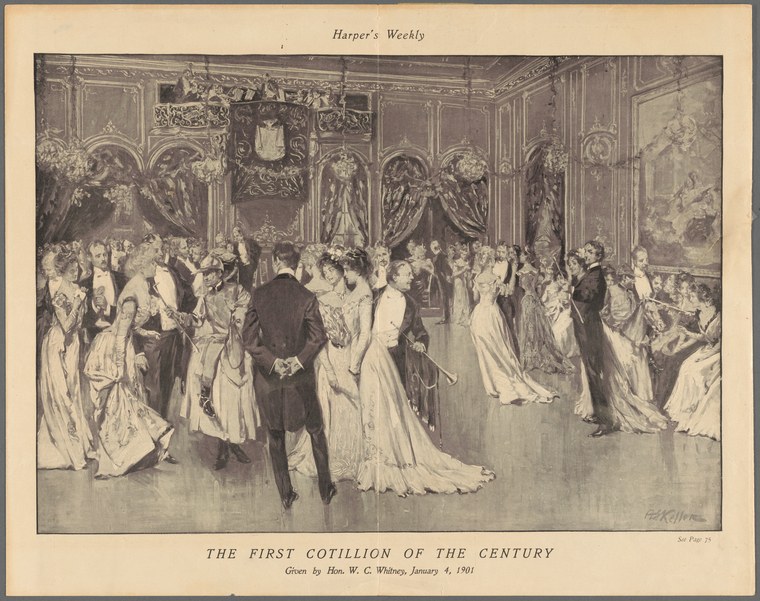
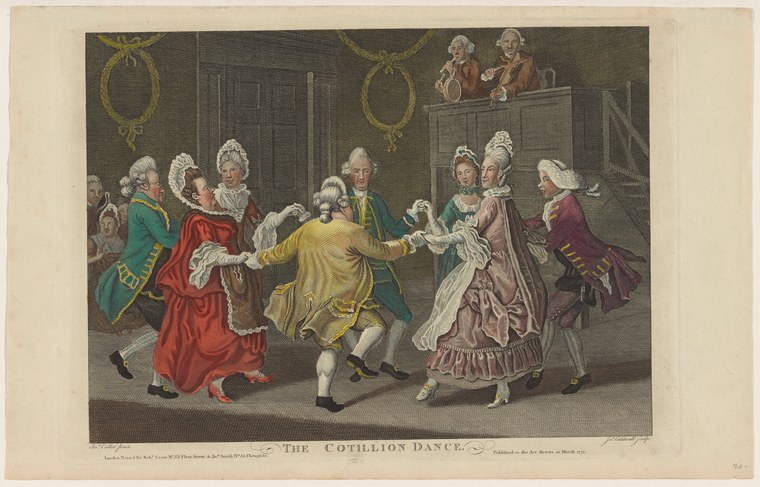
A formal indoor dance takes place in an elegant ballroom lined with classical architectural details. The space is furnished with draped swags bearing gold ornaments suspended from the ceiling, and a musicians' gallery occupies the upper right where two figures sit ready to play. The dancers are arranged in a complex formation typical of figure dances: multiple couples interact across the floor, some in close proximity while others occupy separate quadrants of the visible space. The figures wear late-eighteenth-century court dress—women in elaborate gowns with high waistlines, fitted bodices, and full skirts; men in fitted coats, knee breeches, and buckled shoes. The color palette, rendered in hand-tinted lithograph, shows jewel tones: deep greens, crimsons, and golds dominate the male dancers' coats, while the women wear reds, pinks, purples, and white. A woman in a yellow-ochre gown occupies the center of the composition, engaged with multiple partners in sequence. The lithographic technique renders fabric texture with fine cross-hatching and preserves delicate detail in the dancers' wigs, jewelry, and the architectural framing.
The dancing
The dancers adopt the formal, upright posture required of the period: arms held at controlled heights, backs straight, the body organized for visual display as much as movement. Several couples are shown in conversation hold or with hands joined at shoulder height, typical of quadrille figures. The central female figure in yellow extends her arms to connect with different male partners in sequence, suggesting the rotational or chain elements characteristic of the cotillion. Feet are pointed in the turned-out positions of court dancing, and the arrangement shows the dancers organized into multiple focal points rather than a single unified line—a signature feature of the cotillion's choreographic structure, where smaller groups execute different figures simultaneously.
The dance depicted
This is a cotillion, a formal social dance of the late eighteenth and nineteenth centuries that evolved from earlier French quadrille traditions. The cotillion was danced by multiple couples in a rectangular formation, but unlike the rigid geometry of the quadrille, it allowed for more elaborate and varied figures, often including promenade chains, reversals, and partner changes. It remained a staple of aristocratic and upper-middle-class ballrooms throughout the Victorian era. The image captures the complex, multi-partner choreography that defined the form: the central figure's engagement with successive partners, the simultaneous activity in different parts of the floor, and the formal organization into couple units all point to cotillion rather than any simpler dance form. This was a dance that required both technical competence and social knowledge—dancers had to memorize the sequence of figures and maintain perfect decorum while executing them.
How it was made
This is a hand-colored lithograph, a print medium that allowed relatively rapid and inexpensive reproduction compared to engraving or etching. Lithography's capacity to render soft tonalities and broad color areas made it ideal for capturing the jewel-toned elegance of ballroom dress. The presence of hand-coloring—evident in the careful application of pigment within the printed outlines—indicates this was produced for a market that valued visual documentation of fashionable social practice. Lithographs of dance scenes circulated widely in the nineteenth century among the middle classes, serving as both aesthetic objects and practical references for those learning to dance or seeking visual confirmation of correct form and deportment.
About this work
This is a visual record of the cotillion as practiced in formal ballroom society during the nineteenth century. The lithograph documents both the choreography—the formation, figures, and partner changes—and the material culture of the dance: the architecture of the ballroom, the dress codes, the presence of live musicians. It belongs in a dance gallery because it captures a vanished social practice in precise technical detail, showing how the body was organized, how partners related to one another, and how the dance structured social interaction among the elite. The image is valuable not as art-for-art's-sake but as primary-source evidence of how people actually danced, moved, and presented themselves in a specific historical moment.
How to look at it
Observe the formation: the dancers are not in a simple line but distributed across the space in a complex interweaving pattern. Follow the central woman's connections to her successive partners to understand the rotational logic of the figure. Notice the formal, constrained carriage of the body—this is not free movement but a highly codified system of gesture, and the lithograph captures that constraint as part of the dance's aesthetic. Pay attention to the moment frozen: this appears to be a moment of transition between figures, with different couples at different stages of their movements, which gives the image its sense of orchestrated complexity.
The period
The cotillion reached the height of its popularity in English and American ballrooms during the 1870s–1890s, the period consistent with this print's stylistic features. This was the era when the waltz and polka had already begun to displace earlier quadrille forms among the general dancing public, but the cotillion remained a marker of refined taste and elite social participation. It required a dance master to teach the figures and a social context (formal balls, subscription assemblies) to perform them correctly. The lithographic reproduction of dance scenes was itself a Victorian phenomenon: such prints served to standardize taste, to circulate images of fashionable behavior among aspiring middle-class households, and to create a visual archive of social propriety. The print's composition—showing multiple figures in simultaneous activity, the musicians above, the architectural framing—follows a convention established in earlier ballroom prints and dance instruction manuals.
Where it lives
The print is held in the New York Public Library collection and is catalogued as a late-nineteenth-century lithograph. The NYPL's dance prints collection includes numerous ballroom and ballroom-instruction images, many originally produced as commercial prints for the middle-class market.
Dance in this work
Questions about this work
What is a cotillion and how does it differ from a quadrille?
A cotillion is a formal figure dance for multiple couples that evolved from the quadrille in the late eighteenth century. While the quadrille maintains a strict rectangular formation and repeats a fixed sequence, the cotillion allows for more varied and sometimes improvised figures within a looser structure. Both were danced by couples in formation, but the cotillion was considered more sophisticated and was often taught by professional dance masters. By the Victorian era shown here, the cotillion had become a marker of refined ballroom practice.
Who danced the cotillion and in what contexts?
The cotillion was danced by the aristocratic and upper-middle-class members of formal ballroom society. It appeared at balls, assemblies, and subscription dances—formal social events where dancing was a central activity. Learning the cotillion required instruction from a professional, making it inaccessible to those outside elite social circles. The dance served as a visible marker of education, refinement, and social status.
How do you read the body language and positioning in this image?
The upright carriage, turned-out positions, and controlled arm placements are all features of nineteenth-century ballroom technique. The dancers hold themselves formally erect, with arms positioned to allow for visual clarity and to connect with partners according to the protocol of the figure being danced. The arrangement into multiple focal points shows the simultaneous execution of different elements—a hallmark of the cotillion's complexity.
Why use a lithograph to document this dance?
Lithography allowed for relatively inexpensive, multi-copy reproduction with good color and tonal range, making it ideal for commercial distribution to a middle-class market eager to learn or visualize fashionable behavior. These prints served as both visual references for learning dance and as objects of aspiration—they documented what 'correct' ballroom practice looked like and who performed it.
More Cotillion artwork