49 works in this view — arrow keys or swipe to move between them.
Dance in Art · 2015
Dancing Couple
Unknown artist
- Medium:
- Source:
- New York Public Library
- Rights:
- Public domain — free to use, share and adapt.
- Recorded as:
- public_domain
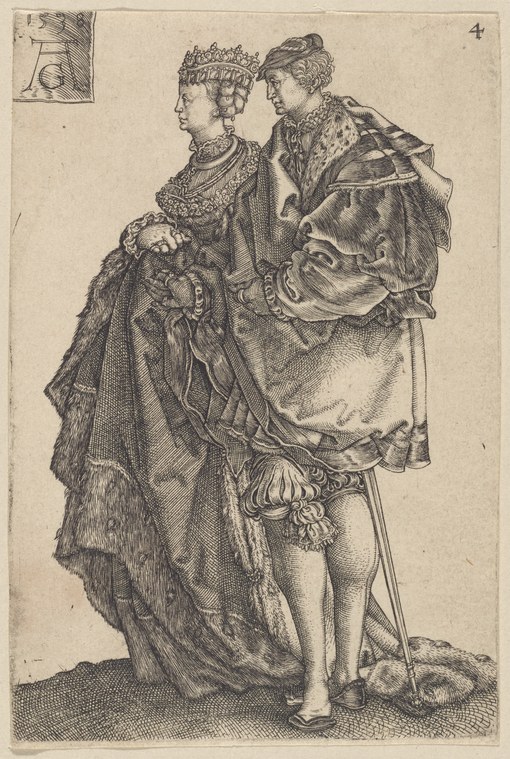
For historians of Renaissance dance and costume, this image preserves the idealized posture and dress of court dancers at a moment when dance was central to courtly identity and social performance. The engraving format and its apparent place in a series indicate that such images were used to teach and disseminate standards of courtly behavior across the European elite.
What you are looking at
A couple in rich Renaissance or early modern court dress stands in an intimate spatial relationship. The woman on the left wears an elaborately patterned gown with a high-collared neckline, jeweled headdress, and a fur-trimmed cloak or overdress that sweeps behind her in luxurious folds. The man on the right, positioned behind and beside her, wears a short tunic with patterned hose and a draped cloak. Both figures are rendered in careful linear detail characteristic of Northern Renaissance engraving. The composition presents them in profile-nearly-frontal view, their bodies angled toward each other but not in a closed dance hold. The woman's weight appears settled; the man leans slightly inward. The setting is minimal—a bare ground line, no interior or landscape—which focuses all attention on the costumes and the spatial intimacy between the pair.
The dancing
The man's right arm extends behind the woman's back in a gesture of courtly attention rather than a dance frame; his left arm hangs at his side. The woman's arms are not clearly engaged in a hold—her posture is upright and frontal, her hands positioned near her body. Neither figure demonstrates the bent knees, lifted weight, or dynamic positioning of active dancers. The spacing between them suggests formal proximity—courtly rather than partnered movement.
The dance depicted
This image most likely depicts a court dance or courtly couple of the 16th century, but the figures are not actively dancing in the moment captured. The print may represent a standard or idealized couple in court dress, or it may show the opening moment of a formal dance such as a pavane or almain—dances in which the initial posture is upright and processional. The lack of visible footwork, the settled weight, and the emphasis on costume over movement suggest this is presentation of courtly dress and decorum rather than documentation of active dancing.
How it was made
This is an engraving on paper, identified by the fine parallel hatching lines that create shadow and volume, the crisp linear detail in costume pattern and jewelry, and the characteristic Northern European print style of the 16th century. Engravings were high-circulation media, produced in multiple impressions from a single copper plate, and disseminated widely among the educated and aristocratic classes. This technique allowed fine detail and could serve as a pattern book for costume, behavior, and courtly conduct. The small notation '4' in the upper right corner suggests this is one plate in a numbered series.
About this work
This engraving represents an idealized courtly couple of the Renaissance period, frozen in formal proximity rather than active movement. The artist has chosen to emphasize costume, jewelry, and proper courtly bearing over the dynamic elements of dance itself. The work belongs in a dance gallery not because it documents an active dance step but because it shows how dance and courtly display were inseparable in Renaissance culture—this is how one appeared, how one held one's body, how one positioned oneself in relation to a partner in the formal social space of the court. The print's circulation as part of a numbered series suggests it functioned as a model of courtly propriety.
How to look at it
Attend to the posture: upright, poised, formal. This is not the dynamic flexion of active stepping but the composed stance expected in courtly presentation. Notice how the engraver has rendered the textures of luxury—the jeweled headdress, the fur, the patterned fabric—with equal or greater care than the bodies themselves. This tells you that in Renaissance court culture, display of wealth and status through dress was as important to the dance as movement was. The spatial relationship between the couple—close but not in a closed hold—shows the formality of courtly proximity: intimate according to the rules of the court, but governed by strict propriety.
The period
This engraving dates to the 16th century, a period when dance was flourishing in European courts, particularly in Italy, France, and the German-speaking lands. Pavanes, almains, and galliards were the dances of choice; they were documented in dancing masters' texts and depicted in prints and paintings as markers of aristocratic refinement. Engravings of costume and courtly types were popular educational and aspirational materials, circulated among the nobility and merchant class. The numbered series format suggests this was part of a larger didactic project—perhaps a book on courtly conduct, costume, or social behavior.
Where it lives
The work is held in the New York Public Library collection. It is identified as a print from an unknown era and artist, but stylistic evidence places it in the 16th-century Northern European engraving tradition. The number '4' visible in the upper right suggests this is one plate in a numbered series, possibly from a published book or suite.
Dance in this work
Questions about this work
Are these two people actually dancing?
Not in the moment shown. Their posture is upright and settled, without the bent knees and lifted weight visible in active dancers. This may show the opening stance of a formal court dance, or it may be an idealized representation of a courtly couple rather than a document of movement in progress.
What dance is this?
The costume and the upright, formal posture suggest a 16th-century court dance such as a pavane or almain, but the image does not provide enough information about footwork or dynamic movement to identify a specific dance with confidence.
Why is this in a dance gallery if they're not moving?
Because dance in the Renaissance court was inseparable from courtly display, dress, and deportment. This image shows how aristocrats were expected to appear and position themselves in formal social space—which is fundamental to understanding court dance as a social practice.
More dance artwork