49 works in this view — arrow keys or swipe to move between them.
Dance in Art · 2015
Dancing Couple
Unknown artist
- Medium:
- Source:
- New York Public Library
- Rights:
- Public domain — free to use, share and adapt.
- Recorded as:
- public_domain
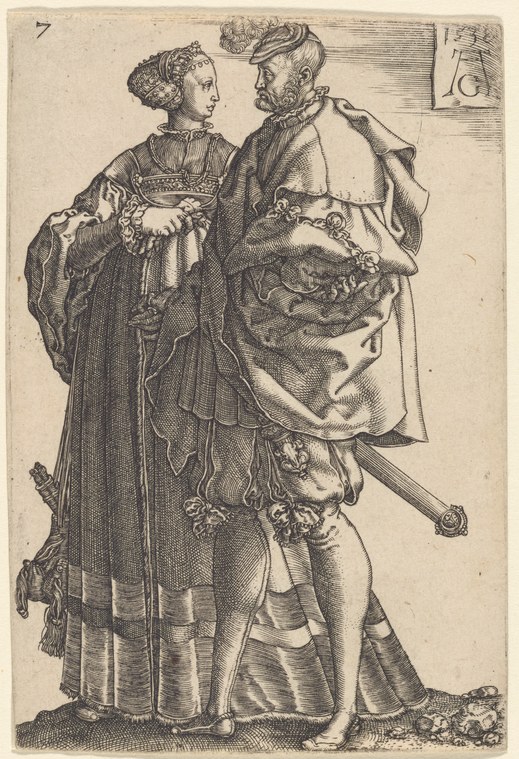
This image preserves evidence of how couples performed courtship and social status through formal posture and dress in Renaissance courts, a context in which dance and courtship were inseparable social performances. For dancers and historians, it documents the costume, bearing, and physical relationship expected of aristocratic dance partners, even if the specific dance cannot be identified from the pose alone.
What you are looking at
A man and woman stand together in a formal, frontal pose against a plain background. The woman, positioned to the left, wears an elaborate gown with a high waistline, long sleeves, and a floor-length skirt with decorative trim and what appears to be a jeweled or embroidered hem. Her hair is elaborately dressed and bound. The man, on the right, wears a short doublet or tunic with puffed sleeves, fitted hose, and decorative leg wrappings or garters. Both figures wear rich fabrics suggesting courtly dress. The man's right hand rests on his hip while his left arm is extended or raised; the woman's arms are at her sides or loosely held. The engraving's fine parallel hatching creates volume and shadow across the fabrics, emphasizing the texture of embroidery and the drape of cloth.
The dancing
The two figures stand close but not in contact, arranged in a presentational rather than active embrace. The man's posture is assertive—hip cocked, one arm raised—while the woman stands more erect and reserved. Their bodies do not form a unified line or connected frame; instead they are posed as complementary figures for display. The positioning suggests courtship or introduction rather than the execution of a dance step. Neither figure's feet are clearly shown in a specific dance position.
The dance depicted
This is likely a courtship or betrothal image rather than a documentation of an actual dance. The title *Dancing Couple* may reflect early modern usage in which 'dance' could connote courtship or the social performance of gender relations, but the image itself shows two figures in formal dress posed for presentation, not mid-movement. The costumes and style are consistent with sixteenth-century German or Northern European court dress. If a dance is intended, it would be a processional, processional-adjacent form like a *Pavane* or *Allemande*, both aristocratic couple dances of the period; however, the lack of clear hand contact and the formal, static poses suggest this is a costume or character study rather than a dance-in-action.
How it was made
This is an engraving, executed in fine parallel lines (hatching and cross-hatching) to create tone and volume. The technique allowed precise rendering of fabric texture and jewelry, making it ideal for depicting the status signified by elaborate courtly dress. Engravings were expensive to produce and circulated among the educated elite, often as pattern books for costume, behavior, or social types. The presence of a monogram or mark in the upper right corner suggests this is a numbered sheet from a series.
About this work
This engraving presents a couple in sixteenth-century court dress in a formal, frontal composition that emphasizes their complementary social roles and sartorial splendor. The image sits at the intersection of dance documentation, costume study, and courtship ritual—categories that were not yet fully separated in early modern visual culture. The work belongs here because it records how dance partners were supposed to present themselves, and because the concept of 'the dancing couple' was central to courtly identity in this period, whether or not any actual movement was taking place in the moment the artist chose to represent.
How to look at it
Attend to the precision with which the engraver has rendered fabric and jewelry: the embroidery on the woman's gown, the puffed sleeves and wrapped legs of the man's hose, the jewels at the hem. These details signal rank and wealth. Notice also the physical distance and restraint between the two figures—they do not embrace or take hands—which suggests that this is a moment of presentation or introduction, not the actual execution of a dance move. The frontal, symmetrical composition treats the pair as complementary types rather than as bodies in motion.
The artist
The artist is not recorded in the catalogue. The monogram visible in the upper right suggests this is one sheet from a numbered series on costume or social types, a genre popular in sixteenth-century German and Netherlandish printmaking. Such series often included dance scenes, court dress, and social couples, and were sold to a literate, image-collecting audience interested in fashion, manners, and courtly behavior.
The period
In the sixteenth century, the couple dance was becoming central to courtly social life, especially in Northern European courts. Dances like the Pavane, Allemande, and Volta involved sustained physical proximity between partners and were occasions for displaying wealth, rank, and masculine and feminine virtue. Engravings and woodcuts of couples in dance dress circulated as models of behavior and fashion. The distinction between 'dance' and 'courtship ritual' was not yet sharp; both involved the formal, visible performance of gender, status, and social harmony.
Where it lives
This print is held in the New York Public Library collection. It is catalogued as a print without further provenance information in the current record.
Dance in this work
Questions about this work
Is this a dance or just fancy dress?
The image shows a couple posed formally in courtly dress, not caught mid-movement. However, 'dancing couple' in sixteenth-century usage could refer to the social and courtship performance of a formally dressed pair, not necessarily to an active dance step. The image likely records both the costume and the bearing expected of dance partners in a Renaissance court.
What dance would they be doing?
The dress, date, and formality suggest a slow, processional couple dance like a Pavane or Allemande, both popular in sixteenth-century Northern European courts. But the static pose and lack of hand contact make it impossible to confirm which dance, or whether a specific dance is intended at all.
How do I know this is sixteenth-century?
The style of the woman's gown (high waistline, long sleeves, floor-length skirt), the man's doublet and puffed hose, and the engraving technique all point to the sixteenth century, most likely German or Netherlandish. The costume details are consistent with court dress from that period and region.
More dance artwork