35 works in this view — arrow keys or swipe to move between them.
Dance in Art · 1900
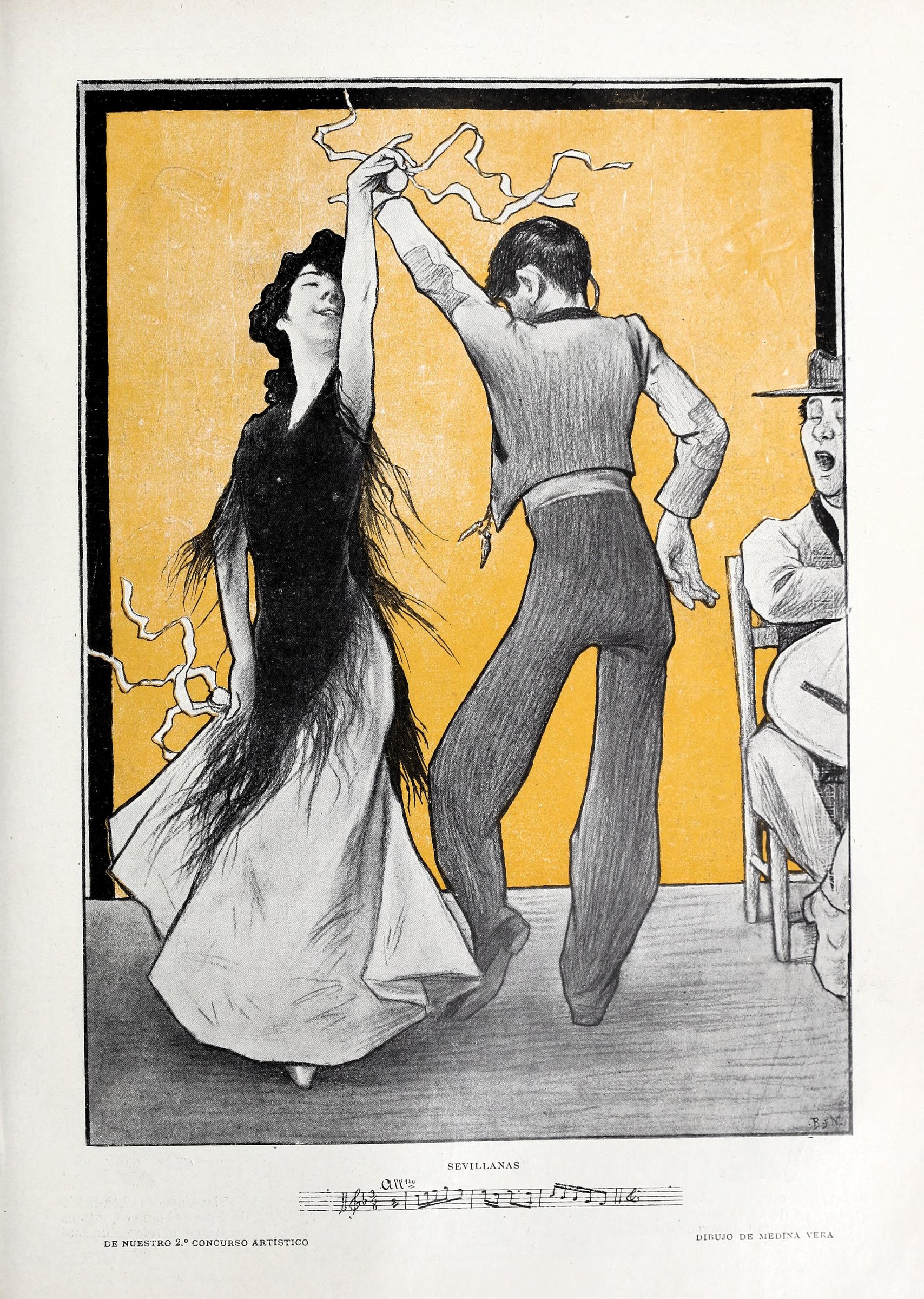
1900-11-17, Blanco y Negro, Sevillanas, Medina Vera
Inocencio Medina Vera
- Medium:
- Oil Painting
- Era:
- 1900-1920 (Ragtime/Early Jazz)
- Source:
- Wikimedia Commons
- Rights:
- Public domain — free to use, share and adapt.
- Recorded as:
- Public Domain
Sevillanas is a living folk tradition central to Andalusian identity, yet it is often overshadowed in dance history by flamenco. This contemporary illustration from 1900 documents how the dance was actually performed in Spanish social settings—informal, intimate, and joyful—rather than as exotic spectacle. The image also captures a specific moment in Spanish visual culture when illustrated magazines were documenting and, in effect, standardizing regional traditions for a national (and increasingly literate) audience.
What you are looking at
A couple dances in a sun-flooded interior against a golden yellow wall. The woman, in a dark dress with voluminous black hair, throws her head back with an open, joyful expression, her arms raised as she moves with fluid energy. The man, dressed in a light shirt and dark fitted trousers, stands close beside her in an engaged posture, his arm raised to meet hers. Their bodies are angled toward one another in an intimate conversational frame. To the right, a partially visible third figure—a man in a hat—watches from the margin of the composition. The warm, saturated background and the couple's animated interaction suggest an evening gathering or social dance, rendered in a style characteristic of early-20th-century illustration with strong line work and economical detail.
The dancing
The principal dancers occupy a close, partner-facing frame with raised arm connections typical of Spanish social dance. The woman's posture—head thrown back, spine arched, weight forward on the balls of her feet—conveys spontaneous joy and rhythmic engagement rather than formal technique. The man maintains an upright, supportive position with his weight centered, allowing the woman's movement space. Both figures' arm positions suggest linked or near-linked holds rather than the open positions of many folk dances; the artist has chosen a moment of dynamic interaction between the partners rather than a solo or formally lined formation.
The dance depicted
This is almost certainly sevillanas, a Spanish social dance of Andalusian origin. The title confirms this. Sevillanas is characterized by rapid footwork, hip movement, and hand flourishes performed to guitars and castanets, typically danced in pairs facing one another in close quarters. The woman's expressive upper body—the thrown-back head and raised arms—aligns with the joyful, flirtatious character of the dance. The intimate proximity and the man's steady framing suggest the social, conversational quality of sevillanas, where couples exchange glances and energy in turn-based phrases. This is a moment of uninhibited enjoyment, capturing the dance not as spectacle but as lived social experience.
How it was made
This is a line illustration with hand-applied color wash, characteristic of early-20th-century magazine artwork. The medium allows sharp, economical rendering of gesture and dress while the ochre-to-gold background unifies the composition and suggests warm lamplight or stage lighting. The technique—bold outlines defining form, selective internal line work, and flat color fields—was ideal for magazine and newspaper reproduction, and was suited to fast deadlines and editorial illustration. The signed 'Medina Vera' cartouche visible in the lower right confirms the artist's hand. The musical notation beneath (marked 'Aire') indicates this was published with or alongside a notated musical accompaniment.
About this work
This is an illustration of sevillanas, the Spanish social dance, published in *Blanco y Negro*, a major Spanish illustrated weekly. The work dates to 1900, at a moment when Spanish national identity was being actively constructed through its folk traditions, and when illustrated magazines were the primary visual medium for documenting contemporary life and leisure. The image captures not a formal stage performance but an intimate social moment—two people dancing for pleasure in what appears to be a private or semi-public setting. The artist, Inocencio Medina Vera, was a respected illustrator for the journal and contributed regularly to its coverage of Spanish customs, festivals, and urban life.
The work belongs to a rich tradition of genre illustration in Spain and across Europe that used dance scenes to explore modernity, leisure, courtship, and national character. Dance imagery in magazines of this period served multiple purposes: documenting social practice, celebrating regional identity, and presenting idealized visions of pleasure and spontaneity to urban readers. This particular image is notable for its emphasis on the dancers' interiority—their joy and absorption in the moment—rather than on technical display or picturesque costume.
How to look at it
The artist has frozen a moment of full engagement—the woman's expression is open and unguarded, her body relaxed into the movement. Notice how Medina Vera uses the couple's proximity and the shared direction of their gaze (she looks up and back, he looks toward her) to convey intimacy and mutual attention. The golden background is not realistic but expressive: it isolates the dancers and bathes them in warmth, suggesting both the interior setting and the emotional quality of the moment. The partial figure on the right—the watching man—anchors the scene in social reality: this is not a performance for the viewer, but a genuine social encounter observed from the margin. Attend to the hands and arms, which are the site of most of the movement: they are raised, flexible, and active, suggesting the hand flourishes and arm movements that characterize sevillanas.
The artist
Inocencio Medina Vera was a prominent Spanish illustrator and cartoonist active in the late 19th and early 20th centuries. He was a regular contributor to *Blanco y Negro*, the influential Madrid-based illustrated weekly founded in 1891, where he produced social commentary, genre scenes, and cultural documentation. Medina Vera was known for his sharp line work, his ability to capture social nuance and body language, and his engagement with contemporary Spanish life—from urban leisure to regional traditions. His work reflects the aesthetic values of fin-de-siècle illustration: clarity of line, economical detail, and an eye for the telling gesture.
The period
In 1900, Spain was at a cultural crossroads. The loss of colonial territories in the Spanish-American War (1898) prompted a wave of introspection about Spanish national identity, and artists, writers, and intellectuals turned to Spain's regional traditions—Andalusian song and dance, folk costume, local festivals—as repositories of authentic Spanish character. *Blanco y Negro*, founded a decade earlier, was part of this movement: it combined European-style illustrated journalism with Spanish subject matter, and helped establish regional folk culture as a legitimate subject for serious visual and literary documentation. Sevillanas, as a symbol of Andalusian identity and joy, was a natural subject for this kind of coverage. The dance was not yet professionalized or elevated to the concert stage as it would be later; it remained genuinely embedded in social life, and illustrations like this one documented its actual practice.
Where it lives
This work was published in *Blanco y Negro*, a Madrid weekly illustrated journal (1891–1936). The image carries the journal's standard publication data and the artist's signature. *Blanco y Negro* was a mass-circulation periodical, so this illustration would have been seen by tens of thousands of Spanish readers in 1900. The source of this particular reproduction is Wikimedia Commons.
Dance in this work
Questions about this work
Is this flamenco?
No. Sevillanas and flamenco are both Andalusian, but they are distinct traditions. Flamenco is characterized by intense emotional expression, complex footwork (zapateado), and a competitive or virtuosic spirit. Sevillanas is a lighter, more social dance, typically danced in pairs or small groups at celebrations, and emphasizes joy and playfulness over technical display. This image shows the conversational, intimate quality of sevillanas, not the dramatic intensity of flamenco.
What is *Blanco y Negro*?
*Blanco y Negro* (Black and White) was one of Spain's most important illustrated magazines, published in Madrid from 1891 to 1936. It combined news, cultural commentary, serialized fiction, and extensive visual coverage of contemporary life. The journal was known for its high-quality illustrations and for documenting Spanish society and culture, including regional traditions, festivals, and urban leisure. It reached a broad, educated audience and helped shape how Spaniards saw themselves and their national identity.
Who danced sevillanas?
Sevillanas was (and is) danced at local celebrations, festivals, fairs, and social gatherings throughout Andalusia, particularly in Seville. In 1900, it was a genuinely popular social dance, not a professionalized or staged form. It was danced by ordinary people—workers, families, young people courting—as a source of pleasure and social bonding. The informality and intimacy of this image reflect that reality.
What does the musical notation tell us?
The notation beneath the image—marked 'Aire' (a tempo designation)—indicates that this illustration was published alongside a musical transcription of sevillanas. The journal often paired visual and musical documentation of Spanish traditions, allowing readers to imagine or reconstruct the dance. This suggests that *Blanco y Negro* saw folk traditions as knowledge to be preserved and shared, not merely as subjects for entertainment.
More dance artwork