43 works in this view — arrow keys or swipe to move between them.
Dance in Art · 1902
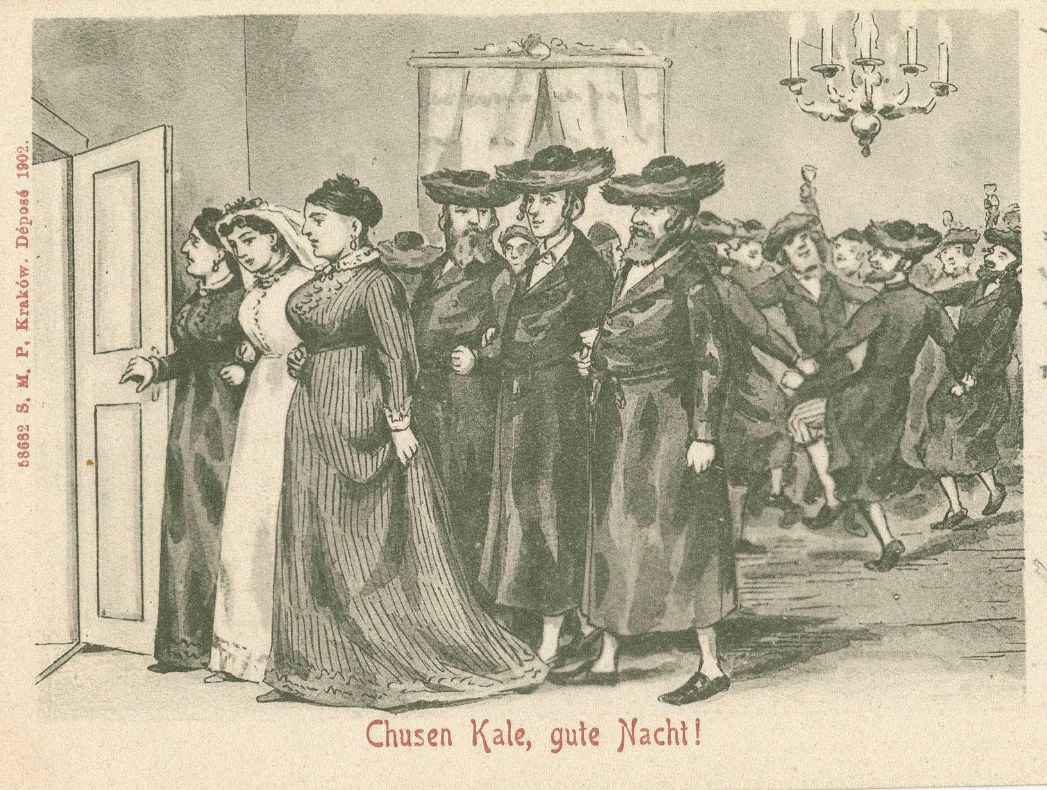
Chusen Kale gute Nacht postcard
Unknown
- Medium:
- Postcard
- Era:
- 1900-1920 (Ragtime/Early Jazz)
- Source:
- Wikimedia Commons
- Rights:
- Public domain — free to use, share and adapt.
- Recorded as:
- Public Domain
For historians of Jewish culture and dance, this postcard is a rare visual record of early 20th-century Eastern European Jewish wedding practice, documenting the ceremonial and social context in which klezmer dancing flourished. For students of diaspora culture, it represents how immigrant communities used popular media to preserve and communicate cultural memory to those who remained or had relocated.
What you are looking at
A crowded interior scene of an Eastern European Jewish wedding celebration, captured in the moment of formal departure. The bride and groom stand at the left near an open doorway, the bride in an ornate white gown with vertical pleating and elaborate train, the groom in dark formal dress with a wide-brimmed hat. They are flanked by attendants in dark suits and hats, several wearing traditional wide-brimmed Jewish wedding headgear. The couple is being escorted out while the wedding festivities continue behind them: a large crowd fills the hall, many wearing similar formal attire and traditional hats, with a festive atmosphere suggested by their animated postures. A decorated canopy hangs from the ceiling in the background, and an ornate chandelier is visible, indicating a formal hall or synagogue interior. The composition captures both the formality of the departure ritual and the ongoing celebration.
The dancing
The bride and groom occupy the compositional center-left, with the bride's elongated silhouette dominating through her trailing gown. Both stand relatively still and upright, in contrast to the surrounding crowd whose bodies lean, cluster, and gesture with greater animation. The attendants immediately surrounding them maintain closer, more formal proximity, while figures deeper in the crowd show looser postures and more active arm positions. The overall impression is of ceremonial stillness contrasted against social movement—the couple in formal departure pose while the wedding guests behind them remain in active, celebratory motion.
The dance depicted
This depicts the formal farewell moment of a traditional Jewish wedding, specifically the ritual known as the 'Chuppah' departure or wedding procession conclusion. The caption 'Chusen Kale, gute Nacht!' ('Bride and Groom, good night!') indicates the moment when the newly married couple withdrew from the main celebration hall. While not a depiction of dance itself, the image documents the social and ceremonial context in which dancing was central to Eastern European Jewish weddings—the celebration visible in the background would have included klezmer music and folk dancing. This is a wedding ceremony image rather than a dance image per se, though it captures the transitional moment between the formal ceremony and the continued social dancing of the guests.
How it was made
The catalogue record lists this as an oil painting, but the image characteristics—fine line work, uniform tonal blocking, the printing artifact visible in the upper left margin, and the chromolithographic color register—indicate this is a chromolithographic reproduction or print, likely a postcard reproduction of an original illustration. The fine detail, the precision of the costume rendering, and the caption placement are consistent with early 20th-century chromolithographic postcard production. This format determined its audience: mass-produced postcards circulated widely among diaspora communities and served as documentary records of cultural practice for those who had emigrated.
About this work
This 1902 chromolithographic postcard documents a pivotal moment in the Eastern European Jewish wedding ceremony: the formal departure of the bride and groom from the celebration hall. Created during a period of intense Jewish emigration from Eastern Europe to America, the image served as both a souvenir and a cultural record for scattered diaspora communities. The work combines ethnographic documentation with celebratory sentiment, capturing not only the formal ritual but also the energetic social world of the wedding feast where dancing and music were central cultural practices. The crowded, animated background suggests the klezmer-accompanied dancing that would have characterized the celebration before and after this moment of formal exit.
How to look at it
Attend to the compositional division between the formal, still figures of the bride and groom in the foreground and the animated crowd behind them, which creates a visual narrative of ritual transition. Note the specificity of the costume details—the bride's pleated gown, the variety of hat styles among the male guests, the formality of the setting—which would have been recognizable to contemporary viewers from Jewish communities. The artist has chosen to freeze the moment of departure itself, emphasizing the ceremonial significance of this threshold moment rather than depicting the dancing that preceded or would follow it.
The period
This postcard was created in 1902, during the period of heaviest Jewish emigration from Eastern Europe to the Americas (1880–1920). At this moment, traditional Jewish wedding practices, including klezmer music and folk dancing, were undergoing rapid transformation due to migration, urbanization, and acculturation. The production and circulation of such postcards reflected both nostalgia for 'old country' traditions and documentary interest in recording them before they disappeared. In visual art, the early 1900s saw increasing interest in ethnographic subjects and folk culture, particularly in European popular imagery.
Where it lives
This is a mass-produced chromolithographic postcard from the early 20th century, sourced from Wikimedia Commons. Its original printing, circulation, and current holding collection are not recorded.
Questions about this work
What does 'Chusen Kale, gute Nacht' mean?
The caption is Yiddish mixed with German: 'Chusen' (from Hebrew 'chatan,' groom) and 'Kale' (bride) with the German 'gute Nacht' (good night). It translates as 'Bride and Groom, good night!'—marking the moment of the couple's formal departure from the wedding celebration.
Was this a moment of dancing?
No; this depicts the formal ceremonial farewell when the bride and groom withdrew from the hall. However, Jewish weddings of this period centered on klezmer music and dancing, and this moment marks the transition between the main celebration (which included dancing) and the couple's private departure.
Why was this scene chosen for a postcard?
Early 20th-century postcards served immigrant communities as cultural souvenirs and records. For Eastern European Jews scattered across the diaspora, images of traditional wedding ceremonies preserved visual memory of homeland customs that were rapidly changing due to migration and modernization.
What can we learn about Eastern European Jewish weddings from this image?
The image documents formal dress codes (dark suits, distinctive hats, elaborate bridal gown), the importance of community witness and participation, the use of formal halls or synagogue spaces, and the presence of ceremonial ritual alongside social celebration. The animated background crowd suggests the central role of music and dancing in the overall celebration.
More dance artwork