49 works in this view — arrow keys or swipe to move between them.
Dance in Art · 1903
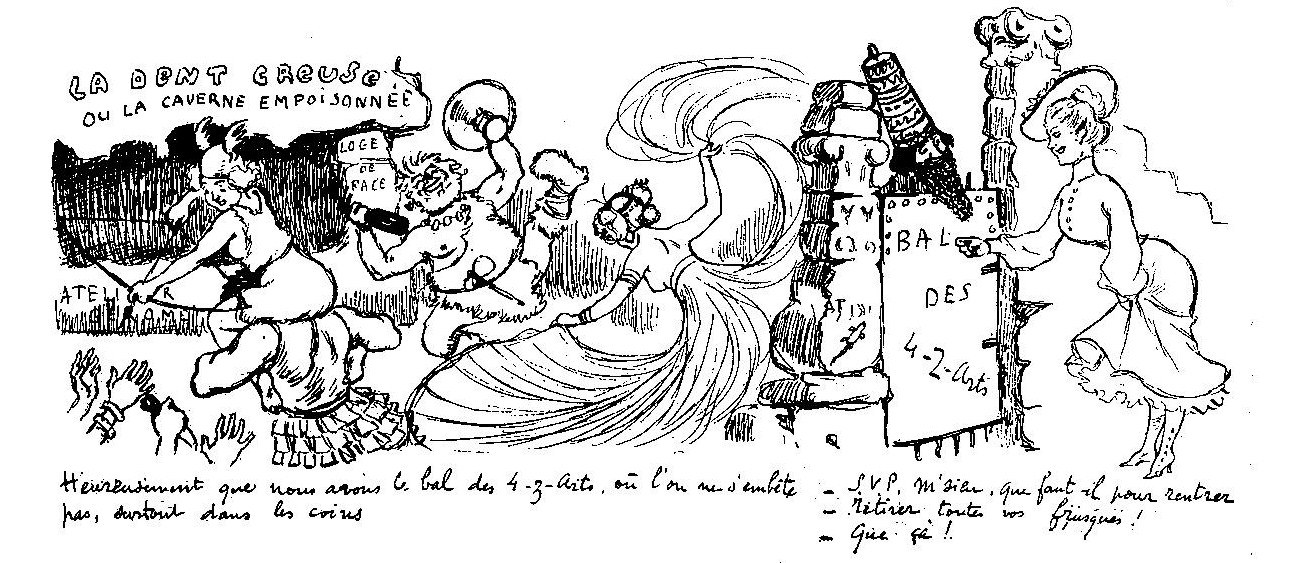
Bal des 4-Z-Arts 1903
Mirande
- Medium:
- Oil Painting
- Era:
- 1900-1920 (Ragtime/Early Jazz)
- Source:
- Wikimedia Commons
- Rights:
- Public domain — free to use, share and adapt.
- Recorded as:
- Public Domain
The 4-z-arts ball was legendary in Belle Époque Paris for its deliberate licence and bodily excess, and this image is one of the few visual documents of the spectacle itself. For historians of dance and social history, it captures a form of movement—carnival, revelry, transgression—that was central to Paris nightlife and student culture but often omitted from formal dance histories.
What you are looking at
A raucous student carnival scene crowded with revellers in various states of undress and exuberance. The composition sprawls across the canvas in loose, energetic pen lines suggesting rapid execution. At left, an atelier sign and figures tumble and cavort; the centre surges with a tangle of bodies—some upright, some inverted, many in mid-leap or contortion. Fabrics billow dramatically across the middle ground. At right, a monumental column or architectural element frames a standing female figure in a dress. The whole has the character of a behind-the-scenes glimpse at student revelry, rendered with satirical zest and little concern for spatial order. The inscription at top reads "LA DENT CREUSE OU LA CAVERNE EMPOISONNÉE" (The Rotten Tooth, or the Poisoned Cave), and at bottom a caption in French discusses the ball of the 4-z-arts and warns that "one would not see it" without entering the "cellar."
The dancing
Bodies are depicted in exaggerated, contorted poses throughout—some arching, some sprawling, several apparently jumping or being lifted. There is no unified formation or couples' hold; instead, figures cluster and overlap in a chaotic press. Limbs extend at sharp angles. Some appear to be climbing or grappling rather than dancing in a traditional sense. The artist captures a sense of uncontrolled motion and carnival licence rather than the controlled frames of ballroom or stage dance.
The dance depicted
This is not a depiction of a formal dance style but of carnival revelry and student excess. The 4-z-arts ball (Bal des 4-Arts) was an infamous annual student celebration in Paris, infamous for its anarchic, licentious atmosphere and deliberate flouting of bourgeois propriety. The image captures not choreography but spontaneous, drunken, or deliberately outrageous movement—tumbling, grappling, and general bodily excess rather than any identifiable dance vocabulary. It is social chaos illustrated as spectacle.
How it was made
The catalogue record lists this as oil painting, but the image shows rapid, linear pen or ink work more consistent with drawing, sketch, or possibly a lithograph or engraving. The loose hatching, the emphasis on line over color, and the fluid, unfinished quality all suggest a graphic medium rather than oil. The technique is deliberately sketchy and caricatural, allowing the artist to convey movement and excess through gestural marks rather than polished form.
About this work
This is a satirical or documentary image of the Bal des 4-Arts, the legendary Paris student carnival, rendered by an artist or printmaker named Mirande in 1903. It captures not a choreographed dance but the anarchic, bodily excess of student revelry—climbing, sprawling, jumping, grappling—in a crowded, deliberately chaotic composition. The work documents a moment of social and bodily transgression that was famous and notorious across Paris, and it belongs in a dance collection because carnival and student revelry were themselves forms of organized transgression expressed through the body in motion.
How to look at it
The viewer should resist looking for a single moment or conventional composition. Instead, scan the density of figures and gestural marks to sense the chaos and press of bodies. Note how the artist uses line and overlap to suggest movement and collision rather than discrete steps or formations. The column and standing figure at right provide an anchor; everything else spirals outward in centrifugal disorder. The technique itself—loose, rapid, overlapping—enacts the tumult it depicts.
The artist
The artist is identified in the catalogue as Mirande. Without further documentation, details of their practice and life remain uncertain. The style suggests a practitioner of caricature, satirical graphic art, or the illustrated press of the Belle Époque period, working in pen or lithographic media.
The period
In 1903, Paris was in the full flush of the Belle Époque, a period of cultural exuberance, nightlife, and—among students and bohemians—deliberate transgression of bourgeois morality. The Bal des 4-Arts was already legendary: a lawless, annual spectacle where art students of the École des Beaux-Arts and related institutions gathered to perform excess and mayhem. This image documents a tradition of carnivalesque student celebration that had roots in 19th-century bohemian Paris and would continue into the 20th century. In formal dance, 1903 saw ballet still dominated by Russian Imperial aesthetics (Diaghilev's Ballets Russes would debut in 1909); this image captures a form of movement radically opposed to that classicism—purely social, bodily, unschooled, and transgressive.
Where it lives
The image is identified as coming from Gallica, the digital library of the Bibliothèque Nationale de France, via Wikimedia Commons. The catalogue record notes it as a source but does not provide an accession number or holding information. It appears to be a reproduction of a historical print or drawing held in the BnF collections.
Questions about this work
What is the Bal des 4-Arts?
The Bal des 4-Arts (Ball of the Four Arts) was an annual student carnival held by art students in Paris, especially those of the École des Beaux-Arts. Held typically in the cellars or studios of student quarters, it became legendary for its anarchic, licentious atmosphere and deliberate transgression of bourgeois propriety. It was famous, notorious, and long-tolerated by Paris authorities as a pressure valve for student excess.
Is this a ballroom dance or ballet?
Neither. This is not a formal or choreographed dance but a documentation of carnival revelry and social chaos. The bodies are depicted in tumbling, grappling, jumping poses that express excess and transgression rather than any identifiable dance style or technique. It belongs in a dance collection as a document of bodily movement and social practice, not as evidence of a named dance form.
Why does the record say oil painting but this looks like a drawing?
The medium listed in the catalogue record may be incorrect. The image shows the linear, gestural qualities of ink, pen, or lithographic work, with little evidence of the modeling or color application typical of oil painting. This is flagged as a potential record discrepancy and deserves verification against the original object.
More dance artwork