49 works in this view — arrow keys or swipe to move between them.
Dance in Art · 1903
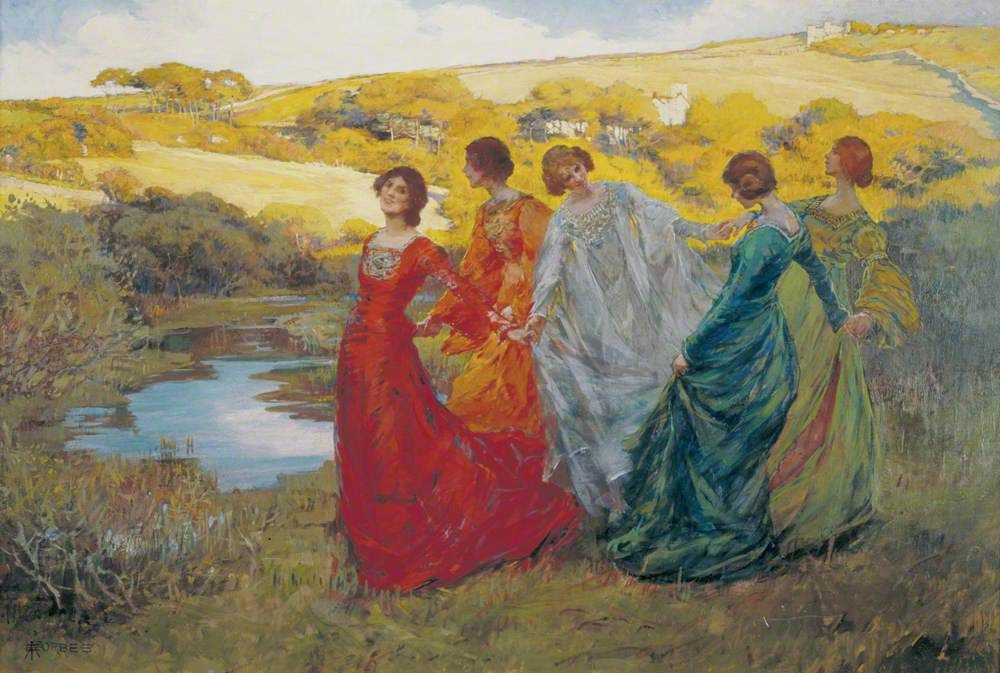
Elizabeth Adela Forbes - On A Fine Day
Elizabeth Forbes
- Medium:
- Oil Painting
- Era:
- 1900-1920 (Ragtime/Early Jazz)
- Source:
- Wikimedia Commons
- Rights:
- Public domain — free to use, share and adapt.
- Recorded as:
- Public Domain
This work matters not because it shows dance technique or a recognizable dance form, but because it reveals how women's social movement—walking, standing, conversing—was aestheticized and elevated to fine art in the early 1900s. The painting documents a moment when the female body in leisure, rather than in formal choreography, became the subject of serious artistic attention, and when the border between dance and social promenade was visually and culturally fluid.
What you are looking at
Five women in elaborate Edwardian dress stand in a rolling landscape beside a small stream, gazing toward distant hills dotted with houses and trees. The foreground figure wears a deep crimson gown; the others are dressed in shades of orange, pale grey-blue, and deep teal with long trained skirts. The composition is arcadian and leisured—no musical instruments, no spectators, no marked stage. The light is golden and diffuse across pale fields; the women appear to pause in conversation or contemplation rather than in active movement. This is a pastoral scene in the mode of late Victorian and Edwardian aestheticism, where the presence of well-dressed figures in a landscape is itself the subject, and dance, if present, would be incidental to the mood of refined leisure.
The dancing
The five women are standing or in gentle contrapposto, their bodies loosely arranged rather than in any formal dance hold. The nearest figure gazes to her left; others turn their heads toward one another or toward the view. Their postures are natural and relaxed, with weight distributed on both feet in a stance of rest rather than momentum. Arms hang at sides or are held casually; there is no evidence of partnering, no ballroom frame, and no rigid formation. If any movement is occurring, it is minimal and social rather than choreographed.
The dance depicted
This painting does not depict an active dance. The figures are posed as if pausing during a walk or gathered for social conversation in a landscape. While the period (early 1900s) saw promenade walks as a social ritual among the leisure classes, and such walks could precede or frame dance, the image itself shows no dance position, hold, or momentum. The catalogue tags this as 'General Dance,' but the visual evidence does not support a dance genre classification. This is a landscape painting with figures.
How it was made
Oil painting on canvas, as stated in the record. The technique is characteristic of Edwardian academic art and the Aesthetic movement: soft-focus landscape rendered in golden and green tones, with figures in contemporary dress integrated into a romanticized natural setting rather than posed in studio light. The translucent handling of fabric, the atmospheric perspective, and the jewel-toned palette are consistent with oil painting circa 1903. The medium allows for the subtle rendering of texture—especially the drape and sheen of the women's gowns—and the diffuse light that softens and humanizes the scene.
About this work
This is a painting of five well-dressed Edwardian women in a pastoral landscape, attributed to Elizabeth Adela Forbes. The work exemplifies early-twentieth-century academic painting in the Aesthetic tradition: figures are integrated into idealized nature, dress is meticulously observed, and mood—leisured, refined, feminine—is paramount. While catalogued under dance, the image shows no active dance. It belongs in a study of how dance and social movement were represented in Edwardian visual culture, and how the figure of the woman in motion or repose became a symbol of beauty and leisure in art of the period. The work is significant not for depicting a dance form but for capturing the visual language of Edwardian femininity and the blurred boundary between social movement and artistic composition.
How to look at it
Look first at what the women are *not* doing: there is no partnering, no symmetrical formation, no visible step or gesture that would mark this as a recognized dance. Instead, notice the arrangement—how each figure occupies her own space in the landscape, and how the eye moves from the crimson dress on the left to the others, following a rhythm of color and pose rather than choreography. Observe the fabric: the trailing hems, the weight of the gowns, the ease with which the women inhabit their dress. This is Edwardian visual culture's way of celebrating the female body not through dance steps but through the natural grace of posture, the beauty of fabric, and the harmony of color and landscape. The 'dance' is in the composition, not in the bodies.
The artist
Elizabeth Adela Forbes (1859–1912) was a British artist and, with her husband Stanhope Forbes, a leading figure in the Newlyn School, a colony of artists working in St Ives, Cornwall. She was trained at the École Colarossi in Paris and the Slade School in London and was known for paintings of everyday life, particularly scenes of women and children, rendered with meticulous attention to light, color, and fabric. Her work bridges academic realism and Aesthetic movement sensibility; figures are observed with naturalism but placed in idealized or poetic landscapes. She exhibited widely and was a respected artist in her lifetime.
The period
In the early 1900s, Edwardian Britain was experiencing a flourishing of visual culture centered on femininity, leisure, and nature. The Aesthetic movement's emphasis on beauty, color, and mood was waning but its influence remained strong in academic painting. Women's roles were beginning to shift—the period saw the rise of the 'New Woman' and increased social freedoms—yet art often froze women in poses of idealized leisure and beauty. In dance, this was a period of transition: classical ballet was being revived and reformed; social ballroom dances were highly codified and taught in formal settings; and promenade walks in parks or gardens remained a central ritual of courtship and leisure. The painting sits at the intersection of all three: it aestheticizes the female body in movement (or near-movement) without committing to any single dance form.
Where it lives
The work is recorded as sourced from Wikimedia Commons, with no holding institution noted in the catalogue record. It is an oil painting dated 1903.
Questions about this work
Is this actually a dance painting?
No. While catalogued under 'General Dance,' the image shows five women standing and conversing in a landscape, with no visible dance position, hold, or technique. The painting documents Edwardian social movement and leisure—promenading, standing, socializing—rather than choreographed dance. It is valuable for understanding how the female body and movement were idealized in art, but it is not a depiction of a dance form.
What is the style of dress?
All five women wear fashionable Edwardian gowns, circa 1900–1910, characterized by S-bend corset silhouettes, long trained skirts, and jewel or pastel tones. The crimson, orange, grey-blue, and teal colors are typical of the period's aesthetic preferences for rich, saturated hues. The gowns are clearly expensive and speak to a leisure class with access to fashionable dress and the time to promenade.
Why is this in a dance gallery?
The painting exists at the threshold of dance and social movement. Early twentieth-century visual culture often blurred the line between ballroom dance, promenade, and aesthetic pose. The catalogue may have tagged it 'General Dance' because it depicts women's bodies in an arranged, rhythmic composition, or because the Edwardian promenade was itself a semi-choreographed social ritual. It is a useful document for understanding how movement was represented and valued in the period.
More dance artwork