49 works in this view — arrow keys or swipe to move between them.
Dance in Art · 1907
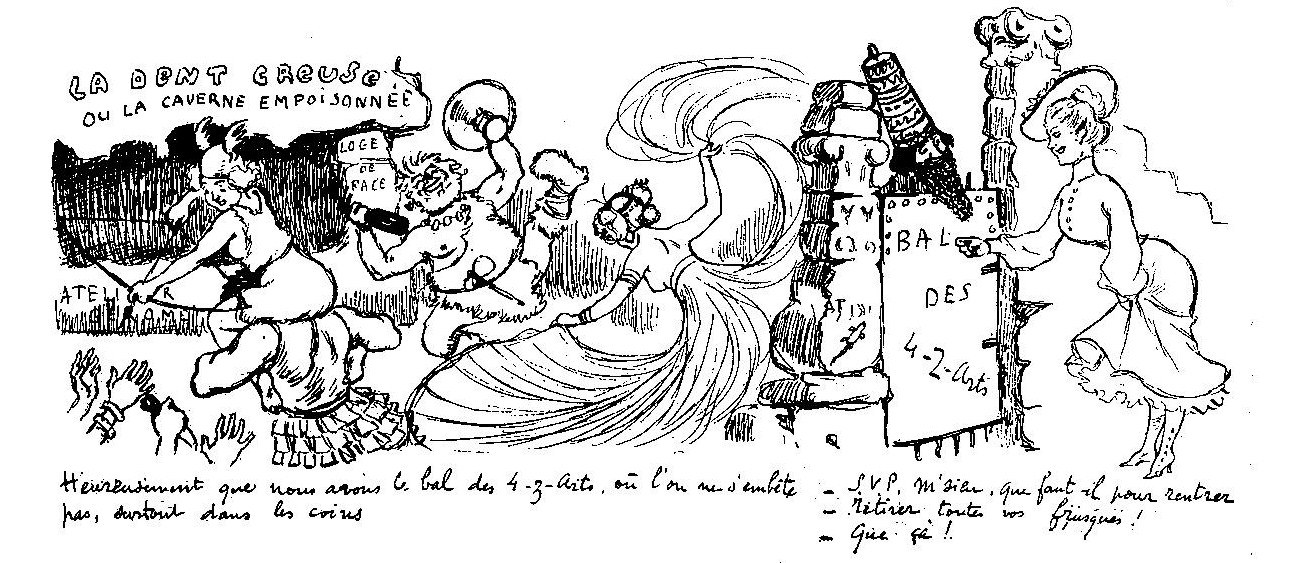
Carte d'invitation au Bal des Quat'z'Arts 1907
Anonymous
- Medium:
- Oil Painting
- Era:
- 1900-1920 (Ragtime/Early Jazz)
- Source:
- Wikimedia Commons
- Rights:
- Public domain — free to use, share and adapt.
- Recorded as:
- Public Domain
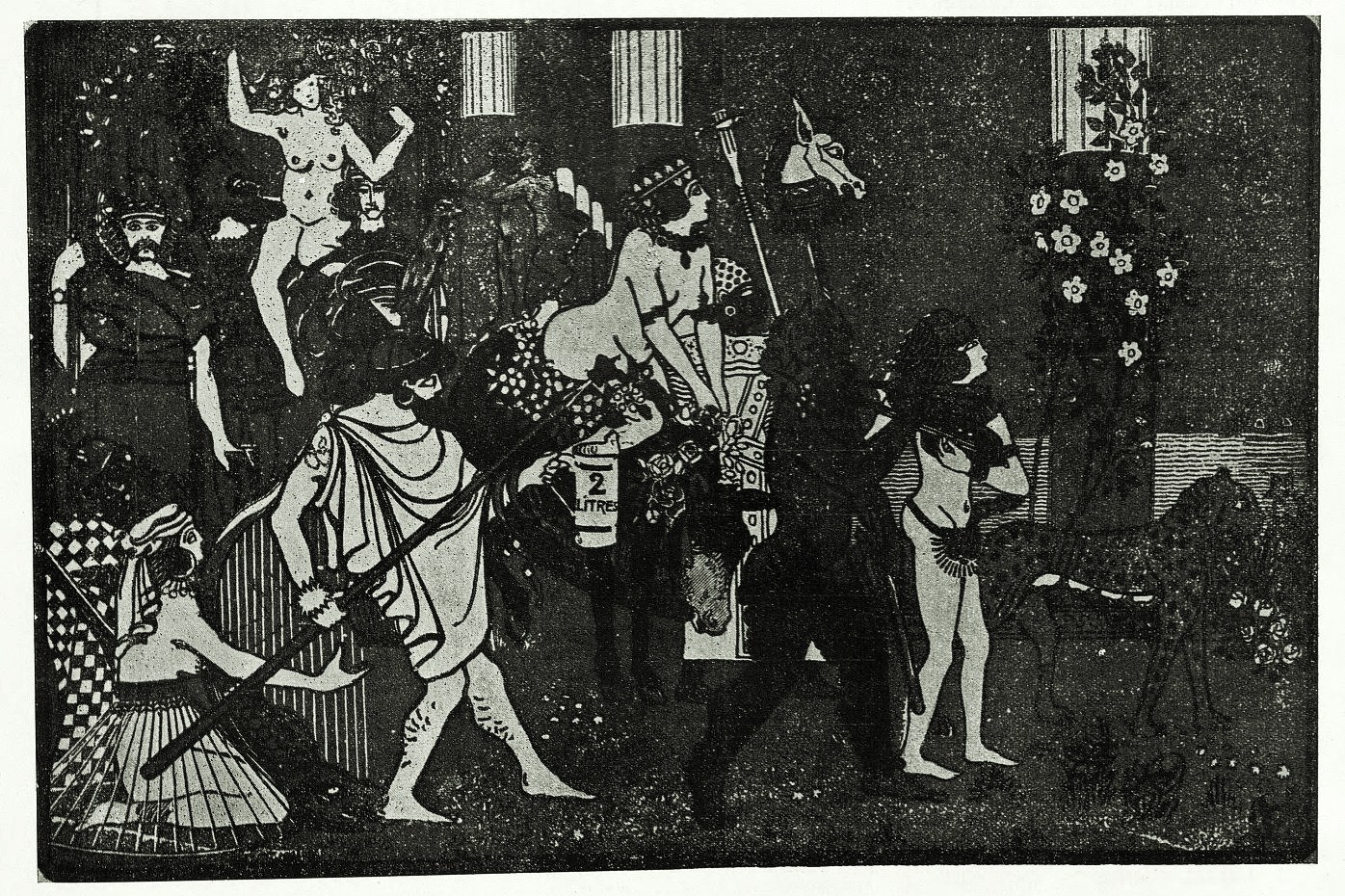
This invitation card documents a seminal moment in Paris's artistic underworld and reveals how costume, nakedness, and expressive movement functioned as forms of artistic rebellion and social transgression at the turn of the 20th century. The Bal des Quat'z'Arts was legendary in its day, and this image captures its transgressive energy in a medium—graphic printmaking—suited to wide circulation and cultural impact. For historians of dance and performance, it shows how informal movement and body display outside ballroom technique were celebrated and mythologized in artistic communities.
What you are looking at
A densely populated ballroom scene rendered in bold black and white, depicting the Bal des Quat'z'Arts—the notorious students' ball held at the Salle Wagram in Paris. The composition is crowded and chaotic, with figures clustered throughout a grand interior with tall windows and classical columns. Nude and semi-nude figures mingle with fully clothed guests; some dance in pairs while others gesture dramatically, recline, or pose. The style is decidedly modernist, employing stark contrast and expressive linework typical of early 20th-century graphic art. At the center, figures in classical or allegorical dress—some seemingly representing artistic or mythological personae—dominate the composition. The upper register includes floating or suspended figures, heightening the scene's theatrical, almost dreamlike quality. Flowers are scattered throughout the composition, and decorative elements suggest luxury and excess. The overall effect is one of bohemian abandon and artistic license, capturing the transgressive energy of a student celebration known for its provocative costumes and uninhibited behavior.
The dancing
Bodies throughout the composition adopt varied postures: some stand in loose social clusters, others lean or recline, and several appear mid-movement in dance-like gestures. A figure in the lower left plays chess, introducing a note of intellectual pursuit amid the revelry. The dancing couples visible do not adopt a formal ballroom hold; instead, gestures are loose, expressive, and often asymmetrical, with arms raised or extended in what appears to be informal, gestural movement rather than structured partnered dance. The nude or lightly draped figures suggest classical artistic reference—models or artistic personae rather than ballroom dancers. Weight distribution and body position are fluid rather than formally postured, consistent with bohemian social dance of the period rather than technique-based ballroom.
The dance depicted
This is not a depiction of formal ballroom dance but rather of the Bal des Quat'z'Arts itself—a raucous student celebration held annually in Paris from the 19th century onward, famous for its costume, excess, and transgressive spirit rather than refined choreography. The ball was a rite of passage for art students and attracted bohemian society; costumes ranged from classical or allegorical to deliberately provocative or nude. The figures here move in loose, social, expressive ways consistent with informal student revelry set to music, not structured ballroom technique. The presence of classical or mythological figures suggests the artistic themes and costume traditions of these events, where art students reimagined themselves as muses, gods, or artistic ideals.
How it was made
The catalogue record states oil painting, but the image characteristics strongly suggest this is a lithograph or woodcut—the bold, high-contrast black-and-white palette, the expressive linear mark-making, and the graphic quality of the composition are typical of printmaking rather than oil painting. The technique allows dramatic, gestural mark-making and strong tonal contrast suitable for reproduction and wide circulation. If this is indeed a print (as the visual evidence suggests), it would have been produced as an invitation card or poster—a printed object distributed to announce and promote the ball, not a unique artwork. The graphic style and composition are consistent with Art Nouveau or Modernist graphic design of the 1900s–1910s.
About this work
This is an invitation card (carte d'invitation) for the Bal des Quat'z'Arts held on 15 May 1907 at the Salle Wagram in Paris. Rather than a painting as catalogued, it appears to be a lithograph or woodcut—a printed work designed for distribution and circulation. The image captures not ballroom dance in the formal sense but the bohemian, transgressive spirit of the students' ball itself: a carnivalesque event where art students, models, and bohemian society gathered in costume to celebrate artistic identity outside conventional social bounds. The composition's crowded, expressive, and provocative character—with its prominent nude and semi-nude figures—reflects the ball's reputation for uninhibited behavior and artistic self-fashioning.
The Bal des Quat'z'Arts was a significant social ritual in Parisian artistic culture, and this invitation card is a document of that world. It speaks to the relationship between visual art, performance, costume, and social transgression in early modernism. For dancers and historians, it offers evidence of how informal, gestural movement and costume-based self-presentation functioned within bohemian social practice—a precursor to later avant-garde performance and a snapshot of student culture at a specific historical moment.
How to look at it
Attend to the composition's deliberately crowded, chaotic arrangement—the artist has rejected spatial clarity in favor of density and visual complexity, suggesting the overwhelming sensory experience of the ball itself. Note how nude or lightly draped classical figures sit alongside clothed partygoers, establishing the ball's key transgression: the collapse of the distinction between artistic (nude) bodies and social (clothed) ones. Look at the gestural quality of the bodies—loose, expressive, unsystematic—and compare it to the formal postures of ballroom dance. The graphic technique, with its stark blacks and whites and bold outlines, heightens the sense of transgression and visual drama; this is not a subtle or refined image but a deliberately provocative one. The floating figures in the upper register and the scattered flowers suggest a heightened, almost dreamlike artistic fantasy overlaid on bohemian social reality.
The artist
The work is catalogued as anonymous. The graphic style—bold, modernist, expressive line work with classical references—is consistent with early 20th-century Parisian graphic art and poster design. The composition and subject matter suggest familiarity with bohemian artistic circles. Without signature or attribution, the artist's identity cannot be established, though the technical skill and understanding of the ball's cultural significance suggest a contemporary artist or designer with insider knowledge of Parisian student culture.
The period
The Bal des Quat'z'Arts was an annual institution dating to the 19th century, reaching its peak of notoriety in the late 1800s and early 1900s. By 1907, when this invitation was produced, the ball was famous throughout Paris as a site of artistic transgression, sexual license, and bohemian performance. The early 1900s saw increased modernist experimentation in visual art and emerging interest in the body as a site of artistic expression outside academic tradition. The graphic style of this invitation reflects Art Nouveau and early Modernist aesthetics, with their embrace of bold forms and expressive line. The ball itself represented a zone of social freedom where art students, models, and bohemian figures could challenge bourgeois convention through costume, nudity, and performance—a cultural moment that would influence avant-garde performance practices throughout the century.
Where it lives
The work is recorded as sourced from Wikimedia Commons with no holding institution noted. It appears to be a printed invitation card produced for distribution at or in advance of the ball held on 15 May 1907. As an invitation, it served both a practical function (announcing the event) and a cultural one (advertising the ball's transgressive character to potential attendees). The fact that this invitation survives and circulates digitally speaks to its significance within Parisian artistic culture.
Dance in this work
Questions about this work
Was the Bal des Quat'z'Arts a real event?
Yes. The Bal des Quat'z'Arts was an annual ball held by Parisian art students, famous for its costumes, nakedness, and transgressive behavior. It began in the 19th century and reached its peak notoriety in the 1880s–1900s. The ball became so infamous for sexual license and disorder that it was eventually suppressed by authorities. This 1907 invitation documents its continued existence at that date.
Why does the catalogue call this an oil painting?
The record is likely incorrect. The visual evidence—bold black-and-white contrast, expressive linear marks, and the composition's graphic character—strongly indicates this is a lithograph or woodcut, not an oil painting. As an invitation card, it would have been printed for distribution, not painted as a unique artwork. The record may have been entered without visual inspection or from incomplete information.
Is this depicting ballroom dance?
No. While music and movement occur at the ball, the figures do not adopt ballroom holds, postures, or technique. Instead, they move in loose, expressive, gestural ways consistent with informal social dancing and bohemian revelry. The ball celebrated artistic identity and transgression, not ballroom refinement. This is a document of student culture and costume performance, not dance technique.
Who is the artist?
The work is catalogued as anonymous, and no signature is visible in the image. The modernist graphic style and intimate knowledge of bohemian Paris suggest a contemporary designer or artist with connections to artistic circles, but the artist's identity cannot be established from available information.
More dance artwork