49 works in this view — arrow keys or swipe to move between them.
Dance in Art · 1914
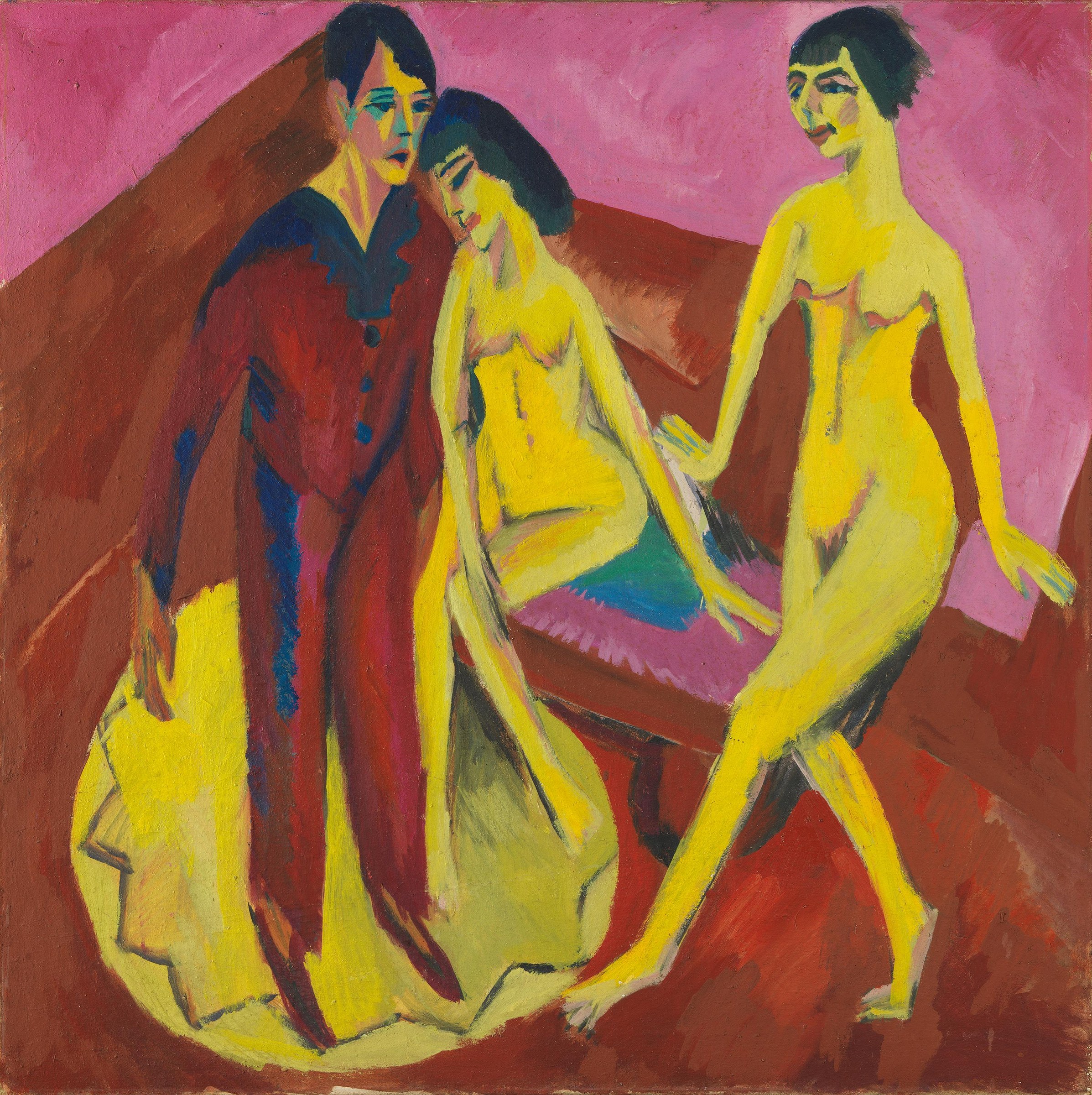
Kirchner - Tanzschule (Ballettszene), 1914, 13350
Ernst Ludwig Kirchner
- Medium:
- Oil Painting
- Dance:
- Ballet
- Era:
- 1900-1920 (Ragtime/Early Jazz)
- Source:
- Wikimedia Commons
- Rights:
- Public domain — free to use, share and adapt.
- Recorded as:
- Public Domain
Kirchner was a founder of Die Brücke and a major Expressionist painter; his work on the theme of dance and the body documents modernism's ambivalent relationship to the performer and the gaze. The painting is valuable evidence of how visual artists of the era understood—and critiqued—the power dynamics embedded in dance training and spectatorship.
What you are looking at
Three figures occupy a shallow stage-like space defined by warm browns and deep reds, set against a vivid magenta ground. At left, a clothed male figure in a dark jacket with bold blue and red geometric striations leans forward, his posture possessive or directing. Two nude or nearly-nude female figures dominate the composition: one seated or crouching centrally, her body rendered in acid yellow with dark contour lines, looking downward; the other standing to the right in the same sickly yellow, her gaze turned toward the viewer or the standing man. The seated figure wears what appears to be a blue or teal skirt; the standing figure is unclothed except for a brief garment. The paint is applied loosely and expressionistically, with colors that clash and vibrate rather than model form naturalistically. The space is compressed and airless, the relationship between the three figures charged with tension.
The dancing
The two female bodies are elongated and angular, their limbs attenuated and their spines curved in ways that suggest emotional or physical strain rather than balletic control. Neither woman is en relevé or in a classical ballet frame. The seated figure's rounded back and downcast head suggest submission, exhaustion, or shame; the standing figure's pose is ambiguous—part-turning, part-presenting. The male figure's forward lean and the direction of his gaze suggest he is observing or directing rather than partnering. There is no partnering hold, no mutual engagement in movement. The bodies read as objects or subjects of his attention rather than as independent dancers.
The dance depicted
The catalogue identifies this as a ballet scene, but nothing in the image suggests classical ballet technique or aesthetic. The women's bodies lack the lifted spine, turned-out legs, and ethereal lightness of ballet. Instead, the composition evokes a rehearsal, a lesson, or a scene of surveillance and power rather than performance. The distorted figures and raw emotional temperature suggest an expressionist or modernist critique of dance, authority, and the human body—closer to German Expressionism's interest in psychology and social critique than to academic ballet. The work may depict a dance lesson or studio scene, but registers as an interrogation of that scenario rather than a celebration of dance.
How it was made
Oil on canvas, executed with bold, flat planes of color and aggressive dark outlines. The paint is not blended to create volume; instead, colors are juxtaposed for emotional and symbolic effect. The yellow figures seem to vibrate against the red and brown ground. This technique—rejecting naturalism in favor of expressive distortion—is characteristic of German Expressionism and allows the artist to emphasize psychological content over visual accuracy. The loose, urgent handling suggests the work was created with conviction rather than polish.
About this work
This is an oil painting by Ernst Ludwig Kirchner, catalogued as a ballet scene from 1914 and sourced from Wikimedia Commons. It depicts three figures in a compressed interior space: a clothed man and two nude or semi-nude women rendered in vivid, non-naturalistic color. The work is recognized as a significant example of German Expressionist painting and is held in a major collection (specifics not recorded here).
The painting belongs in a gallery of dance in art not because it celebrates dance, but because it scrutinizes the social and erotic dynamics of the dance studio and lesson. Kirchner was responding to the avant-garde dance scene of early 20th-century Berlin, where dance was both liberation and commodification, and where the body became a site of both artistic experiment and social anxiety.
How to look at it
Attend to the color first: the acidic yellow of the women's bodies creates visual discomfort and draws the eye, while the dark outlines prevent the forms from dissolving or becoming soft. Notice the asymmetry of the composition and the spatial compression—there is no depth, no stage, no conventional theatrical framing. Observe the direction of gazes: who is looking at whom, and what does that tell you about power and desire? The work freezes no single moment of movement; instead, it captures a relationship or dynamic. Compare the treatment of the clothed man's body (modeled with facets of color, more contained) to the nude women's bodies (stretched, vulnerable, outlined). Ask yourself: is this a dance scene, or a critique of one?
The artist
Ernst Ludwig Kirchner (1880–1938) was a German Expressionist painter and a founder of Die Brücke (The Bridge), one of the most important avant-garde movements of the early 20th century. Kirchner was fascinated by the human figure, performance, and urban modernity, and made numerous paintings, prints, and drawings of dancers, circus performers, and entertainers. His style is characterized by angular, distorted forms; acid and clashing colors; and a raw emotional intensity. He worked in Berlin during a period of extraordinary artistic ferment, and his work engaged critically with themes of sexuality, desire, power, and the commodification of the body in modern urban culture.
The period
In 1914, Berlin was a center of avant-garde performance and visual art. Modern dance was emerging as a force—figures like Mary Wigman and the Ballets Russes were revolutionizing dance away from classical ballet toward expressionistic and non-Western forms. Simultaneously, commercial dance halls, music halls, and cabarets flourished, and the boundaries between high art and entertainment, liberation and exploitation, were actively contested. German Expressionism as a movement was intensely interested in the psychology of the body and in challenging bourgeois aesthetic conventions. Kirchner's dance paintings must be read in this context: as responses to both the utopian possibilities of modernist dance and its troubling social and erotic economies.
Where it lives
The work is sourced from Wikimedia Commons; the holding collection and accession number are not recorded in the catalogue metadata. It is documented as a significant painting in the Expressionist tradition and appears in major surveys of Kirchner's work and of German Expressionism.
Dance in this work
Questions about this work
Is this really a ballet scene?
The catalogue record calls it one, but the painting does not depict classical ballet. The women's bodies are too distorted, their postures too grounded and inward, for traditional ballet aesthetics. It is more likely a studio scene, rehearsal, or lesson, painted from an expressionist perspective that foregrounds psychology and power over technique and beauty.
Why are the women rendered in yellow?
In Expressionism, color is not naturalistic but symbolic and emotional. Yellow can evoke sickness, alienation, or intensity. Here it makes the female bodies vibrate against the warm red and brown tones, drawing urgent attention to them while simultaneously making them seem strange and vulnerable.
What was Kirchner's relationship to dance?
Kirchner was deeply engaged with modern dance and performance throughout his career. He painted dancers, circus performers, and cabaret scenes as ways to explore modernism, the body, sexuality, and urban experience. His dance paintings are not uncritical celebrations but complex investigations of desire, power, and art-making.
When was this painted and why does that matter?
1914 is the eve of World War I and a moment of intense artistic ferment in Berlin. Modernist dance was emerging; Expressionism was at its height; the social and sexual upheaval of the city was reflected in and debated by visual artists. This painting is a document of that moment's anxieties and energies.
More Ballet artwork