36 works in this view — arrow keys or swipe to move between them.
Dance in Art · 1902
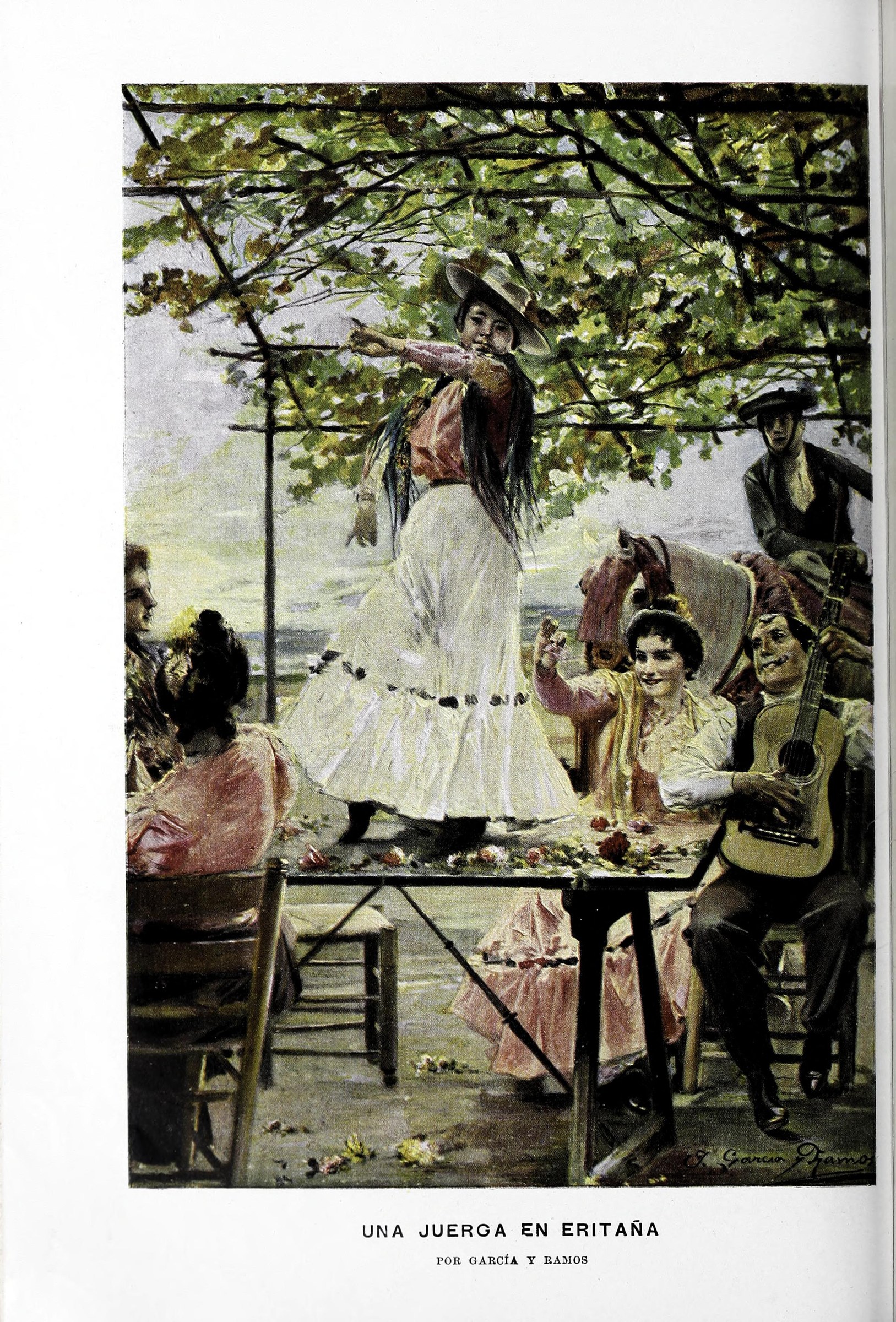
1902-04-19, Blanco y Negro, Una juerga en Eritaña, García y Ramos
José García y Ramos
- Medium:
- Oil Painting
- Era:
- 1900-1920 (Ragtime/Early Jazz)
- Source:
- Wikimedia Commons
- Rights:
- Public domain — free to use, share and adapt.
- Recorded as:
- Public Domain
This work documents how ordinary people danced socially in early 20th-century Spain—improvised, joyful, and rooted in regional tradition—at a moment when such scenes were beginning to attract the attention of fine artists and the educated middle class. It shows that dance existed far outside the theater and the academy, embedded in leisure, companionship, and rural or regional identity.
What you are looking at
A lively outdoor garden party unfolds beneath a leafy pergola, rendered in warm oils with vivid greens and ochres. In the center stands a woman in an elegant white dress decorated with dark embroidery or beading at the waist, her body tilted back in an exuberant gesture as she reaches upward to touch the vine-covered trellis. Around her, five figures in period dress—the men in dark suits and hats, the women in colored skirts and yellow-ochre bodices—watch and participate in the merrymaking. One woman sits left in rose-toned fabric; another stands center-right in yellow, her hand raised toward the central dancer; a man with a guitar sits right, contributing music. The ground is scattered with fallen flowers or petals. The lighting is naturalistic, filtering through the pergola to create dappled shadows across the figures and ground.
The dancing
The central figure's body is extended and lifted, her right arm reaching overhead in an uninhibited arc while her torso arches backward—a posture of abandonment and joy rather than technical control. Her companions remain relatively static, oriented toward her as audience and chorus. The guitarist's posture is grounded and seated. None of the figures display the turned-out legs, pointed feet, or formal frame of classical dance; instead, the movement reads as spontaneous and social, captured mid-gesture rather than mid-step.
The dance depicted
This depicts a *juerga*—a Spanish colloquial gathering or party, often musical and festive, with roots in regional folk celebration. The title specifies Eritaña, likely a regional or local reference. The image shows not a formal choreographed dance but an improvised moment of celebration: a woman dancing unselfconsciously while companions provide music and witness. The white dress, garden setting, and daylight suggest bourgeois leisure rather than professional or courtly performance. The pose—arms raised, body open—is consistent with regional Spanish social dance of the early 20th century, though the specific steps are invisible.
How it was made
This is an oil painting, likely a chromolithographic reproduction or original oil on paper or canvas, printed or published in the journal *Blanco y Negro* in 1902. The warm palette, soft modeling of fabric, and naturalistic light suggest oils or high-quality color lithography. Its appearance in a Spanish illustrated journal indicates it was made for middle-class domestic and reading-room circulation—a scene of genteel leisure and cultural life aimed at an urban, literate audience interested in contemporary manners and aesthetics.
About this work
This is a snapshot of Spanish leisure-class life at the turn of the 20th century, capturing a private moment of improvisational social dance in a garden setting. The painting documents not a staged or formal performance but an intimate gathering—a *juerga*—where a woman dances unselfconsciously among friends and musicians. The work belongs in a gallery of dance art because it captures the aesthetic and bodily reality of social, vernacular dance in the early modern period: uncodified, joyful, and rooted in companionship rather than spectacle.
The painting also marks the emergence of dance as a legitimate subject for fine art in Spain at the fin de siècle. By placing this scene of folk celebration within a cultivated bourgeois garden and rendering it in the language of contemporary salon painting, the artist elevates everyday social dance to the status of a worthy artistic subject—a gesture toward the valorization of regional and popular culture that would gather force in early 20th-century Spanish and European art.
How to look at it
Look first at the central figure's body: the arch of the back, the reach of the arm, the tilt of the head—these capture a moment of unselfconscious abandon rather than formal technique. Notice how the artist has positioned her among her companions: she is the subject of the gathering's attention, yet the scene remains intimate and domestic, not performative. The garden setting—the pergola, the flowers, the dappled light—frames the dance as a natural outgrowth of leisure and companionship, not as spectacle. The painting is interested in the *mood* and social context of dance, not its steps.
The artist
José García y Ramos (1852–1912) was a Spanish academic painter known for genre scenes of Spanish regional life, often depicting festive, musical, or intimate domestic moments. He worked in a naturalistic style attentive to light, fabric, and social detail, and was commercially successful in the late 19th and early 20th centuries. His work circulated through illustrated journals and salons, reaching a broad educated audience interested in contemporary Spanish life and aesthetics.
The period
The painting dates to 1902, a moment of cultural nationalism and regionalism in Spain. Spanish intellectuals and artists were increasingly interested in documenting and aestheticizing local and regional traditions—music, dress, festival, dance—as expressions of authentic national identity. This coincided with broader European interest in folk culture and the picturesque. At the same time, the early 20th century saw the emergence of flamenco and other regional Spanish dances as subjects of serious artistic and ethnographic attention. Social dance itself was becoming more visible in art and literature, reflecting both the expansion of leisure culture and the influence of modern visual media (photography, journal illustration) in capturing everyday life.
Where it lives
The work is catalogued from a reproduction in *Blanco y Negro*, a major Spanish illustrated weekly journal founded in 1891. The journal's archive serves as a primary source for tracking contemporary Spanish visual culture and the circulation of genre and social scenes in the early 20th century. The painting's original location is not recorded.
Dance in this work
Questions about this work
What is a juerga?
A juerga is a Spanish colloquial term for a party, gathering, or festive occasion, often with music and dancing. It can refer to informal, spontaneous merrymaking among friends or community, as opposed to a formal or staged event. The term carries connotations of gaiety, warmth, and regional tradition.
Is this flamenco?
The image does not depict flamenco, which has a distinctive posture, footwork, hand movement, and costuming not present here. This is a social, garden-party dance—likely a regional folk or popular dance—captured in a moment of joyful improvisation. Flamenco was a separate, increasingly professionalized art form by 1902, though both were part of Spanish regional culture.
Who is the artist?
José García y Ramos was a Spanish academic painter (1852–1912) specializing in genre scenes of Spanish life, particularly festive, musical, or intimate social moments. He was commercially successful and widely published in journals and exhibitions during his lifetime. His work appealed to middle-class audiences interested in contemporary Spanish culture and aesthetics.
Why is this in Blanco y Negro?
*Blanco y Negro* was a leading Spanish illustrated weekly journal (founded 1891) that published art, literature, criticism, and commentary for an educated, urban middle-class readership. Works by contemporary academic painters like García y Ramos appeared regularly, often as reproductions or contributions that reflected the journal's interest in contemporary Spanish life, fashion, and culture.
More dance artwork