37 works in this view — arrow keys or swipe to move between them.
Dance in Art · 1903
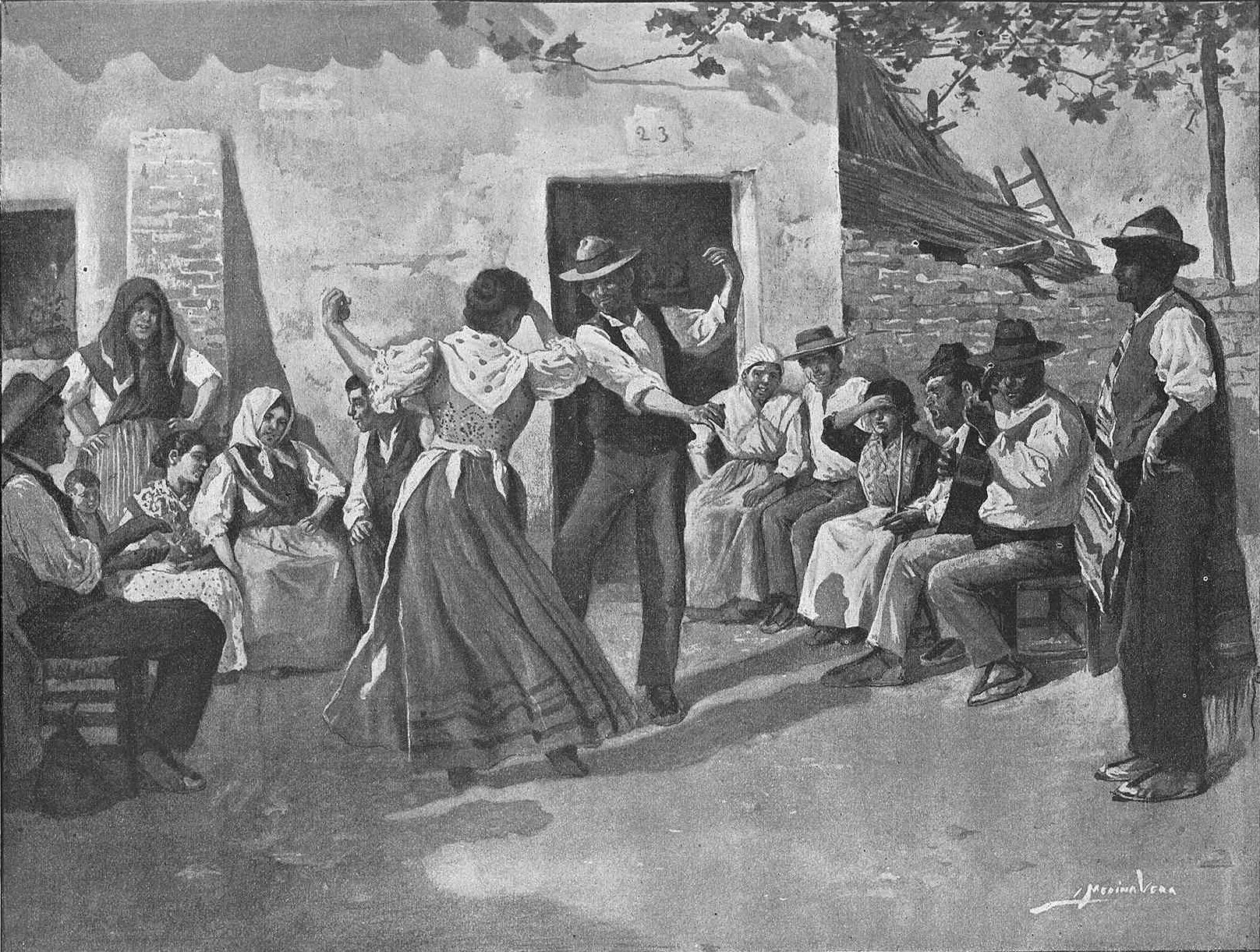
1903-09-21, La Ilustración Artística, El fuego se había roto al fin y las parejas se lanzaban al baile, Medina Vera
Inocencio Medina Vera
- Medium:
- Oil Painting
- Era:
- 1900-1920 (Ragtime/Early Jazz)
- Source:
- Wikimedia Commons
- Rights:
- Public domain — free to use, share and adapt.
- Recorded as:
- Public Domain
The work preserves a specific moment and style of folk dance documentation—not instruction but rather narrative illustration of dance as lived social practice. For historians of Spanish folk dance and for those studying how artists and periodicals represented rural life in the early 20th century, this is primary visual evidence of posture, dress, setting, and the social choreography of participation.
What you are looking at
A village courtyard or outdoor space filled with rural figures in what appears to be a moment of social gathering and dance. The setting is rustic—whitewashed buildings with dark doorways frame the scene, and bare trees suggest late autumn or winter. A central couple dominates the foreground: a woman in a full skirt and white blouse with arms raised and spread wide, her body angled in evident motion, faces a man in a hat and dark jacket. Around them, seated and standing figures watch—women in headscarves and long skirts, men in hats and vests, children scattered among them. The lighting is soft and diffuse, casting gentle shadows. The composition creates depth from the watching figures in the middle ground to the doorway and buildings beyond, and the title's phrase 'the fire had finally broken and the couples threw themselves into the dance' suggests this captures the moment when restraint gives way to celebration.
The dancing
The central woman's raised arms, spread wide and lifted high, show an expansive, uncontained energy—her posture reads as exultant rather than technically controlled. The man opposite her maintains a more grounded stance, his frame open and receptive. Around them, seated spectators lean forward with evident interest. The poses and positions suggest social, participatory dancing rather than performance-oriented choreography; the watching figures are part of the social fabric, not an audience at remove. No visible closed holds or ballroom frame; instead, an open, gestural, and emotionally communicative physicality.
The dance depicted
This appears to be rural Spanish or Latin American social dance of the late 19th or early 20th century—likely a jota, seguidilla, or similar folk celebration. The raised-arm gesture, the outdoor village setting, the watching community, and the sense of collective joy all point to participatory folk dance rather than ballroom. The woman's exuberant arm position and the man's receptive stance suggest the flirtation and play-acting typical of courtship dances in Iberian and Iberian-descended traditions. The title's emphasis on the 'breaking' of restraint (presumably social decorum) and the rush into dance speaks to the cultural significance of these moments—dance as release and social bonding.
How it was made
This is an oil painting reproduced from *La Ilustración Artística*, a major Spanish illustrated periodical. The soft modeling of light, the warm palette dominated by ochres and grays, and the gestural brushwork all indicate oil on canvas. As an illustration for a magazine, it would have been reproduced via photomechanical process, which accounts for the tonal range and the slight graininess of the print. The choice of oil for magazine illustration speaks to the status of both artist and publication—this was high-quality visual journalism aimed at educated readers who could appreciate narrative and technical skill.
About this work
This oil painting captures a moment of rupture and release in village social life: the instant when a couple abandons formal restraint and throws themselves into dance before a gathered community. The artist, Inocencio Medina Vera, was documenting rural Spanish life and manners at a moment when industrialization and urbanization were transforming village culture. The work belongs to a tradition of literary and visual illustration of folk life—romantic, sympathetic, and invested in capturing the authenticity and emotional truth of rural celebration. It is both a document of how people danced and a statement about what dance meant to communities: freedom, courtship, collective identity, and the breaking of everyday constraint.
How to look at it
Attend first to the woman's arms and the openness of her body—the artist has chosen to capture maximum expansion and lift, the moment of abandon rather than control. Notice how the watching figures frame and validate the dancing couple; this is not a performance before an external audience but a community participating in its own ritual. The architectural setting—the whitewashed walls and dark doorways—grounds the scene in a specific geography and social world. The soft, diffuse light suggests either early morning or the golden hour, investing the scene with a lyrical, almost elegiac quality, as if the artist is aware this way of life is passing.
The artist
Inocencio Medina Vera was a Spanish painter and illustrator active in the late 19th and early 20th centuries, contributing to *La Ilustración Artística* and other periodicals. His work specialized in scenes of rural and village life, often with narrative and anecdotal content. He worked in a representational, accessible style suited to magazine publication, combining technical competence with attention to costume detail and social observation.
The period
Spain in the 1900s was experiencing rapid social change. Rural village life and folk traditions were being documented, collected, and valorized by urban intellectuals and artists as Spain modernized. Illustrated magazines like *La Ilustración Artística* (founded 1882) circulated these scenes to educated urban readers, creating a market for images of 'authentic' rural culture. Simultaneously, flamenco and regional folk dances were being formalized and staged for theatrical audiences. This painting sits between those impulses—it shows folk dance as genuinely lived and felt, not as performance, yet it is itself a form of cultural mediation and representation.
Where it lives
The work is recorded as appearing in *La Ilustración Artística*, the Spanish illustrated periodical, in September 1903. It is an oil painting, likely created for publication. Current holding collection is not recorded.
Dance in this work
Questions about this work
What dance is being shown?
The painting most likely depicts a Spanish folk dance such as a jota or seguidilla—dances of flirtation and courtship performed at village celebrations. The raised arms, the outdoor setting, and the community gathering are all characteristic of Iberian folk traditions. The title emphasizes the emotional and social meaning—the moment when couples 'throw themselves into the dance'—rather than technical precision.
Why is this in a magazine?
*La Ilustración Artística* was a prestigious Spanish periodical that combined fine art reproduction with journalism and cultural commentary. Publishing oil paintings of rural life allowed urban, educated readers to consume images of village culture and folk tradition as part of broader intellectual interest in Spanish identity and folk heritage.
Is this a real moment or imagined?
The painting is a narrative illustration—the artist has imagined and composed the scene, but based on observation of actual village life, dress, and custom. It is documentary in intention and attention to detail, but theatrical in its selection of the most dramatic and emotionally charged moment.
More dance artwork