38 works in this view — arrow keys or swipe to move between them.
Dance in Art · 1909
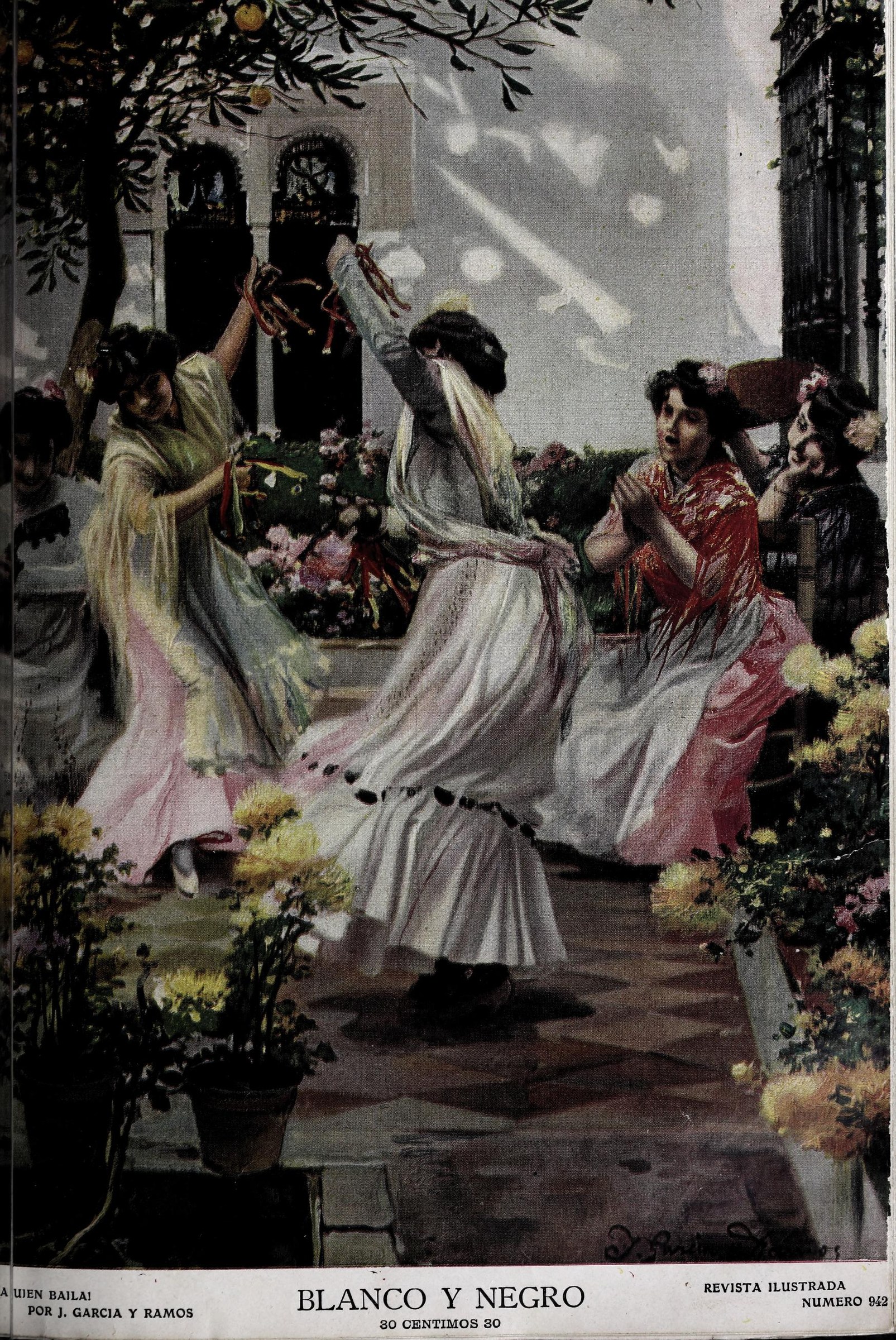
1909-05-22, Blanco y Negro, quien baila, García y Ramos
José García y Ramos
- Medium:
- Oil Painting
- Era:
- 1900-1920 (Ragtime/Early Jazz)
- Source:
- Wikimedia Commons
- Rights:
- Public domain — free to use, share and adapt.
- Recorded as:
- Public Domain
The work documents the social context of dance in early 20th-century Spanish society, showing dance not as a performed art but as an everyday social practice of courtship and display among the middle and upper classes. For historians of dance, the painting is valuable not because it depicts a specific, identifiable style with technical precision, but because it captures the informality, the outdoor settings, the gender dynamics, and the role of dance in social leisure during the Edwardian period.
What you are looking at
An outdoor garden party or courtyard scene, likely in Spain or Spanish America, captures a moment of social dancing among well-dressed figures in Edwardian-era clothing. The composition is framed by flowering potted plants and hanging foliage—clusters of pale yellow and pink blooms—creating an intimate garden setting. In the center, a woman in a flowing white or pale gray gown with a reddish sash or belt dances with raised arms, her body caught in an upright, animated posture. She is surrounded by other women in pastel day dresses (cream, pink, rust red) and at least one man in darker formal wear. The sky beyond the garden wall is overcast and atmospheric, rendered in soft grays and whites. The overall mood is one of refined leisure and flirtation—a moment of fashionable society at play.
The dancing
The central dancer stands nearly upright with both arms raised at shoulder height or higher, in an expansive, open frame. Her posture suggests a relatively vertical, buoyant movement rather than the close partnering of ballroom dance. The surrounding figures are standing or moving at ease, watching or participating loosely rather than in formal couples. None of the figures display the closed hold or strict frame of international or American standard ballroom. The raised-arm position and the freedom of the central figure's spacing from her partner(s) suggest a more relaxed, social form of movement.
The dance depicted
The specific dance form is difficult to determine from the image alone. The Edwardian date, Spanish context (suggested by the publication title 'Blanco y Negro,' a Madrid magazine), outdoor garden setting, and the central figure's open posture and raised arms all point toward a social or regional dance of the Iberian sphere—possibly a regional Spanish form such as a regional waltz variant, a local folk or social dance, or an early 20th-century popular ballroom social. The painting does not show the characteristic frame or footwork of flamenco, nor the close partnering typical of Argentine tango or formal ballroom of the period. The work is titled 'Quien Baila' (Who Dances), emphasizing the social observation aspect rather than the technical classification of a specific style.
How it was made
This is an oil painting, executed with a Romantic or Academic style characteristic of early 20th-century Spanish illustration and salon art. The artist has used soft, muted color harmonies—pale pinks, yellows, creams, and cool grays—with careful attention to the texture of fabrics and the dappled effect of garden light. The medium allows for atmospheric perspective and the subtle rendering of outdoors light and shadow. As a published illustration in the 'Revista Ilustrada' (Illustrated Magazine), this work was produced for mass circulation among the educated reading public, suggesting the subject—fashionable social dance—held interest for the urban Spanish audience of the period.
About this work
José García y Ramos's painting documents a moment of Edwardian-era social dancing in what appears to be a Spanish or Spanish American garden setting, rendered as an illustration for a popular magazine. The work captures not a formal performance or a specific codified dance style, but rather the social experience of dance as an activity of leisure and courtship among the fashionable classes. The painting sits at the intersection of social history, fashion history, and dance practice, recording how dance functioned in educated society at the turn of the 20th century. Its publication in 'Blanco y Negro,' a leading Spanish illustrated magazine, places it within the genre of journalistic art—visual reportage on contemporary life.
How to look at it
Attend first to the central dancer's posture and arm frame: the raised, open arms and upright stance suggest a moment of spontaneity or ease rather than the technical precision of a formalized ballroom hold. Notice also the garden setting—the potted flowers, the architectural backdrop, the overcast sky—which signals that this is not a ball, but a social gathering. The artist has chosen a moment of animation rather than a formal pose, capturing the energy and informality of social dancing among friends. The surrounding figures, some watching, some participating, establish the work as documentation of a social event rather than a performance.
The artist
José García y Ramos (1852–1925) was a Spanish painter, illustrator, and contributor to 'Blanco y Negro,' one of Madrid's most prestigious illustrated magazines. He was known for genre scenes of Spanish social life—interiors, garden parties, and fashionable society—rendered in a graceful, detailed Academic style. His work was popular among the magazine's readership and helped define the visual culture of turn-of-the-century Spanish urbanism and leisure.
The period
The painting dates to 1909, a moment when illustrated magazines had become the primary vehicle for visual culture among educated readers. At this time, ballroom dance was undergoing rapid codification and internationalization—the waltz, tango, and foxtrot were being formalized into competitive styles—but social dance among the non-professional classes remained fluid, regional, and integrated into everyday courtship and entertainment. The Spanish context is significant: Spain was developing its own ballroom traditions while flamenco and regional folk dances remained strong in popular culture. The Edwardian fashion visible in the painting—the high-waisted dresses, the men's formal wear—places the image at the very end of the Belle Époque.
Where it lives
This work was published as an illustration in 'Blanco y Negro' (issue dated May 22, 1909), a leading Spanish illustrated magazine based in Madrid. The work is credited to José García y Ramos as both artist and likely as the source of the subject matter. The current holding institution is not recorded.
Dance in this work
Questions about this work
What dance is being shown in this painting?
The specific dance form is not identifiable from the image alone. The open posture, garden setting, and Edwardian date suggest a social or regional Spanish dance of the early 20th century, but the painting appears to document social dancing in general rather than to illustrate a particular named style. The title 'Quien Baila' (Who Dances) emphasizes the social observation rather than technical classification.
Why was this published in a magazine?
Illustrated magazines like 'Blanco y Negro' were the primary vehicle for visual culture among educated Spanish readers in the early 20th century. They published genre scenes of contemporary social life to entertain and inform readers about fashionable society, leisure, and courtship. This painting would have been one of many scenes of urbane, modern Spanish life.
What does the garden setting tell us?
The outdoor, garden setting indicates that this is a private social gathering among friends or acquaintances, not a formal ball or public performance. It suggests the informality and everyday nature of social dancing among the educated classes, as distinct from professional or theatrical dance.
More dance artwork