27 works in this view — arrow keys or swipe to move between them.
Dance in Art · 1850
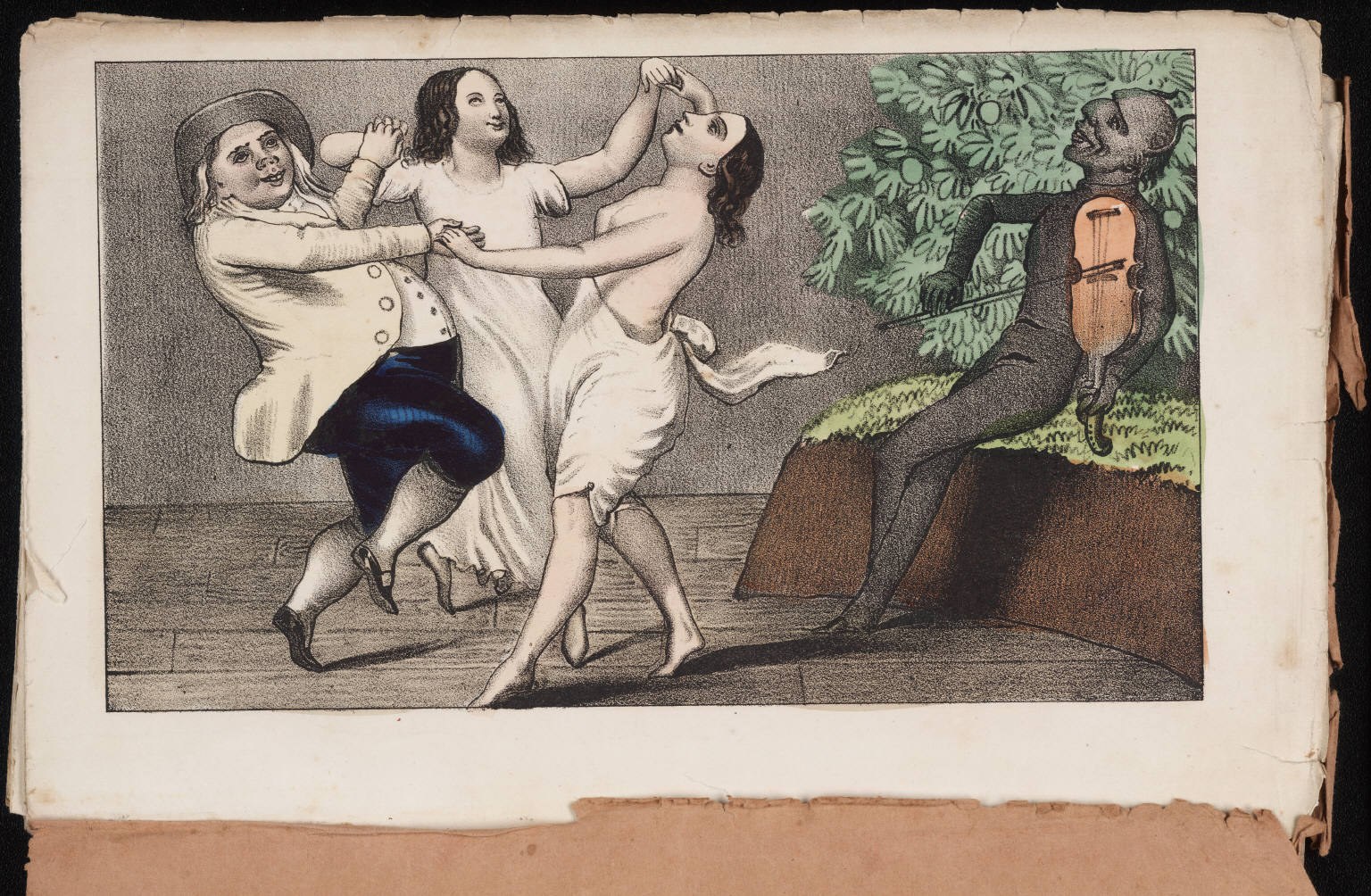
A Mormon and his wives dancing to the devil's tune 1850
McGee Van Dusen
- Medium:
- Lithograph
- Era:
- Mid 1800s (Polka Era)
- Source:
- Wikimedia Commons
- Rights:
- Public domain — free to use, share and adapt.
- Recorded as:
- Public Domain
This print is a rare document of how ordinary people danced in the early 19th century—the posture, the grouping, the contact between partners—captured in a context where the dance had to be legible and recognizable to viewers as a common social practice. It also reveals the deep anxiety surrounding Mormon religious practices in 19th-century America, and shows how the female body in motion was used to symbolize moral danger and social disorder. For dance historians, it provides evidence of country and folk-derived social dances in circulation; for religious and cultural historians, it demonstrates the central role of visual propaganda in the American anti-Mormon movement.
What you are looking at
A lithograph depicting a man in early 19th-century dress—wearing a jacket with visible buttons and blue breeches—dancing with two women in flowing white muslin gowns. The trio occupies the left and center of the composition, their bodies animated in a dynamic, playful arrangement. The man holds the hand of the woman on the right while the woman on the left grasps his arm; both women lean away from him with their faces turned upward in expressions of pleasure or exertion. A fourth figure, a formally dressed man in dark clothing holding a violin, stands to the right amid foliage and trees, positioned as the musician providing the music. The setting appears to be an outdoor garden or pastoral space, with vegetation visible in the background. The handcoloring is restrained—primarily the blue of the man's breeches and the warm brown and green of the landscape—while the figures remain largely in the monochrome wash typical of period lithography. The composition captures a moment of social gaiety with undercurrents of the satirical intent embedded in the title.
The dancing
Three figures dance in an informal, energetic grouping that suggests country or folk-style social movement rather than ballroom technique. The central man's posture is upright but loose, with arms extended to both partners; the women are positioned at angles to him, their arms raised and bodies leaning outward in a way that suggests rotation or swinging. Their feet are planted firmly on the ground with weight distributed across the body rather than concentrated in the heel-toe articulation of refined ballroom dancing. The positioning and the strain visible in the women's raised faces suggest vigorous, playful contact—possibly a reel or rustic couple dance. The musician stands apart, isolated in his formality.
The dance depicted
This print documents a social dance, most likely a country reel, cotillion, or similar rustic couple dance of the mid-19th century. The three-person grouping and the vigorous, asymmetrical arrangement of the bodies suggest the kind of improvised or folk-derived dances that would have been performed at country gatherings or informal social events. The presence of a violin and the outdoor setting support this reading. However, the image is primarily a political and religious satire rather than a neutral documentation of dance practice: the title's reference to 'the devil's tune' and the 'Mormon spiritual-wife system' makes clear that the dance itself is the vehicle for an attack on Mormon polygamy practices. The dance is depicted as undignified, excessive, and morally transgressive—a visual argument against the religious community rather than a celebration of the movement itself.
How it was made
This is a hand-colored lithograph, a process that allowed for rapid, relatively inexpensive mass reproduction in the early 19th century. The artist drew the composition on a limestone plate, which was then printed and hand-tinted with watercolor or gouache in a workshop. Lithography's accessibility made it the dominant medium for political satire, social commentary, and popular illustration in this period. The technique is visible in the slightly loose, expressive line work and the broad tonal washes, particularly in the background. This medium was deliberately chosen for polemical prints: it could reach a wide audience quickly and at low cost, making it ideal for a sensational expose of Mormon religious practice aimed at American readers in 1850.
About this work
This hand-colored lithograph is a visual argument against Mormon polygamy, published in 1850 as an illustration to a sensational exposé. It depicts a man dancing with two women while a violin player provides the music, framed as a scene of moral disorder and religious transgression. The dance itself—likely a reel or country cotillion—is rendered with energy and physical immediacy, but the print's real subject is not the movement or the social practice of dancing; it is the condemnation of plural marriage as unchristian and socially dangerous. The image sits at the intersection of dance history, American religious controversy, and the visual culture of mid-19th-century satire. It survives as evidence of how dance and dancers' bodies were deployed in American political argument, and of how a social practice could be transformed into a weapon of religious critique.
How to look at it
Attend to the physical contact and the energy of the movement: the women's bodies lean away from the man while their arms remain engaged with him, and their upturned faces suggest exertion or pleasure rather than composure. This is not a ballroom dance—there is no closed hold, no formality of frame. The print captures a moment of vigorous rotation or swinging, a country or folk dance rendered with physical immediacy. The isolation of the musician on the right, formally dressed and visually separated from the dancers, invites a reading of the dance as excessive or uncontrolled. Notice also what the artist included: the outdoor setting, the informal dress, the physical exuberance—all markers of a dance outside the refined social world, which was precisely the point of the satire.
The artist
McGee Van Dusen (author, with his wife Maria Van Dusen) of the text to which this print was an illustration. The print itself was published by Blake & Jackson of New York in 1850. Van Dusen authored the 'Startling Disclosures' as a first-hand account (or claimed account) of Mormon ritual and practice, drawing on the sensational literature of anti-Mormon polemic that circulated widely in this period. Little is recorded about Van Dusen's life or artistic practice beyond this publication.
The period
The 1840s and 1850s saw intense American anxiety about the Mormon movement, particularly after the migration of the Church of Jesus Christ of Latter-day Saints to Nauvoo, Illinois in the 1840s and the revelation and practice of polygamy within the community. Anti-Mormon literature—part memoir, part expose, part moral panic—flooded the American print market in this period. Simultaneously, lithography had become the dominant medium for political satire and social commentary, allowing publishers to reach a mass audience with illustrated arguments against unpopular or threatening groups. The dance depicted here would have been recognizable to mid-19th-century viewers as a common country social form, which made it an effective vehicle for satire: the familiar gesture of sociability and pleasure was inverted into a symbol of transgression and disorder.
Where it lives
The print is documented in the Yale Collection of Western Americana, a major repository of printed primary sources related to American western history and frontier culture. It was published by Blake & Jackson of New York as an illustration to the 1850 edition of 'Startling Disclosures of the Wonderful Ceremonies of the Mormon Spiritual-Wife System,' authored by McGee Van Dusen and Maria Van Dusen. The work circulated as part of anti-Mormon polemic aimed at an American readership.
Dance in this work
Questions about this work
What dance are they doing?
The specific dance cannot be identified with certainty, but the composition and positioning suggest a country reel, cotillion, or similar folk-derived couple dance common to 19th-century American social life. The three-person grouping, the vigorous arm movement, and the outdoor setting all point to an informal, improvisational country dance rather than a taught ballroom form. The print does not document the dance for its own sake; it uses the dance as a vehicle for satire.
Why is this image in a gallery about dance?
Because it provides evidence of how ordinary people danced in the early-to-mid 19th century—the posture, contact, and energy of country social dancing—preserved in a primary historical source. Even though the image is primarily a work of political polemic, it captures legible, recognizable movement that viewers would have understood as a common social practice. It is also rare evidence of how the dancing body was deployed in American political and religious argument.
What is the 'devil's tune' in the title?
The title is a deliberate inversion: the dance itself is presented as sinful and transgressive, corrupted by the Mormon practice of polygamy. In religious polemic of this period, music and dancing associated with unorthodox or heretical groups were often characterized as demonic or corrupting. The 'devil's tune' is the print's way of saying that Mormon religious practice inverts Christian morality and corrupts even the innocent social gesture of a dance.
Who were the Van Dusens?
McGee Van Dusen and Maria Van Dusen authored the 'Startling Disclosures' in 1850, a sensational expose of Mormon religious practice and plural marriage. Little biographical information survives beyond this publication. Their text, illustrated with prints like this one, was part of a larger body of anti-Mormon literature that circulated widely in 19th-century America.
More dance artwork