25 works in this view — arrow keys or swipe to move between them.
Dance in Art
The Proverbs: If Marion Will Dance, Then She Has to Take the Consequences
Francisco de Goya (Spanish, 1746–1828)
- Era:
- Mid 1800s (Polka Era)
- Source:
- Internet Archive
- Rights:
- Public domain — free to use, share and adapt.
- Recorded as:
- https://creativecommons.org/publicdomain/zero/1.0/
For historians of dance and gender, this print is invaluable evidence of how uninhibited female movement was perceived as socially dangerous and how the dancing body became a site of moral judgment. It reveals the ideological stakes embedded in the policing of women's movement—a concern that persists in debates over dance today. Goya's technique and composition show an artist who understood the dancing body not as beautiful form but as a text that could be read for moral and social meaning.
What you are looking at
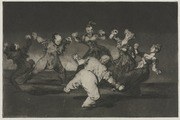
A darkly lit scene rendered in dramatic chiaroscuro shows a woman in white at the center of a circle of onlookers, her body arched backward in an accentuated pose that suggests energetic or transgressive movement. She wears a long dress with a pale bodice and dark skirt, her limbs extended in a manner that reads as abandonment or loss of control. Around her stand roughly a dozen figures in dark clothing, their faces barely distinguishable in shadow, forming an enclosing ring. The composition suggests a moment of public judgment or consequence—the title's reference to Marion "taking the consequences" is visually embodied in her isolated, exposed position at the heart of the crowd's gaze. The print technique creates pools of light and deep shadow that emphasize the theatrical nature of the moment and the moral weight of the scene.
The dancing
The central woman's body is thrown backward in a dramatic arch, her torso and limbs extended with a fluidity that suggests rapid, uncontrolled movement rather than the measured positions of formal dance. Her head is thrown back, her arms loosely positioned. The surrounding figures stand upright and static, their postures closed and observant, creating a clear visual hierarchy: the woman is the object of the gaze, the others the judges. The contrast between her curved, expressive body and their rigid, angular forms compounds the reading of transgression and social surveillance.
The dance depicted
This appears to be a satirical or moral commentary on social dancing rather than a depiction of a specific dance style. The extreme arch of the body and the title's reference to consequences suggest this is a caricature of popular or scandalous dancing—possibly the kind of uninhibited movement that caused moral anxiety in late 18th and early 19th century Spain and Europe. The woman's abandon reads as a visual metaphor for loss of propriety; this is not a waltz or country dance but a deliberate exaggeration of transgressive movement for the purpose of social critique. The composition echoes prints of carnival excess or morality tales, a genre in which Goya was active.
How it was made
This is a print—almost certainly an etching or aquatint, given the characteristic tonal ranges and the handling of light and shadow. The technique's use of selective burnishing and careful wiping of the plate creates the dramatic contrast between illuminated and shadowed areas. Prints of this type circulated widely in Spain and Europe as satire, moral commentary, or social observation, reaching audiences beyond the court or academy. The dark, expressive technique suggests intentional mood-making for public consumption, not private commission.
About this work
This is a satirical social scene from the late Gilded Age or early Romantic period, one of a series of works by Goya examining the consequences of social transgression and moral loosening in contemporary Spanish life. The title—"If Marion Will Dance, Then She Has to Take the Consequences"—frames the image as a cautionary tale in the tradition of 18th-century moral prints. The woman's extravagant bodily display is presented not as an expression of freedom but as a kind of public spectacle for which she pays a social price. The work belongs in a gallery of dance imagery because it reveals how dance was understood not merely as entertainment or technique, but as a barometer of social order and female virtue. Goya uses the dancing body as a vehicle for commentary on power, gender, and the surveillance of women's behavior in public space.
How to look at it
Attend to the relationship between the woman's body and the circle around her. The arch of her back is not a position held in balance; it reads as a moment of collapse or loss of composure, captured and made public. Notice how the title and the image work together: the word 'consequences' is visualized in the presence of the watching crowd. Look at the hands and faces of the surrounding figures—what little can be seen suggests judgment rather than participation. The woman is both the subject and the object of the gaze, both agent and victim. This ambiguity—whether her movement is freedom or transgression—is the point of the work.
The artist
Francisco de Goya (1746–1828) was a Spanish painter and printmaker whose work spans the late Baroque, Enlightenment, and Romantic periods. He is best known for his royal portraits, his black paintings, and his social satire. His prints, particularly the series *Los Caprichos* and *The Proverbs* (to which this title suggests this work belongs), use exaggerated, sometimes grotesque imagery to critique contemporary Spanish society, superstition, ignorance, and moral hypocrisy. His late work became increasingly dark and experimental, employing dramatic contrasts of light and shadow to convey psychological and social anxiety. Goya's engagement with popular culture, street life, and the human body in states of abandon or distress makes him a crucial figure in the visual culture of dance.
The period
This work dates from the early 19th century, a period of enormous change in European dance and social mores. The waltz was revolutionizing ballroom culture and provoking moral panic about the closeness of male-female contact and the speed of movement. Simultaneously, artists and moralists were anxious about the loosening of social restraint, urbanization, and the visibility of women in public space. Goya's Spain was undergoing political turmoil and cultural contestation over Enlightenment values. In this context, a woman dancing with abandon—or appearing to lose control through dance—became a shorthand for moral and social disorder. The print tradition of social satire was itself a response to these anxieties; prints circulated widely and were understood as a form of public critique and moral instruction.
Where it lives
The source is recorded as the Internet Archive digital collection. The work is catalogued as a print from the early 19th century. Without a surviving catalogue record for medium, accession number, or current holding, the object's institutional history cannot be fully established from available information.
Questions about this work
What does the title mean?
The title uses the conditional form typical of moral proverbs or fables: 'If Marion will dance, then she has to take the consequences.' It suggests that dance—or a particular kind of uninhibited dance—is a transgressive act for which Marion (or any woman) will be judged or punished. The image shows that judgment visually, in the form of the encircling crowd.
Is this a real dance or a caricature?
It is a caricature, not a depiction of an actual dance technique. The exaggerated arch of the woman's body, the title, and the satirical context all suggest this is a moral commentary on the appearance or threat of uninhibited female movement. Goya is not describing how women actually danced, but how society feared or imagined they might.
Why would dancing be so dangerous?
In the early 19th century, rapid social dances (especially the waltz) and the visibility of women in public spaces provoked intense moral anxiety. Dance was associated with passion, loss of control, and sexual impropriety. A woman dancing with abandon risked her reputation and was seen as a threat to social order. Goya's print engages with these anxieties, using the dancing body as a vehicle for satire about morality and power.
Is this part of a series?
The title's reference to 'The Proverbs' suggests it belongs to a series of prints using proverbial or moral sayings as titles. Goya created several such series, including *Los Caprichos*, which used similarly dark, satirical imagery to critique Spanish society. The existence of a series would have amplified the reach and impact of these works among educated audiences.
More dance artwork