49 works in this view — arrow keys or swipe to move between them.
Dance in Art
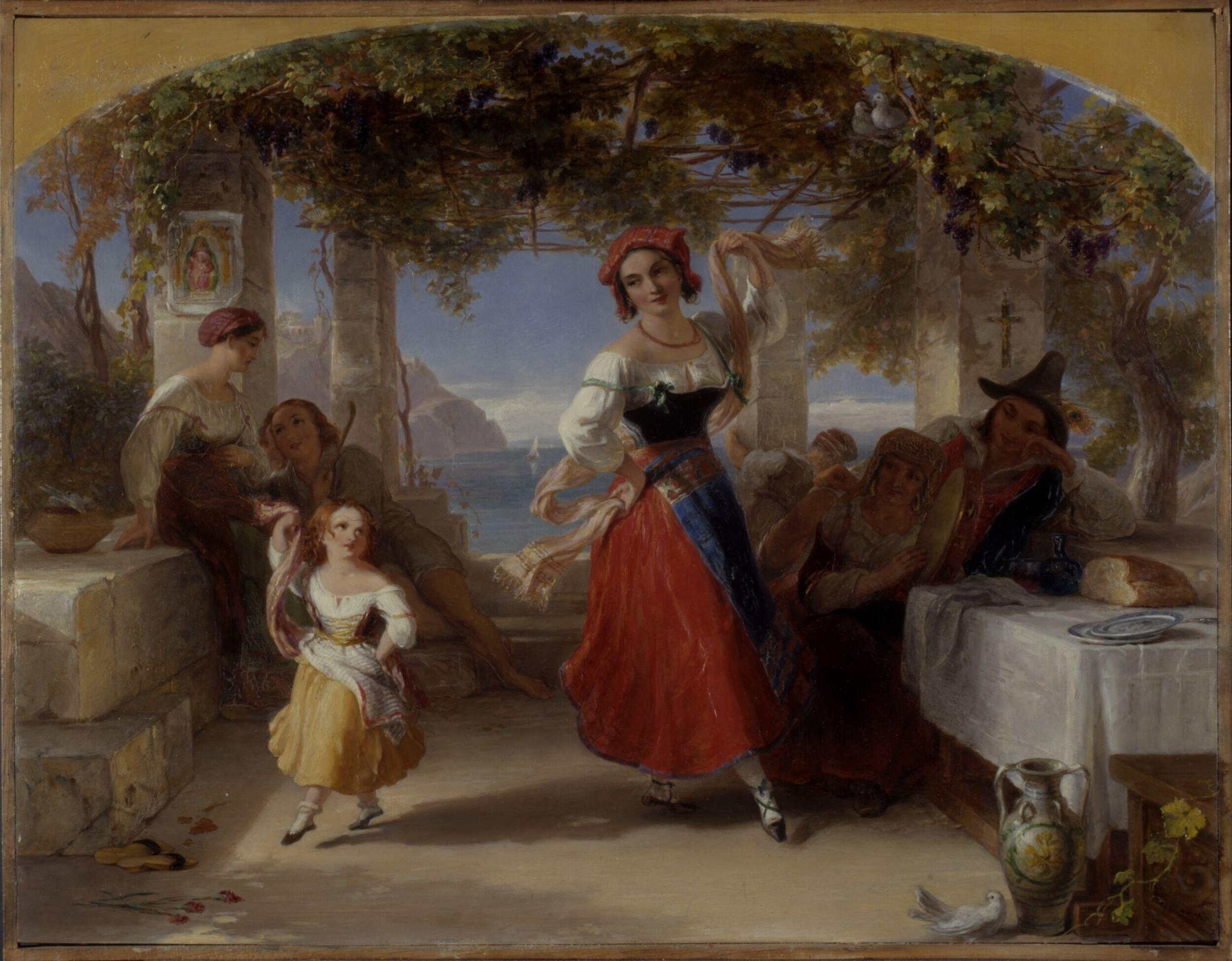
An Italian Mother Teaching her Child the Tarantella
Uwins, Thomas
- Dance:
- Folk/Country
- Era:
- Mid 1800s (Polka Era)
- Source:
- Victoria and Albert Museum
- Rights:
- Rights vary by item — check the source record before reusing this image. Source record ↗
- Recorded as:
- Check V&A creditLine
The work documents the tarantella in its nineteenth-century social context as a women's solo dance, captured by a European artist of repute at a moment when folk practices were being recorded for educated audiences. It illustrates how non-academic dance entered the European salon and gallery, and the role of visual art in both preserving and aestheticizing folk traditions during the early modern period.
What you are looking at
A sunlit courtyard or terrace opens onto a blue Mediterranean landscape, its stone columns wrapped in grapevines heavy with fruit. A young woman in a black-bodiced red skirt and white chemise—her red cap catching the light—dances with animated grace at the center, one arm raised and her body in a turning motion. To the left, an older woman holds a small child in yellow; behind the dancer, three figures in dark robes watch from the right, while a seated figure leans toward a large decorated vessel. The composition uses deep shadow under the vine-wrapped pergola to frame the bright figure of the dancer, who commands the scene through contrast and placement. The work appears to be oil on canvas, painted with the smooth finish and warm tonality characteristic of mid-nineteenth-century European academic practice.
The dancing
The central dancer stands in a spiral posture, her weight shifted onto her right leg while her left leg extends or rises, her right arm lifted and bent, her torso turned—a moment of rotational movement caught mid-spin. Her skirt, full and unconfined, swings around her with centrifugal force. The observers—the older woman with child, the three robed figures—are passive, static in posture, their attention fixed on the dancer. No other figures show the characteristic frame or hold of formal partnered dance; the dancer performs for an audience rather than with them.
The dance depicted
The work is titled *An Italian Mother Teaching her Child the Tarantella* and depicts the tarantella, a rapid rotational dance of southern Italy traditionally associated with folk celebration and courtship. The footwork is not clearly legible, but the spinning posture, the solitary dancer, the folk costume (the red skirt and cap are consistent with Neapolitan dress), and the Mediterranean setting all confirm the identification. The image suggests the tarantella as a social, celebratory dance performed by women, taught and transmitted within family and community. The moment chosen—the dancer mid-rotation, observed rather than joined—captures the tarantella as spectacle and as cultural transmission, though the title's emphasis on maternal teaching sits slightly uneasily with what the canvas shows: a virtuoso female dancer performing for an attentive group rather than a child being instructed.
How it was made
The work appears to be oil on canvas, executed with the high finish and luminous color typical of mid-nineteenth-century European salon painting. The technique allows for subtle modeling of light across the figures, the warm stone of the architecture, and the translucent foliage of the vines. The smooth surface and polished rendering suggest this was a finished exhibition work intended for a educated, urban audience rather than a sketch or study. The medium's capacity for narrative and anecdotal detail—the decorated vessel, the varied textures of fabric and stone—supports the work's function as a picturesque documentation of folk life for European viewers.
About this work
This is an oil painting by Thomas Uwins from 1842 depicting the tarantella, a southern Italian folk dance, performed by a woman in traditional Neapolitan dress within a romanticized Mediterranean setting. The work combines the academic realism of mid-nineteenth-century European painting with the picturesque tradition of documenting folk customs and regional dress. It captures a moment of female virtuosity and cultural transmission, presenting the tarantella to a metropolitan audience as both a spirited social practice and a subject worthy of fine art. The painting sits at the intersection of ethnographic interest, romantic orientalism, and genuine engagement with a living folk tradition—characteristic of the period's fascination with regional and national character.
How to look at it
Attend to the dancer's spiraling posture and the swirl of her skirt—the artist has chosen the moment of maximum rotation, when the body is most dramatically extended and the drapery most dynamically displayed. Notice how the strong light from the left isolates her against the shadowed figures and architecture, making her the undeniable focus despite her position off-center. The contrast between her animated movement and the stillness of the onlookers emphasizes the tarantella as a solo performance within a social gathering. The setting—the classical columns and Mediterranean view—frames this as folk life observed through a European aesthetic lens.
The artist
Thomas Uwins (1782–1857) was an English painter and Royal Academician known for historical, literary, and genre scenes, and for his Italian subjects. He traveled extensively in Italy and the Middle East, drawing on those experiences for picturesque and ethnographic subjects. His work often combined narrative interest with careful attention to costume, architecture, and light, and was intended to appeal to educated collectors interested in foreign lands and customs. The tarantella painting is consistent with his practice of documenting regional life and dress with formal technique.
The period
The 1840s saw intense European interest in national identity, folk traditions, and regional costume. Romanticism had elevated folk culture as an expression of national character and authenticity, and visual artists increasingly documented peasant life, dance, and dress as subjects of aesthetic interest. Simultaneously, the academic tradition remained dominant: ambitious depictions of folk subject matter were painted in the grand manner, with careful composition, controlled light, and polished technique. The tarantella had already entered European consciousness through music and literature; Uwins's painting participates in a broader visual documentation of southern Italian folk life, alongside contemporary ethnographic interest in Mediterranean cultures.
Where it lives
The work is held in the Victoria and Albert Museum, London. It is catalogued in their online collection as a nineteenth-century painting, likely acquired as part of their historical collecting practice emphasizing design, costume, and narrative art.
Dance in this work
Questions about this work
What is the tarantella and why did European artists paint it?
The tarantella is a rapid, spiraling solo or couple dance of southern Italy, traditionally performed at celebrations and festivals. Nineteenth-century European artists, influenced by Romanticism and fascinated with folk life and national character, documented regional dances as picturesque subjects worthy of fine art. The tarantella's speed, vigor, and regional costume made it visually compelling and symbolically rich—a marker of southern Italian identity and folk authenticity.
Is this a portrait of a specific person?
No. The work is a genre scene—a representation of a type of social moment and cultural practice rather than a commission depicting an identifiable individual. The title identifies the subject as an Italian mother teaching the dance, but the composition presents this as a general scene of cultural transmission, not a specific family or occasion.
How accurate is the costume and setting?
The red skirt, white chemise, and red cap are consistent with documented Neapolitan folk dress of the period. The Mediterranean setting—the classical columns, grapevines, and sea view—draws on real architectural elements found in southern Italian courtyards and loggias. However, the composition is idealized: the light is painterly, the grouping is arranged for narrative effect, and the whole scene is composed for European viewers rather than documented from lived practice.
Who are the other figures in the painting?
The canvas shows an audience for the dancer: an older woman with a young child, and three figures in dark robes (possibly elderly relatives or observers). Their stillness and attention create a frame around the dancer's movement, emphasizing the tarantella as both family transmission and public performance. The figures suggest a domestic or village setting where dance is woven into social life.
More Folk/Country artwork