48 works in this view — arrow keys or swipe to move between them.
Dance in Art
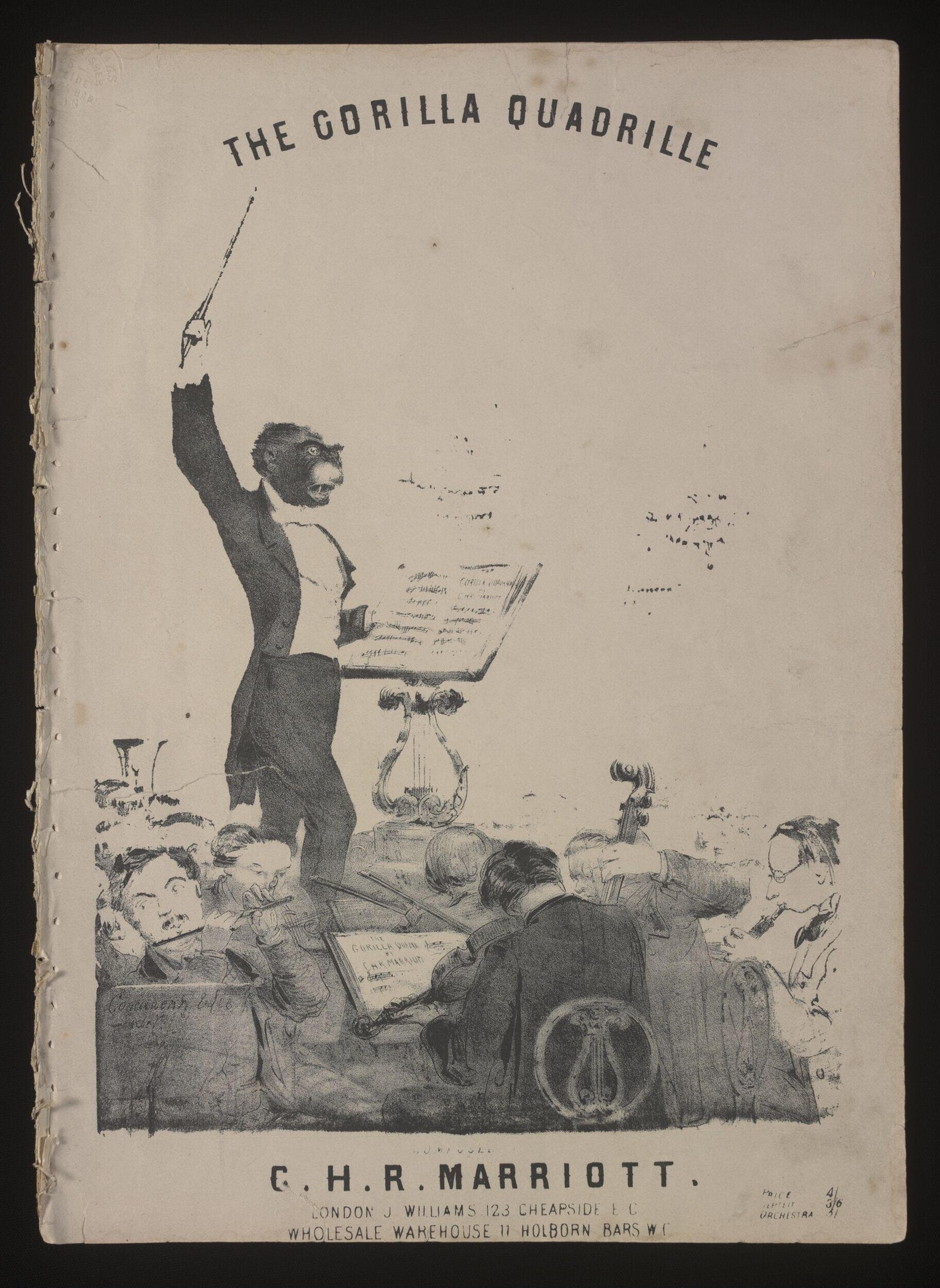
The Gorilla Quadrille
Marriott, Charles Handel Rand
- Dance:
- Quadrille
- Era:
- Mid 1800s (Polka Era)
- Source:
- Victoria and Albert Museum
- Rights:
- Rights vary by item — check the source record before reusing this image. Source record ↗
- Recorded as:
- Check V&A creditLine
The image is valuable evidence of how the quadrille was actually performed in 1860s London—the body positions, holds, spatial arrangement, and formality are all documented in precise visual detail. For historians of social dance and Victorian society, it is a primary source that reveals both the physical technique of ballroom dancing and the cultural anxieties about refinement, conformity, and social performance that the era's satire obsessively worried. The work demonstrates that dance was never merely a social accomplishment but a contested site of meaning about civilization, hierarchy, and human nature itself.
What you are looking at
A satirical engraving depicts a gorilla conducting an orchestra of fashionable London society figures, who perform a quadrille dance. The gorilla stands elevated on a ornate pedestal at the center-right, conducting with a baton raised high, wearing human dress (a vest visible beneath its simian torso). Below and around the pedestal, elegant couples and individual dancers in mid-Victorian formal attire execute the geometric patterns of the quadrille, their bodies arranged in the ordered lines and formations the dance demands. The composition is crowded and animated, with multiple figures overlapping—some facing forward, others in profile, all engaged in the precise footwork and positioning of the social dance. The engraving is rendered in fine black line work on pale ground, with stippled and crosshatched shading creating volume and movement in the figures' garments and bodies. The humor lies in the juxtaposition: the very proper, elite Victorian dancers executing their refined social ritual under the direction of an animal, suggesting satire of either fashionable excess or social pretension.
The dancing
The figures are distributed across multiple planes, creating depth and rhythm across the composition. The dancers maintain the closed and open holds characteristic of quadrille formation: pairs face one another or stand side-by-side in the structured geometry required by the dance. Arms are extended in the formal frame of ballroom dancing—women's right hands resting on partners' left shoulders or held at frame height, men's left arms raised to hold partners. The bodies show the upright carriage and controlled posture of Victorian ballroom technique, with skirts indicated by sweeping lines suggesting the swirl of movement. The gorilla-conductor dominates spatially, its arm raised in an exaggerated conducting gesture that parodies the authority of a human dance master.
The dance depicted
This is explicitly a quadrille, as stated in the title and confirmed by the formal arrangement of couples in the rigid geometric patterns the dance required. The quadrille was the dominant social dance of the mid-Victorian era, performed in fashionable London ballrooms by exactly the society figures depicted here. The image captures the quadrille in motion—the couples arranged in the squares, lines, and counter-lines that structured each figure of the dance. By placing a gorilla as conductor rather than a human dancing master, the print satirizes the spectacle and artificiality of the quadrille's formality, likely commenting on either the pretension of fashionable society or the animal-like conformity demanded by rigid social ritual.
How it was made
This is a wood or steel engraving, executed in fine black line work with dense crosshatching and stippling to create tonal variation and model the figures' forms. The technique allows sharp detail and high contrast, characteristic of mid-nineteenth-century satirical and topical prints. The regular, uniform line suggests mechanical reproduction—this was made for mass distribution as a print, likely issued as a single sheet or collected in a satirical publication. The engraving technique was ideal for topical satire because it was fast to produce, widely circulated, and accessible to the viewing public who followed London's fashionable society.
About this work
The Gorilla Quadrille is a satirical engraving by Charles Handel Rand Marriott, likely from the 1860s, depicting fashionable Victorian society figures executing a quadrille under the direction of a gorilla conductor. The work is a print in the tradition of English social satire, using the formal ballroom dance as a vehicle for commentary on contemporary society. The quadrille was the quintessential social dance of the mid-Victorian elite—rigidly formal, rule-bound, and a key arena for the display of breeding and refinement. By displacing the human dance master with a simian figure, Marriott inverts the hierarchy of civilization and animal nature that Victorian thought held dear, suggesting that fashionable society's rigid adherence to dance convention was no more rational or refined than animal behavior. The work circulated as a topical print, likely reaching a broad London audience familiar with both ballroom culture and the visual language of contemporary satire.
How to look at it
Look first at the gorilla's commanding position and raised baton: the artist has frozen the moment of instruction, with the dancers below in the act of following orders. Observe the precision of the dancers' geometric arrangement—the way couples are aligned in parallel lines and squares, how no figure overlaps another in a way that breaks the formal pattern. The engraving's fine, uniform linework is characteristic of the reproductive print tradition; there is no painterly brushwork or spontaneity, only the controlled mark-making necessary for mass production. The humor emerges from the juxtaposition of two registers: the exaggerated formality and precision of the quadrille, rendered in meticulous detail, placed under the authority of a creature that Victorian thinking classified as utterly lacking in civilization or refinement.
The artist
Charles Handel Rand Marriott was a London-based engraver and illustrator active in the mid-nineteenth century. He worked primarily in satirical and topical prints, often targeting fashionable society, politics, and contemporary manners. His work appeared in print shops and publications aimed at a broad London audience. The precise dates of his practice and his other commissions are not fully documented in standard references, but his output suggests he was part of the lively tradition of English graphic satire that flourished in the 1850s–1870s.
The period
The quadrille was at the height of its fashion in the 1850s–1870s, having dominated European ballrooms since the early 1800s. By the 1860s, the rigid formality and geometric precision of the quadrille made it a natural target for satire—it represented the peak of Victorian social conformity and the codification of behavior into strict rules. Simultaneously, the mid-nineteenth century saw intense public fascination with animal behavior and evolutionary theory, especially after Darwin's Origin of Species (1859). Marriott's choice to replace the human dance master with a gorilla may also reference contemporary exhibitions of exotic animals in London and the Victorian public's morbid fascination with primates. Satirical prints mocking fashionable society were a thriving genre, widely circulated and consumed by a literate urban middle class who enjoyed seeing their own world reflected back in exaggerated form.
Where it lives
The work is held in the Victoria and Albert Museum collection. It survives as a printed sheet, likely issued individually or as part of a collection of satirical prints. The publication information printed at the bottom identifies the London printer and wholesaler, indicating it was a commercial product distributed through the London print trade.
Dance in this work
Questions about this work
What is a quadrille?
A quadrille is a formal social dance for four couples arranged in a square, performed in a series of geometric figures with prescribed steps and movements. It was the dominant ballroom dance of the nineteenth century and required dancers to follow strict rules of positioning and etiquette. The dance was a key test of social refinement and breeding in Victorian society.
Why is there a gorilla conducting the dancers?
The gorilla is a satirical device, likely mocking the rigid conformity and artificiality demanded by fashionable ballroom society. By replacing the human dance master with an animal, Marriott suggests that the dancers' mechanical obedience to the rules of the quadrille is no more rational than animal behavior, or that society's obsession with proper form is absurd. The gorilla may also reference contemporary Victorian anxieties about evolution and the boundary between civilization and nature.
Who was C. H. R. Marriott?
Charles Handel Rand Marriott was a Victorian-era engraver and illustrator based in London who produced satirical and topical prints for the mass market. Little is known about his biography, but his work circulated through London print shops and reached a broad audience interested in social commentary. He was part of a flourishing tradition of graphic satire in mid-nineteenth-century England.
When was this made?
The catalogue record dates the work to around 1860, placing it in the mid-Victorian era when the quadrille was at the height of fashion and satirical prints targeting fashionable society were widely popular. The style of dress and the techniques of engraving are consistent with that period.
More Quadrille artwork